

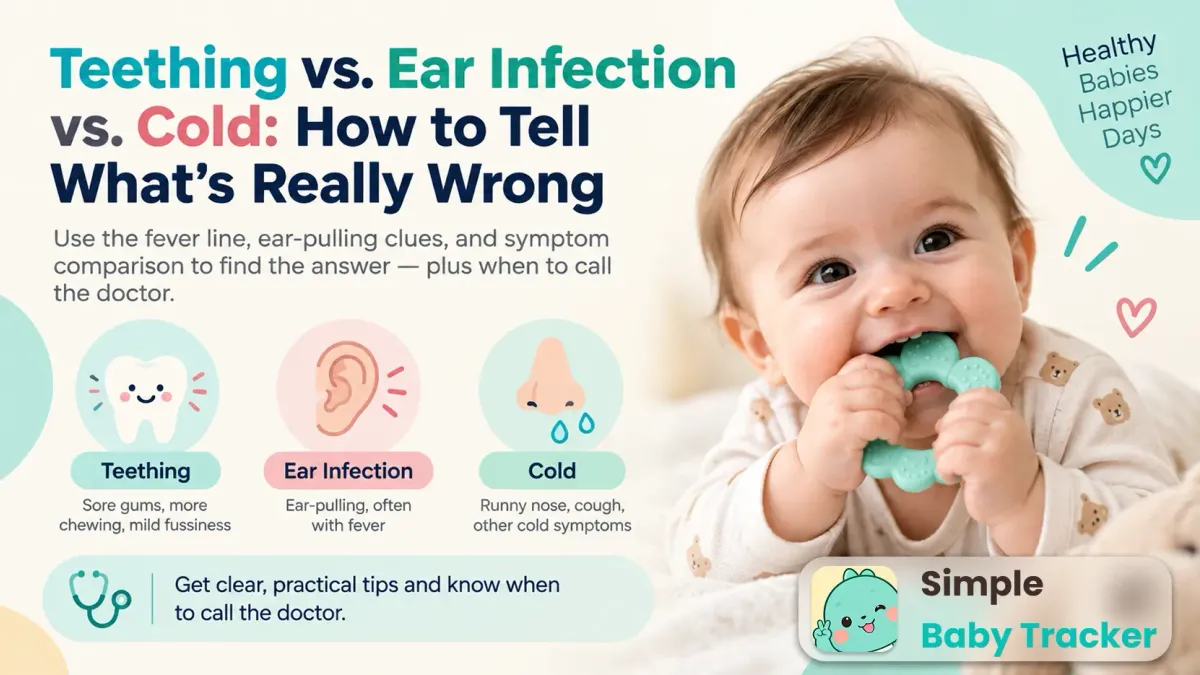
Teething vs. Ear Infection vs. Cold: How to Tell What's Really Wrong
By Simple Baby Tracker Editorial TeamBaby Care
Is it teething, an ear infection, or a cold? The fever line, ear-pulling clue, snot check, and comparison tables that tell them apart — plus exactly when to call the doctor.
Key Takeaways
- Fever is the fastest test. Teething can raise temperature slightly but never causes a true fever of 100.4°F (38°C) or higher — that number means something else is going on 12.
- Ear-pulling alone usually means teething. Suspect an ear infection when ear-pulling comes with fever, a recent cold, fluid from the ear, or trouble hearing 34.
- Runny nose, cough, vomiting, and diarrhea are not teething symptoms. They point to a cold or another illness, even if a tooth is also coming in 56.
- Any fever in a baby under 3 months old is an emergency — go to the ER or call your pediatrician right away, no waiting 2.
Why this question is so hard (and so important)
Your baby is fussy, chewing everything, waking at night — and a tooth is probably on its way. But she also feels warm, tugs her ear, and has a runny nose. Is it “just teething”?
Here is the problem: teething happens at exactly the age when babies catch their first colds and ear infections (around 6–12 months). The two overlap constantly. And the stakes of guessing wrong are real — the AAP warns that blaming teething for fevers can delay care for real infections like ear infections 5.
The good news: you do not need a medical degree to tell them apart. Three checks — temperature, ears, and nose — answer the question in most cases. This guide walks through each one in plain language.
A note on what teething truly causes: drooling, extra chewing, sore or swollen gums, mild crankiness, a face rash from drool, and a slight temperature rise that stays below fever level 17. Our teething chart guide covers the full timeline and soothing methods. This article answers a different question: is it teething, or is it something else?
Check 1: the thermometer (the fastest test)
If you do one thing, take the temperature. It divides the possibilities faster than any other check.
| Reading (rectal is most reliable for infants) | What it means |
|---|---|
| Below 100.4°F (38°C) | Could be teething. Teething may nudge temperature up to about 99–100°F, but no higher 18 |
| 100.4°F (38°C) or higher | Not teething. This is a true fever — look for infection (ear, cold, flu, UTI) 12 |
| Any fever under 3 months old | Emergency. ER or immediate pediatrician call, whatever the cause 2 |
Two details that matter:
Use a rectal reading for babies. The AAP considers rectal temperatures the most reliable in infants, and the fever line (100.4°F / 38°C) is defined on rectal readings 2. Forehead and ear readings run cooler and miss fevers; an armpit reading that looks “borderline” deserves a rectal recheck.
Slight rise vs. fever is the whole ballgame. Research backs the strict line. A meta-analysis of 16 studies with 3,506 children found teething could raise temperature but not to fever level 9. A separate meta-analysis found no overall link between fever and tooth eruption at all 10. Parent-facing guidance describes teething temperatures as topping out around 99–100°F, staying below the fever line 8. So: warm forehead with a 99.5°F reading plus drool and chewing? Teething fits. A 101°F reading? Stop blaming the tooth.
Check 2: the ears (teething vs. ear infection)
This is the confusion parents ask about most — and no wonder. Teething babies rub and pull their ears (it was one of the symptoms statistically tied to teething in the largest prospective study) 11. Babies with ear infections also pull their ears. Same gesture, different meaning. Here is how to separate them:
| Clue | Teething | Ear infection |
|---|---|---|
| Fever | None, or slight rise below 100.4°F 1 | Often 100.4°F or higher 34 |
| Ear-pulling | Both sides, on and off, baby otherwise okay | Often one side, persistent, with crying or distress 34 |
| Recent cold | No cold before it started | Often starts days after a cold (fluid trapped behind the eardrum) 3 |
| Fluid from the ear | Never | Yellow, white, or bloody drainage means infection — call the doctor 3 |
| Hearing/response | Normal — turns to your voice | Seems not to hear, doesn’t startle at sounds 4 |
| Feeding | Chews more, may refuse solids but still drinks 11 | Cries during sucking/swallowing (pressure hurts the ear), may refuse the breast or bottle 4 |
| Mood between episodes | Happy and playful in between fussy spells | Miserable, hard to console, clearly sick 4 |
The simple rule: ear-pulling in a baby with no fever who otherwise looks well is usually teething 4. Ear-pulling plus fever, plus a cold that started a few days ago, plus a baby who seems truly sick — that combination needs a same-day call so the doctor can look inside the ear. Only an ear exam can confirm an infection; no checklist replaces it.
Why colds lead to ear infections: a cold swells the tube connecting the nose to the middle ear, fluid gets trapped behind the eardrum, and bacteria can grow in it 3. That is why the sequence “runny nose for a few days, then fever and ear-pulling” is the classic ear-infection story — and why it peaks in the same months teeth arrive.
Check 3: the nose, cough, and tummy (teething vs. cold)
Teething does not cause runny noses, coughs, vomiting, or diarrhea. Full stop. The AAP symptom checker lists what teething does not cause: fever, diarrhea, diaper rash, runny nose, a lot of crying, and catching colds more easily 5. The big prospective study agreed — congestion, cough, stool looseness, vomiting, and rashes anywhere besides the face were not linked to tooth eruption 11.
| Symptom | Teething? | More likely |
|---|---|---|
| Clear runny nose + sneezing | No | Common cold 6 |
| Cough | No | Cold; see a doctor for barky cough, wheezing, or trouble breathing 6 |
| Vomiting | No | Stomach bug or other illness — call for repeated vomiting 5 |
| Diarrhea / many loose stools | No | Stomach bug or other illness; watch diapers and hydration 5 |
| Diaper rash | No (both the AAP and Cleveland Clinic say so) 512 | Wetness, stool enzymes, yeast — see our diaper rash guide |
| Drool rash on chin/cheeks | Yes — the one true teething rash, from saliva irritating the skin 1 | — |
| Rash on the body, hands, or feet | No | Viral rash or hand-foot-mouth — needs a doctor’s eyes 11 |
| Red cheeks | Mild flushing can come with teething | Bright-red “slapped” cheeks with a lacy body rash can be fifth disease — call 5 |
The timing trap: babies get 6–8 colds in the first year, often back to back through fall and winter — exactly when the front teeth and first molars erupt. A cold during teething looks like “teething with a runny nose.” It is two things at once: a tooth and a cold. Treat the cold as a cold.
When a cold needs the doctor: the NHS advises getting help for babies with a cold who breathe fast or noisily, feed much less than usual, have a fever that won’t come down, or are under 3 months old with any fever 6. Trust the same instincts here — a cold that behaves unusually is worth a call regardless of teeth. A barky, seal-like cough is croup rather than a cold, and what croup sounds like and when it is urgent covers the difference.
Fussiness, sleep, and appetite: reading the pattern
Fever, ears, and nose settle most cases. For the rest, watch how the baby is upset, not just that she is upset:
- Mild fussiness that comes and goes, peaking for a few days before a tooth appears — fits teething. Teething discomfort tends to peak in the days right before breakthrough and ease within 3–4 days 12.
- Crying that cannot be consoled, or a baby who is unhappy even between episodes — points to illness. Teething gum pain is mild: the AAP notes it is often not even enough to cause crying or sleep problems on its own 5.
- Refusing solids but still drinking milk — fits teething (chewing solids hurts sore gums; the big study tied decreased appetite for solids, but not liquids, to teething) 11. For a breastfed baby who won’t latch, try expressed milk from a cup, spoon, or syringe for a short time 7.
- Refusing all feeds, or crying while swallowing — points to ear infection or sore throat, and risks dehydration. Watch wet diapers: fewer than 6 a day, no wet diaper for 6–8 hours, dry mouth, no tears, or a sunken soft spot all warrant a call 13.
- Night waking for a few nights around a new tooth — common and usually short. Our baby sleep schedule by age shows the typical totals so you can tell a rough patch from a real shortfall. But be honest with yourself: large studies disagree on whether teething truly disrupts sleep, and one 2025 study of 849 infants found no sleep difference on teething nights even though half the parents reported disturbances 14. A week of terrible nights with fever or congestion is illness, not teeth.
What to do tonight: a 5-step plan
- Take a rectal temperature. Below 100.4°F with drool and chewing: teething care (gum massage, chilled — not frozen — teether). At or above 100.4°F: treat as illness, not teething 12.
- Check the story. Cold in the last few days + new fever + ear-pulling? Suspect an ear infection and call in the morning (sooner if the baby is very young, very sick, or has ear drainage) 34.
- Soothe the gums, skip the risky stuff. Rub gums with a clean finger, offer a firm chilled teether. Never use benzocaine gels, homeopathic tablets, or amber necklaces — the FDA and AAP warn against all three 15.
- Medicine only with a reason. If the baby is clearly uncomfortable, ask your pediatrician about a weight-based dose of acetaminophen (from ~3 months) or ibuprofen (from 6 months) — and cap it at a day or two; pain lasting longer means something other than teething 712.
- Log it. Write down temperature readings with times, which symptoms appeared when, feeds skipped, and wet diapers. A dated pattern (“fever 101.2°F Tuesday evening, runny nose since Sunday, pulling left ear”) gets your pediatrician to the answer in seconds — far better than a 3 AM memory. Our symptom tracker keeps temperatures, symptoms, and medicines in one timeline for exactly this situation.
When to call the doctor: the red lines
Call promptly for any of these — none of them is teething:
- Fever of 100.4°F (38°C) or higher, rectal; any fever at all under 3 months is an ER visit 2.
- Fluid draining from the ear (yellow, white, or bloody) 3.
- Trouble breathing: fast or noisy breathing, wheezing, ribs showing with each breath 6.
- Dehydration signs: fewer than 6 wet diapers a day, no wet diaper for 6–8 hours, dry mouth, no tears when crying, sunken soft spot, unusual sleepiness 13.
- Vomiting repeatedly, bloody stool, or diarrhea with fever 5.
- A baby who is inconsolable, floppy, unusually sleepy, or just looks seriously ill to you — parental instinct counts; call 5.
Frequently asked questions
Can teething cause a fever of 101 or 102°F?
No. Teething may raise temperature to about 99–100°F but does not cause true fever (100.4°F/38°C or higher) 18. A temperature of 101–102°F means infection — commonly an ear infection, cold, or flu at this age — and deserves a call to your pediatrician 25.
How can I tell teething vs. an ear infection?
Check three things: fever (ear infection usually has one ≥100.4°F; teething doesn’t), timing (ear infections often follow a cold by a few days), and the full picture (ear infection babies look and act sick; teething babies are happy between fussy spells) 34. Ear-pulling by itself, with no fever in a well-looking baby, is usually teething. Only a doctor looking inside the ear can confirm an infection.
Can teething cause a runny nose or cough?
No. Congestion, runny nose, and cough were not linked to tooth eruption in the largest prospective study, and the AAP lists runny nose among things teething does not cause 511. A runny nose plus a new tooth is a cold plus a tooth — treat the cold as a cold 6.
Can teething cause diarrhea or vomiting?
No. Stool looseness, increased stool number, and vomiting showed no link to teething in prospective research 11. Vomiting or diarrhea with or without fever needs evaluation as its own illness — watch hydration (wet diapers, tears, energy) and call if it persists 513.
Why does my baby pull their ears if it’s just teething?
Gum, jaw, and ear share nerve pathways, so teething pain radiates — rubbing the ear is a real teething behavior, found in the eruption studies 11. It becomes a worry sign only with company: fever, recent cold, ear drainage, or a clearly sick baby 34.
Can teeth come with a cold at the same time?
Constantly — that is exactly why this confusion exists. Babies cut teeth through the same months they catch their first colds. Assume both: soothe the gums and manage the cold (saline drops, suction, fluids, humidity), and use the fever line to decide whether the doctor needs to hear about it 67.
Should I give pain medicine before I know which it is?
Don’t medicate the uncertainty. Take the temperature first: if it’s teething-range fussiness, start with gum massage and a chilled teether; medicine is a short backup dosed by weight, not a diagnostic tool 7. If there’s true fever or the baby looks sick, call your pediatrician — masking a fever before the visit hides the most useful clue 2.
When should I stop saying “it’s just teething”?
Use the 48-hour rule of thumb: teething fussiness peaks for a few days around breakthrough and then eases 12. Symptoms that worsen, spread (new fever, new rash, new vomiting), or outlast the tooth by days were never the tooth. And any single red line above — high fever, ear drainage, breathing trouble, dehydration — ends the debate immediately.
Disclaimer: This article is for informational purposes only and does not constitute medical advice. Every baby is different. Always consult your pediatrician with questions about your baby’s symptoms, fever, or health.
Footnotes
-
American Academy of Pediatrics (HealthyChildren.org), “Teething Pain Relief: How to Soothe Your Baby’s Discomfort,” published July 9, 2025. Source ↩ ↩2 ↩3 ↩4 ↩5 ↩6 ↩7 ↩8
-
American Academy of Pediatrics (HealthyChildren.org), “Fever and Your Baby,” published Sept. 23, 2025. Source ↩ ↩2 ↩3 ↩4 ↩5 ↩6 ↩7 ↩8 ↩9
-
American Academy of Pediatrics (HealthyChildren.org), “Ear Infection Symptoms.” Source ↩ ↩2 ↩3 ↩4 ↩5 ↩6 ↩7 ↩8 ↩9 ↩10
-
American Academy of Pediatrics (HealthyChildren.org), “Ear Infections in Children: Information for Parents.” Source ↩ ↩2 ↩3 ↩4 ↩5 ↩6 ↩7 ↩8 ↩9 ↩10
-
American Academy of Pediatrics (HealthyChildren.org), “Teething” (KidsDoc Symptom Checker), by Barton Schmitt, MD, FAAP, copyright 2000-2025 Schmitt Pediatric Guidelines LLC. Source ↩ ↩2 ↩3 ↩4 ↩5 ↩6 ↩7 ↩8 ↩9 ↩10 ↩11 ↩12 ↩13
-
NHS, “Colds, coughs and ear infections in children,” page last reviewed May 14, 2026. Source ↩ ↩2 ↩3 ↩4 ↩5 ↩6 ↩7
-
Mayo Clinic, “Teething: Tips for soothing sore gums,” published Dec. 21, 2024. Source ↩ ↩2 ↩3 ↩4 ↩5
-
Blueberry Pediatrics, “Can Teething Cause a Fever? What Pediatricians Want Parents to Know,” medically reviewed by Dr. Melissa Tribuzio, MD, July 2026. Source ↩ ↩2 ↩3
-
Massignan C, Cardoso M, Porporatti AL, et al., “Signs and Symptoms of Primary Tooth Eruption: A Meta-analysis,” Pediatrics 2016;137(3):e20153501. Source ↩
-
Nemezio MA, De Oliveira KMH, Romualdo PC, et al., “Association between Fever and Primary Tooth Eruption: A Systematic Review and Meta-analysis,” International Journal of Clinical Pediatric Dentistry 2017;10(3):293-298. Source ↩
-
Macknin ML, Piedmonte M, Jacobs J, Skibinski C, “Symptoms associated with infant teething: a prospective study,” Pediatrics 2000;105(4):747-752. Source ↩ ↩2 ↩3 ↩4 ↩5 ↩6 ↩7 ↩8
-
Cleveland Clinic Health Essentials, “Teething Doesn’t Cause Fevers, and Other Myths To Sink Your Teeth Into,” by Lisa Diard, MD, published Feb. 25, 2026. Source ↩ ↩2 ↩3 ↩4
-
American Academy of Pediatrics (HealthyChildren.org), “Signs of Dehydration in Infants and Children,” updated Sept. 24, 2019. Source ↩ ↩2 ↩3
-
Kahn M, Lucchini M, Oster E, et al., “Does Teething Disrupt Infant Sleep? A Longitudinal Auto-Videosomnography Study,” Journal of Pediatrics 2025;279:114461. Source ↩
-
U.S. Food and Drug Administration, “Safely Soothing Teething Pain in Infants and Children,” updated June 26, 2024. Source ↩
Keep reading