

Croup in Babies: The Barking Cough and When to Worry
By Simple Baby Tracker Editorial TeamBaby Care
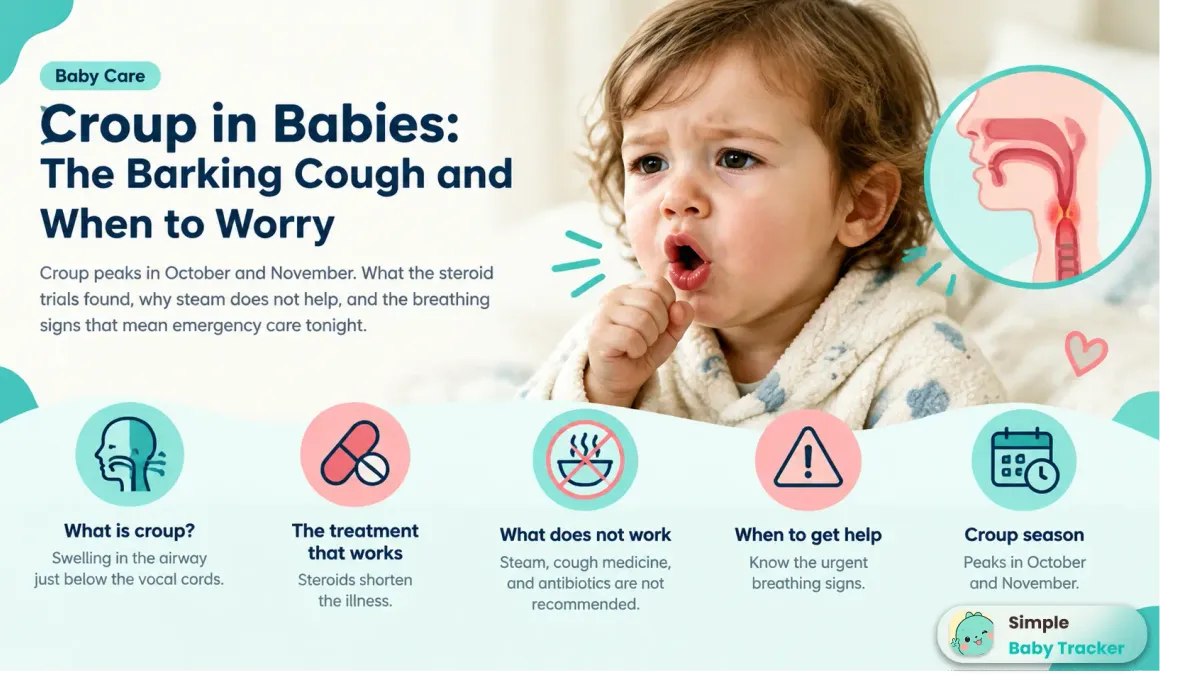
Croup peaks in October and November. What the steroid trials found, why the NHS advises against steam, and the breathing signs that mean emergency care.
Key Takeaways
- Croup is swelling in the airway just below the vocal cords, and the seal-bark cough is the sound of a narrow tube rather than a chest infection 12.
- Croup usually settles on its own within 48 hours. A doctor may prescribe a single steroid dose to shorten it 1.
- The steroid evidence is large: 45 trials and 5,888 children, with lower croup scores at 2, 6 and 12 hours on low-certainty evidence 3.
- Steam is on the NHS “don’t” list, and cough medicine is not recommended for children under 4 14.
- Nebulized epinephrine works fast and fades fast: a large improvement at 30 minutes, no significant difference at 2 hours 5.
The short answer
Croup is swelling in the airway just below the vocal cords. The swelling narrows the upper airway, which is why the cough and the voice change together 2.
It is usually mild. The NHS says croup usually gets better on its own within 48 hours 1.
The reason to involve a clinician is not the cough by itself. The NHS tells parents to call because a doctor may give a single dose of medicine that shortens the illness 1.
What the bark actually is
Four sounds matter, and they point at different parts of the airway.
| What you hear | What it suggests |
|---|---|
| A barking cough, like a seal | Swelling below the vocal cords, the classic croup sound 1 |
| A hoarse or lost voice | The same swelling reaching the vocal cords 1 |
| A high-pitched rasping sound on the in-breath | Stridor, which means the narrowing is audible 1 |
| A whistling or wheezing sound | More typical of bronchiolitis than croup 6 |
The usual story starts with a cold. A runny nose and a mild temperature for a day or two, then the bark arrives, and it is worse at night 1. That delay is why parents often describe a cough that “changed” rather than a cough that started. For how to measure and treat the fever in those first days, the fever guide covers it.
Stridor is the sound that changes the urgency. A child who barks but breathes quietly between coughs is in one category. A child with a rasping sound on every in-breath, at rest, is in another. That child needs an urgent call, and if the work of breathing has changed, it is an emergency 1.
Why it shows up in late October
Croup has a peak incidence in October and November 2. That matters for a practical reason. A barking cough in late October is more likely to be croup than at any other time of year.
Season changes the odds, not the threshold. A rasping sound at rest needs the same call in July as in November. In croup season you can simply expect the answer to be croup more often 2.
Age is the other anchor. In a recent audit of 437 croup visits, the average age was 25.6 months 7.
The treatment that works
Corticosteroids are first-line, and the evidence behind them is old, large and consistent.
| What the 2023 review measured | Result |
|---|---|
| Croup score at 2 hours | SMD -0.65 (95% CI -1.13 to -0.18), 7 trials, 426 children, low certainty |
| At 6 hours | SMD -0.76 (-1.12 to -0.40), 11 trials, 959 children, low certainty |
| At 12 hours | SMD -1.03 (-1.53 to -0.53), 8 trials, 571 children, low certainty |
| Return visits or readmissions, dexamethasone versus prednisolone | RR 0.55 (0.28 to 1.11), 4 trials, 1,537 children, moderate certainty |
| Prednisolone versus dexamethasone at 2 hours | SMD 0.06 (-0.06 to 0.18), 1 trial, 1,231 children, high certainty |
That is the 2023 Cochrane update, which pooled 45 trials and 5,888 children 3. A standardized mean difference is not a number a parent can use, so read the direction rather than the size. Every time point against placebo favors steroids. The point estimates get larger at each later time point, though each one comes from a different set of trials, so do not read them as a curve.
Read the return-visit row more carefully. That comparison is dexamethasone against prednisolone, not against placebo, and the confidence interval runs from 0.28 to 1.11, which includes no difference. The honest summary is “probably fewer return visits than prednisolone,” not “halves them.”
The dose question is where the newest evidence gets interesting.
| Dexamethasone dose | What the evidence shows |
|---|---|
| 0.6 mg/kg, maximum 12 mg | The standard single oral dose in current guidance 2 |
| 0.15 mg/kg | May be as effective, according to the Cochrane review 3 |
| 0.15 versus 0.6 mg/kg, 13,437 treated episodes | Return visits 2.9% versus 4.1%, not significant; but the low dose was linked to more hospitalizations, adjusted odds ratio 3.18 (1.52 to 6.00) 8 |
That last row needs a caveat before anyone reorganizes their expectations. The 2026 study was a retrospective chart review. Only 172 of the 13,437 episodes analysed were treated at the low dose, so the hospitalization finding rests on a small and unusual subgroup 8. The two sources are not really in conflict. The Cochrane review asks whether the low dose controls symptoms, and the chart review asks what happened to children afterward. Both can be true.
None of this is a decision you make. The dose is the clinician’s call, and the question for you is whether to make the call at all.
Why the emergency department seems to fix it, then doesn’t
Nebulized epinephrine is used alongside a steroid in moderate to severe croup, and its timing explains a pattern parents describe constantly 2.
| Time after nebulized epinephrine | Effect |
|---|---|
| 30 minutes | SMD -1.48 (95% CI -2.83 to -0.13), a large improvement |
| 2 hours | SMD -0.51 (-1.11 to 0.09), no longer significant |
| Hospital stay | Mean difference -25.1 hours (-52.34 to 2.15), P = 0.07 |
Those figures come from a 2026 systematic review of 12 studies, with 325 treated children and 347 controls 5. By two hours the measured benefit is no longer statistically significant. That is not proof the drug stopped working, but it is why a child can improve in the emergency department and still sound worse again in the middle of the night.
It is also the reason observation follows a dose. One national guideline counts at least four hours of observation as part of adequate care for moderate to severe croup 7. If you are discharged sooner, ask what to watch for on the drive and overnight.
What does not work
Steam. The NHS lists “do not put your child in a steamy room or get them to inhale steam” under its “don’t” heading 1. It is the remedy that gets handed down from one parent to the next, and the health service names it as something to avoid. It still feels like it works. The reason is probably the position rather than the vapor. A child in a steamy bathroom is upright and being held, and both of those do help.
Cough medicine. The AAP says cough and cold medications are not recommended for children under 4 unless a doctor advises one, and should not be used under 2 at all 4. It also notes there is little evidence that cough medicine helps with mucus. A sedating syrup blunts the signal you are actually watching, which is how hard your child is working to breathe.
Antibiotics. Neither the current review nor the Cochrane analysis lists antibiotics as a treatment for croup 23. The infection is viral, so a course does not address the cause.
Humidifiers and cold air. Neither appears in the guidance as a treatment, and this page cannot point to a trial behind either 12. That is different from saying they are dangerous. It means that if you try one, you are running an experiment rather than following evidence, and you should judge it that way.
The night-time plan
The NHS “do” list is short and every item is free 1. Put it in order for the hours when you are tired.
- Keep your child upright. Sit them up, or hold them against your shoulder. The NHS says to try not to let them lie down.
- Keep them calm. Crying makes the symptoms worse, which is a hard instruction at 2 am and the most useful one on the list.
- Offer plenty of fluids.
- Check on them regularly, including overnight.
- Use acetaminophen or ibuprofen for a high temperature or discomfort. Acetaminophen is sold as paracetamol outside the US. Ibuprofen is not for babies under 6 months unless a doctor advises it 4.
Two additions follow from the same logic. Sleep close enough to hear the breathing, because what you are listening for is a change in sound. And write down the time of each dose, because a tired 3 am is when doses get doubled by accident.
If your child is getting worse rather than better, that is the point to call rather than wait 1.
When it is not croup
The reason clinicians take a barking cough seriously is the short list of conditions that imitate it and do not improve on their own.
| Condition | The clue that separates it |
|---|---|
| Epiglottitis | Drooling, trouble swallowing and wanting to sit up are emergency signs on the NHS list 1 |
| Bronchiolitis | Wheezing, fast breathing and poor feeding, usually in children under 2 6 |
| Whooping cough | Fits of coughing with a whoop on the in-breath 1 |
The full list a clinician works through is longer. It includes bacterial tracheitis, an abscess behind the throat or beside the tonsil, and a swallowed object 2. None of those improve at home, which is why a barking cough that does not follow the usual two-day course is worth a second look.
When to get help tonight
Call emergency services or go to an emergency department if your child 1:
- Is struggling to breathe, with grunting, the skin pulling in under the ribs, or a breathing sound that has changed
- Has blue, gray, pale or blotchy skin, lips or tongue, which may be easier to see on the palms and soles if your child has brown or black skin
- Is sleepier than normal, or difficult to wake
- Is unusually quiet and still, or limp and floppy
- Is very upset or restless, cannot be calmed, and is working hard to breathe
- Is drooling more than usual, cannot swallow, or wants to sit up rather than lie down
Call an urgent care line, or ask for a same-day appointment, if you think your child has croup. Do the same if they are getting worse, or are not improving after being seen 1. The NHS also notes that children under 3 months may be referred to hospital, which is a lower threshold than the one applied to older children 1.
When croup keeps coming back
One episode is ordinary. Repeated episodes deserve a different conversation.
Recurrent croup should prompt an evaluation for an underlying anatomic abnormality or medical condition 2. In practice that means a conversation about why the airway narrows so easily, rather than another prescription for the same night.
The useful thing to bring to that appointment is a record: how many episodes in the past year, whether each one followed a cold, how long each lasted, and whether any needed epinephrine. Patterns that are hard to remember in a consulting room are easy to see on a list.
What is worth tracking
Croup is a short illness with a fast-moving night, and the details that matter are all things a tired parent forgets by morning.
Five things cover it.
- The date the barking started
- Whether the rasping sound is there at rest, or only when crying
- The time and dose of every medicine
- How much your child drank, and how many wet diapers
- The breathing rate, counted for a full minute while they are calm
Our symptom tracker keeps those entries in one timeline, which is what a clinician wants when you say “it started Tuesday and got worse last night.” The health tracker keeps the episodes together, so a pattern of recurrent croup becomes visible instead of being reconstructed from memory.
The doctor visit tracker holds the prescriptions, the doses and the follow-up dates.
For the nights that turn out to be something else, the teething and congestion guide and the cold, ear infection and teething comparison cover the overlap.
Frequently asked questions
How long does croup last?
The NHS puts the usual course at 48 hours, with symptoms often worse at night 1. A dry cough that outlasts the barking is not the same as the croup coming back.
Does steam or a humidifier help?
The NHS explicitly advises against steamy rooms and steam inhalation 1. Humidifiers are not named in the guidance, and this page cannot point to a trial behind them 12. The position that comes with the bathroom routine, upright and held, is the part that helps.
Do children with croup need antibiotics or cough medicine?
Neither. Antibiotics are not listed as a treatment in current guidance 23, and cough and cold medicines are not recommended under 4 or used under 2 at all 4.
When should I go to the emergency department?
Go if your child is struggling to breathe, has skin pulling in under the ribs, is pale or blue, is hard to wake, is drooling or cannot swallow, or is working hard and cannot be calmed 1. A rasping sound at rest, rather than only when crying, is the finding that turns a wait-and-see into a call today. If your child is also working harder to breathe, go straight to emergency care.
Can croup come back?
Yes, and repeated episodes deserve a look at why 2. Bring the number of episodes, the dates, and whether any needed epinephrine.
Disclaimer: This article is for informational purposes only and does not constitute medical advice. Croup is usually mild and occasionally is not, and the studies here describe groups rather than your child. Follow the guidance from your own pediatrician or health service. Seek emergency care for a child who is struggling to breathe, is pale or blue, is hard to wake, or is drooling and unable to swallow.
Footnotes
-
NHS, “Croup,” accessed October 2026. Source ↩ ↩2 ↩3 ↩4 ↩5 ↩6 ↩7 ↩8 ↩9 ↩10 ↩11 ↩12 ↩13 ↩14 ↩15 ↩16 ↩17 ↩18 ↩19 ↩20 ↩21 ↩22 ↩23
-
Cooke A, Conway S, Griffin L, “Croup: Rapid Evidence Review,” American Family Physician, 2026. Source ↩ ↩2 ↩3 ↩4 ↩5 ↩6 ↩7 ↩8 ↩9 ↩10 ↩11 ↩12 ↩13
-
Aregbesola A, Tam CM, Kothari A, Le ML, Ragheb M, Klassen TP, “Glucocorticoids for croup in children,” Cochrane Database of Systematic Reviews, 2023. Source ↩ ↩2 ↩3 ↩4 ↩5
-
American Academy of Pediatrics, “A Parent’s Guide to Over-the-Counter Medicines for Children,” HealthyChildren.org, accessed October 2026. Source ↩ ↩2 ↩3 ↩4
-
Wei Y, Li L, Wei N, Pu Y, Zhao J, Xiong P, “Nebulized epinephrine for croup in children: an updated systematic review,” Frontiers in Pediatrics, 2026. Source ↩ ↩2
-
Jirawong J, Anuntasaree W, Ruangnapa K, Saelim K, Prasertsan P, “A Decade of Croup Management: Guideline Adherence, Practice Variation, and Opportunities for Improvement,” Children (Basel), 2026. Source ↩ ↩2
-
Aregbesola A, Turnbull J, Oketola B, et al., “Using a Single Dose of Dexamethasone at 0.6 Versus 0.15 mg/kg of Body Weight for the Treatment of Croup: A Multicenter Retrospective Chart Review,” Pediatric Emergency Care, 2026. Source ↩ ↩2