

Can Teething Cause Congestion or Cough? Why a Stuffy Nose Means a Cold
By Simple Baby Tracker Editorial TeamBaby Care
Can teething cause congestion or a cough? No — research finds no link between tooth eruption and cough or congestion. Learn why colds coincide with teething, how to ease a stuffy nose safely, and the breathing red flags that need urgent care.
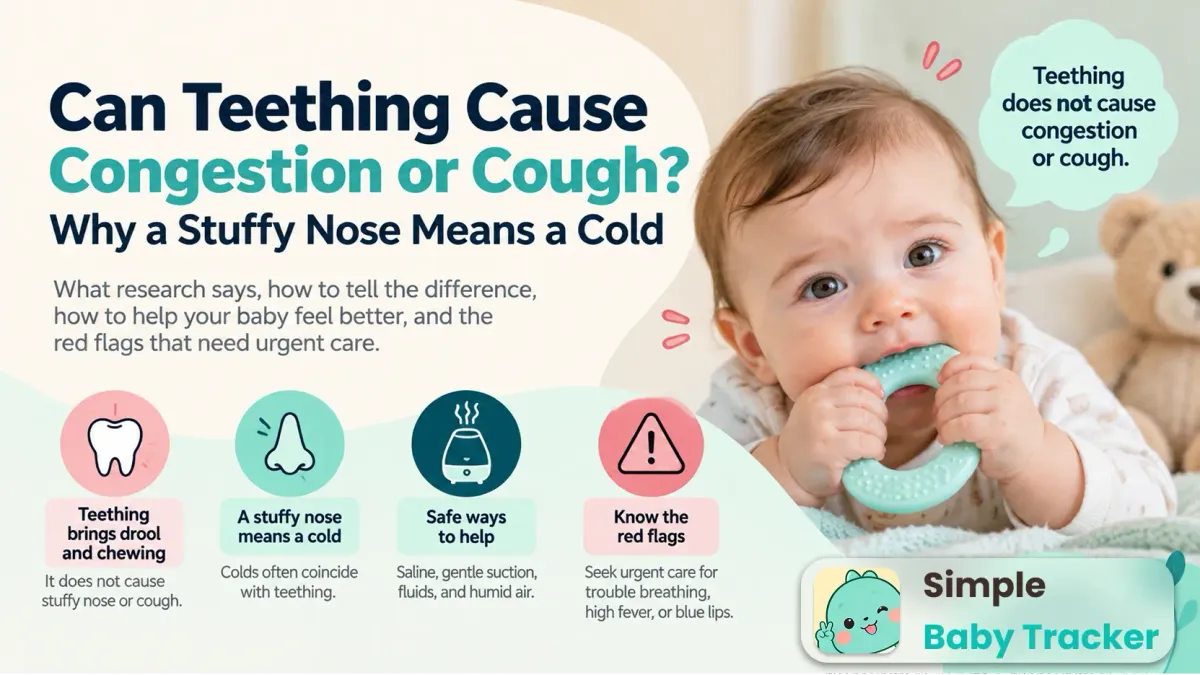
Key Takeaways
- No. Teething does not cause congestion or cough. The largest prospective study of teething symptoms found neither was linked to tooth eruption 1.
- A stuffy nose and cough during teething mean a cold arrived at the same time. Babies cut teeth through the same months they catch their first colds 2.
- Extra drool does not cause a chesty cough. Brief gagging on drool is common, but an ongoing cough comes from the airways, not the gums 34.
- Manage the cold as a cold: fluids, saline drops, gentle suction, and humid air. Keep the sleep surface flat — no wedges or positioners 25.
- Barky cough, wheeze, fast or noisy breathing, or blue lips need urgent care, teeth or no teeth 26.
The short answer: no
Congestion and cough are not teething symptoms. The prospective study that followed infants day by day through tooth eruption found cough and congestion were not associated with teething 1. A meta-analysis of teething signs reached the same conclusion for respiratory symptoms 7. The AAP symptom checker lists runny nose among the things teething does not cause, alongside fever, diarrhea, and diaper rash 3.
So if your baby is drooling and chewing and has a stuffy nose and a cough, you are dealing with two things at once: a tooth and a cold. Our teething vs. ear infection vs. cold guide walks through the full differential — this article focuses on the breathing symptoms. For a runny nose specifically, see can teething cause a runny nose.
Why the confusion is so common
Three things collide at once.
Timing. The first teeth arrive around 6 months, right when maternal antibodies fade and babies start catching colds. A cold during teething looks like “teething with congestion.” It is coincidence, not cause 24.
Post-nasal drip. A cold makes mucus that drips down the back of the throat. That drip triggers coughing, especially at night and after lying flat. Parents see drool plus cough and connect them. The real chain is simpler: cold causes mucus, mucus causes cough 2.
The drool worry. Teething babies produce remarkable amounts of saliva. Many parents wonder whether swallowed drool settles in the chest and causes coughing. Brief gagging or a wet-sounding cough for a moment after a mouthful of drool is common and harmless. But drool cannot cause a persistent cough, a stuffy nose, or chest congestion. Ongoing cough means airway irritation or infection, which needs cold care — not gum care 34.
Teething or cold? One table tells them apart
| Clue | Teething alone | Cold (with or without a tooth) |
|---|---|---|
| Nose | Dry, or drool around the mouth only | Stuffy or runny nose, sneezing 2 |
| Cough | None beyond a moment of drool gagging | Persistent cough, worse at night from mucus 2 |
| Fever | None, or slight rise below 100.4°F (38°C) 8 | Often 100.4°F (38°C) or higher 8 |
| Behavior between episodes | Happy and playful between fussy spells 3 | Miserable, clingy, clearly sick 2 |
| Feeding | Chews more, may refuse solids but still drinks 1 | Feeds less overall, nose blocks sucking 2 |
Fever is the fastest tiebreaker. Teething never causes a true fever of 100.4°F (38°C) or higher — that number means infection 38.
Home care for congestion and cough
Treat the cold, soothe the gums, and keep sleep safe.
Clear the nose. Saline drops loosen mucus, then gentle suction removes it. Do this before feeds and sleep so the baby can breathe while sucking 2. Wipe the nose gently and apply a thin layer of petroleum jelly around the nostrils if the skin gets sore.
Offer fluids. Extra milk feeds keep babies hydrated. For babies over 6 months, small sips of water are fine too 2. Watch wet diapers — fewer than 6 a day, or no wet diaper for 6 to 8 hours, warrants a call 3.
Add humidity. A cool-mist humidifier in the bedroom or a steamy bathroom sit-together can loosen mucus. Clean the humidifier daily so mold does not grow in it 2.
Keep the sleep surface flat. This rule is absolute. Put the baby down on the back, on a flat firm mattress, with nothing else in the crib. Never use wedges, positioners, or propped mattresses to “drain” congestion — they raise suffocation risk without clearing the nose 5. Suction and saline before bed are the safe alternative. Night waking during a cold with a new tooth can stretch for several nights; our four-month sleep regression guide explains how illness and developmental phases stack onto already fragile sleep.
What not to do. Do not give over-the-counter cough and cold medicines to babies — they are not safe or effective at this age 2. Do not use honey under 12 months. Skip Vicks-style rubs on infants unless your pediatrician approves. And do not give antibiotics for a cold: colds are viral.
When to call the doctor: breathing red lines
Call promptly — or seek urgent care — for any of these. None of them is teething:
- Barky, seal-like cough or hoarse voice. This pattern suggests croup, which swells the upper airway and can worsen at night. Croup needs medical assessment 6. The croup guide covers what the bark sounds like and when it becomes an emergency.
- Wheeze or whistling when breathing out. Wheeze means narrowed lower airways and always deserves a call 2.
- Fast, noisy, or labored breathing. Watch for ribs showing with each breath, nostrils flaring, or grunting 2.
- Blue lips, tongue, or face — call emergency services. This means the baby is not getting enough oxygen 26.
- Fever of 100.4°F (38°C) or higher, rectal; any fever at all under 3 months old is an emergency 8.
- Feeding much less than usual, very few wet diapers, or a baby who is unusually sleepy or hard to wake 32.
A cough that lingers beyond two to three weeks, even without red flags, also deserves a routine visit to rule out other causes.
Frequently asked questions
Does teething cause coughing?
No. Persistent coughing was not linked to tooth eruption in prospective research 1. A brief gag on drool is normal, but an ongoing cough comes from a cold or another airway cause — treat it as one 2.
Can teething cause a cough?
No. Teething, colds, and cough guidance all agree: teething does not cause cough, congestion, or runny nose 329. When cough and a new tooth appear together, the cold explains the cough and the tooth explains the drool.
Can teething cause congestion?
No. Nasal congestion reflects swollen nasal passages and mucus from infection, not gum inflammation. Saline drops, suction, fluids, and humid air help; gum massage does not 24.
Can drool get into the lungs and cause a cough?
Swallowed drool goes down the food pipe, not the airway — the swallow reflex protects the windpipe. Occasional choking or gagging on a mouthful of saliva passes in seconds. A cough that keeps returning, produces mucus, or comes with a stuffy nose is a respiratory symptom, not a drool symptom 34.
How do I help my congested baby sleep?
Suction the nose with saline drops right before bed, run a cool-mist humidifier, and keep the room comfortable. Keep the crib flat, firm, and empty — never elevate the mattress or add positioners 5. Expect some night waking until the cold passes; feed and resettle as needed.
Disclaimer: This article is for informational purposes only and does not constitute medical advice. Every baby is different. Always consult your pediatrician with questions about your baby’s breathing, cough, fever, or health.
Footnotes
-
Macknin ML, Piedmonte M, Jacobs J, Skibinski C, “Symptoms associated with infant teething: a prospective study,” Pediatrics 2000;105(4):747-752. Source ↩ ↩2 ↩3 ↩4
-
NHS, “Colds, coughs and ear infections in children.” Source ↩ ↩2 ↩3 ↩4 ↩5 ↩6 ↩7 ↩8 ↩9 ↩10 ↩11 ↩12 ↩13 ↩14 ↩15 ↩16 ↩17 ↩18 ↩19 ↩20
-
American Academy of Pediatrics (HealthyChildren.org), “Teething” (KidsDoc Symptom Checker). Source ↩ ↩2 ↩3 ↩4 ↩5 ↩6 ↩7 ↩8 ↩9
-
Cleveland Clinic Health Essentials, “Teething Doesn’t Cause Fevers, and Other Myths To Sink Your Teeth Into.” Source ↩ ↩2 ↩3 ↩4 ↩5
-
American Academy of Pediatrics (HealthyChildren.org), “How to Keep Your Sleeping Baby Safe: AAP Policy Explained.” Source ↩ ↩2 ↩3
-
Massignan C, Cardoso M, Porporatti AL, et al., “Signs and Symptoms of Primary Tooth Eruption: A Meta-analysis,” Pediatrics 2016;137(3):e20153501. Source ↩
-
American Academy of Pediatrics (HealthyChildren.org), “Fever and Your Baby.” Source ↩ ↩2 ↩3 ↩4
-
Mayo Clinic, “Teething: Tips for soothing sore gums.” Source ↩
Keep reading