

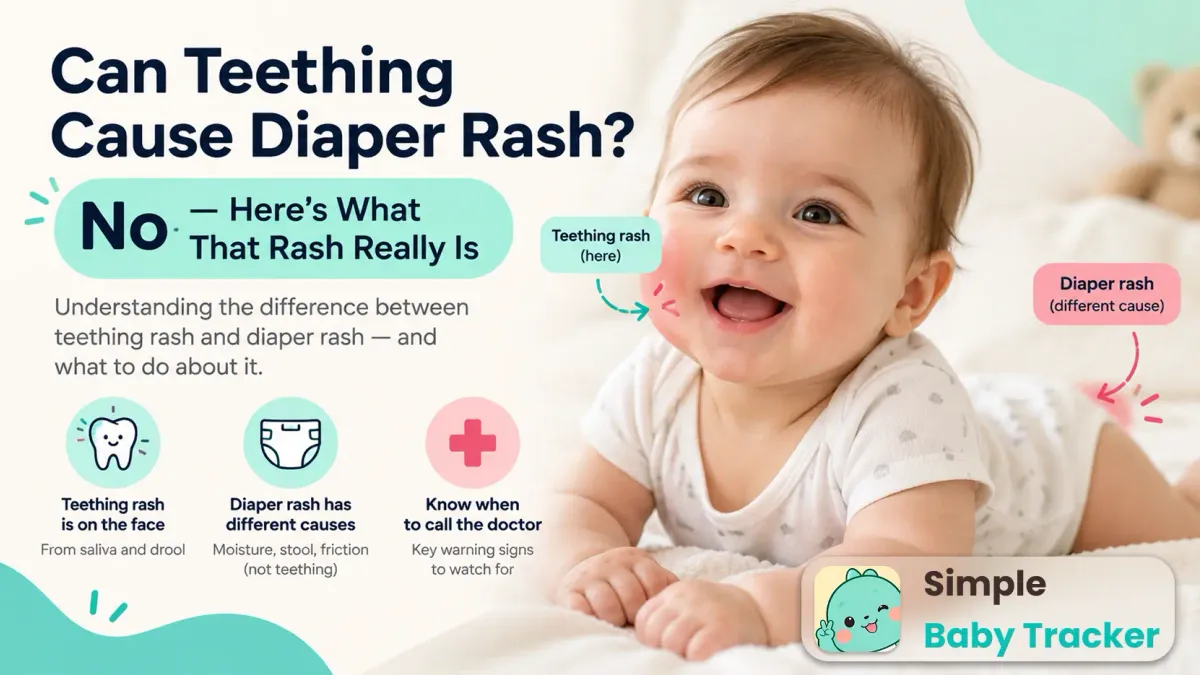
Can Teething Cause Diaper Rash? No — Here's What That Rash Really Is
By Simple Baby Tracker Editorial TeamBaby Care
Teething does not cause diaper rash. Why the drool rash on the face gets confused with a rash in the diaper, what actually irritates the skin, and when to call the doctor.
Key Takeaways
- No. Teething does not cause diaper rash. The AAP symptom checker lists diaper rash among the things teething does not cause, and Cleveland Clinic agrees 12.
- Teething has one true rash, and it is on the face. Saliva irritates the chin and cheeks. A rash under the diaper is a different condition with different causes 34.
- When a rash and a new tooth arrive together, the usual link is stool, not the tooth. Loose stools irritate the skin. The stool is the cause 56.
- For the full diagnosis — folds, satellite spots, and what to do step by step — see our diaper rash guide. For loose stools, see can teething cause diarrhea.
The verdict: no
If your baby is cutting a tooth and has a red bottom, you are dealing with two things at once. The tooth did not cause the rash.
The AAP KidsDoc symptom checker for teething is explicit: teething does not cause diaper rash 1. Cleveland Clinic’s teething-myths review says the same 2. The largest prospective study of teething symptoms agreed — rashes anywhere besides the face were not linked to tooth eruption 7.
For the bigger picture on what teething can and cannot do, see our pillar guide: teething vs. ear infection vs. cold.
The confusion: teething’s one true rash is on the face
Teething does cause a rash — just not there.
When babies teethe, they drool. Saliva sits on the chin, cheeks, and around the mouth, carrying small bits of food that irritate delicate skin 3. Mayo Clinic describes the same thing: a facial rash alongside drooling, crankiness, sore gums, and chewing 4. Wiping drool gently and keeping the face dry is the fix.
The diaper area is a different disease in a different place. Read them side by side:
| Drool rash (teething) | Diaper rash (not teething) | |
|---|---|---|
| Where | Around the mouth, chin, cheeks | Under the diaper: buttocks, thighs, genitals |
| Cause | Saliva sitting on skin 34 | Moisture, stool enzymes, friction, sometimes yeast 56 |
| Teething link | Yes — the one rash teething causes | No — both the AAP and Cleveland Clinic say so 12 |
| First move | Wipe drool, keep face dry | Change promptly, thick zinc oxide barrier — details in our diaper rash guide |
Location is the whole diagnosis in one glance. Face rash with drool and chewing fits teething. Redness under the diaper needs diaper-rash care, whatever the gums are doing.
Why parents link them: it is the stool, not the tooth
Three things make the link feel real.
First, timing. Teeth arrive in the same months when diaper rash peaks, solids start, and babies catch one bug after another. Overlap looks like cause.
Second, loose stools. A stomach bug or other illness brings looser, more frequent stools at the same time a tooth appears. Stool enzymes and prolonged wetness injure the skin barrier, and friction does the rest 56. Diarrhea multiplies the irritation — which is why a teething-age tummy bug so often ends in a red bottom. The irritant is the stool, not the tooth.
Third, swallowed drool. You may hear that extra swallowed saliva changes stool acidity and irritates the diaper area. That mechanism has been proposed but remains unproven — and it does not override the direct verdict from the AAP and Cleveland Clinic 12. Treat what you can see: the stool and the skin.
What to do: brief care, then hand off
This spoke stays short on purpose. Our diaper rash guide owns the full diagnosis and treatment, so here is only the core routine:
- Change promptly — as soon as you notice, including at night.
- Clean gently with water and a soft cloth, or a fragrance-free, alcohol-free wipe. Pat dry, including the creases.
- Apply a thick layer of zinc oxide barrier and leave it on between changes.
- Give some diaper-free air time where age and practicality allow 56.
If that is all you needed, stop here and follow the guide above for the details. What matters now is knowing when the routine is the wrong routine.
When to call the doctor: the red lines
Call rather than trying another cream if you see any of these:
- Satellite spots or folds involved. Small separate spots scattered at the rash edge, or redness that has crept into the skin folds, points to yeast or infection — it needs a clinician’s diagnosis, not more barrier cream. Our diaper rash guide shows what to look for 6.
- No improvement after 48–72 hours of correct barrier care, or the rash is getting worse fast. No improvement means the diagnosis is wrong, not the cream 6.
- Infection signs: fever, blisters, pus draining from the rash, or a rapidly spreading, tender rash 5.
- A baby in pain or hard to console, or a rash plus lesions elsewhere on the body (scalp, armpits, palms, soles, mouth) — that pattern needs a doctor’s eyes 5.
Fever itself is never from teething. A rectal temperature of 100.4°F (38°C) or higher means illness, and any fever under 3 months old is an emergency 8.
Frequently asked questions
Does teething cause diaper rash?
No. Both the AAP symptom checker and Cleveland Clinic say teething does not cause diaper rash 12. Prospective research agreed: rashes outside the face were not linked to tooth eruption 7.
What does a teething rash actually look like?
Redness or small bumps around the mouth, chin, and cheeks where drool sits 34. It comes with the classic teething picture — drooling, chewing, sore gums — and it stays on the face.
Can drool get into the stool and cause diaper rash?
This is sometimes proposed — swallowed saliva changing the stool and irritating the skin — but it is unproven 12. The established irritants are moisture, stool enzymes, and friction, which is why loose stools of any cause redden the area 56.
Can diarrhea during teething cause diaper rash?
Diarrhea can cause diaper rash, but teething does not cause the diarrhea. Teething showed no link to stool looseness or stool number in prospective research 7. Treat the loose stools as their own illness and protect the skin meanwhile 5.
How long should I try barrier cream before calling?
If there is no improvement after 48–72 hours of frequent changes plus thick zinc oxide, or the rash worsens quickly, call your pediatrician 6. Satellite spots, folds involved, blisters, pus, or fever should prompt a call sooner 56.
Disclaimer: This article is for informational purposes only and does not constitute medical advice. Every baby is different. Always consult your pediatrician with questions about your baby’s skin, stools, or health.
Footnotes
-
American Academy of Pediatrics (HealthyChildren.org), “Teething” (KidsDoc Symptom Checker), by Barton Schmitt, MD, FAAP. Source ↩ ↩2 ↩3 ↩4 ↩5 ↩6
-
Cleveland Clinic Health Essentials, “Teething Doesn’t Cause Fevers, and Other Myths To Sink Your Teeth Into,” published Feb. 25, 2026. Source ↩ ↩2 ↩3 ↩4 ↩5 ↩6
-
American Academy of Pediatrics (HealthyChildren.org), “Teething Pain Relief: How to Soothe Your Baby’s Discomfort,” published July 9, 2025. Source ↩ ↩2 ↩3 ↩4
-
Mayo Clinic, “Teething: Tips for soothing sore gums,” published Dec. 21, 2024. Source ↩ ↩2 ↩3 ↩4
-
American Academy of Pediatrics (HealthyChildren.org), “Common Diaper Rashes & Treatments,” updated Dec. 2024. Source ↩ ↩2 ↩3 ↩4 ↩5 ↩6 ↩7 ↩8 ↩9
-
American Academy of Dermatology, “How to treat diaper rash.” Source ↩ ↩2 ↩3 ↩4 ↩5 ↩6 ↩7 ↩8 ↩9
-
Macknin ML, Piedmonte M, Jacobs J, Skibinski C, “Symptoms associated with infant teething: a prospective study,” Pediatrics 2000;105(4):747-752. Source ↩ ↩2 ↩3
-
American Academy of Pediatrics (HealthyChildren.org), “Fever and Your Baby,” published Sept. 23, 2025. Source ↩
Keep reading