

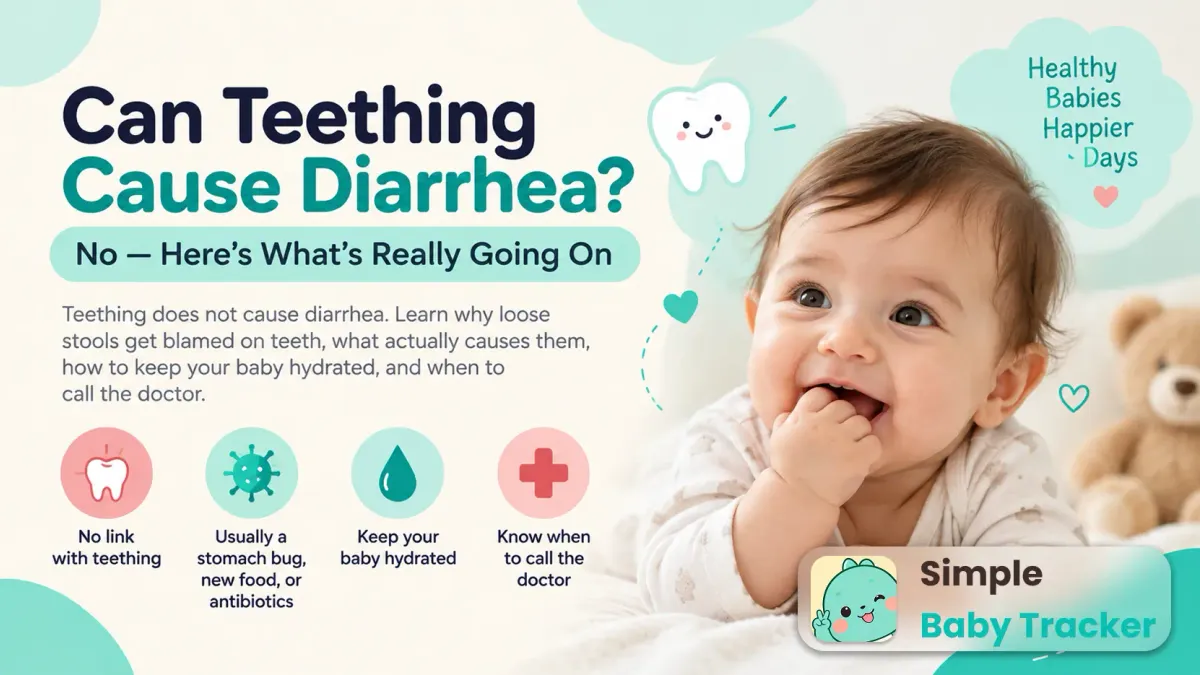
Can Teething Cause Diarrhea? No — Here's What's Really Going On
By Simple Baby Tracker Editorial TeamBaby Care
Teething does not cause diarrhea. Why loose stools get blamed on teeth, what actually causes them, how to keep your baby hydrated, and when to call the doctor.
Key Takeaways
- No. Teething does not cause diarrhea. Prospective research found no link between tooth eruption and stool looseness or stool number 12.
- Loose stools during teething usually mean a stomach bug, a new food, or antibiotics — all common at the same age teeth arrive 34.
- Keep feeding, offer fluids often in small amounts, and watch hydration: wet diapers, tears, and energy 35.
- Call promptly for blood or mucus in stool, high fever, signs of dehydration, or any diarrhea in a baby under 3 months old 35.
The short answer: no
Teething does not cause diarrhea. The AAP symptom checker lists diarrhea among the symptoms teething does not cause 1. The largest prospective teething study tracked babies day by day and found stool looseness and increased stool number were not linked to tooth eruption 2. A meta-analysis of teething signs reached the same conclusion: true gastrointestinal symptoms are not teething symptoms 6.
If your baby has watery or much looser stools than usual, treat it as its own illness — even if a tooth is also coming in. Our teething vs. ear infection vs. cold guide explains the general rule: runny nose, cough, vomiting, and diarrhea point to infection, not teeth.
Why everyone thinks teeth cause diarrhea
The saliva theory sounds convincing but is unproven. The story goes that teething babies swallow extra drool, and the drool loosens stools. It makes intuitive sense — teething babies do drool a lot. But when researchers actually tracked drooling days against stool patterns, the link did not hold up 2. Lots of drool plus loose stools is coincidence, not cause and effect.
The timing trap does the rest. Teeth arrive between about 6 and 18 months — exactly when:
- Stomach bugs sweep through daycare and playgroups, often several in a row 3.
- Babies start solids and try new foods, juices, and higher-fiber foods that change stools.
- Babies put everything in their mouths, picking up viruses from toys, hands, and floors.
- Ear infections and colds get treated with antibiotics, which commonly loosen stools.
A loose stool on the same day a tooth bump appears feels connected. It is two things at once: a tooth and a tummy trigger.
New foods deserve a special mention. Pears, prunes, peaches, peas, and excess fruit juice can all loosen stools in a baby just starting solids. If loose stools began within a day or two of a new food, suspect the food before the tooth.
What loose stools usually are instead
Most infant diarrhea is viral gastroenteritis — a stomach bug that runs its course in a few days 3. Typical pattern: sudden looser or more frequent stools, sometimes with vomiting first (see can teething cause vomiting for the vomit side), mild fever, cranky appetite, then gradual recovery.
| Clue | Teething alone | Stomach bug |
|---|---|---|
| Stools | Normal for your baby — maybe slightly softer for a day, no real change in frequency 2 | Clearly looser, watery, or much more frequent than usual 3 |
| Vomiting | No 1 | Often, especially in the first day or two 3 |
| Fever | None, or slight rise below 100.4°F (38°C) 7 | Possible true fever of 100.4°F (38°C) or higher 8 |
| Appetite | Chews more, may refuse solids but still drinks 2 | May refuse feeds entirely or vomit them back 3 |
| Sick contacts | None | Siblings, daycare mates, or parents with similar symptoms 3 |
| Duration | Fussiness peaks for a few days around breakthrough, then eases 9 | Loose stools last days, then firm up steadily |
One more link worth knowing: diarrhea itself worsens diaper rash. Stool enzymes and prolonged wetness irritate the skin, so a stomach bug often brings a rash a day later — and parents blame both on teeth. Neither is caused by teeth; the rash is caused by the diarrhea 19. See our diaper rash guide for barrier and changing steps that help while stools are loose.
What to do at home
- Keep feeding. Do not stop breast milk or formula, and do not withhold solids from an older baby who wants them. Continued feeding supports recovery in childhood gastroenteritis 4.
- Offer fluids often, in small amounts. Breastfeed more often; for formula-fed or older babies, offer usual fluids plus oral rehydration solution (ORS) as advised by your pediatrician or pharmacist 45. Small sips frequently stay down better than big drinks.
- Skip juice, soda, and sports drinks. Sugary drinks can worsen diarrhea. Water and ORS are better choices for rehydration 45.
- No anti-diarrhea medicines unless prescribed. They are not recommended for young children and can hide the real picture 3.
- Change diapers fast and protect the skin. Rinse gently, pat dry, and apply a thick barrier layer — diarrhea stools sting. Change immediately after each stool, including overnight when you can 9.
- Wash hands well. Stomach bugs spread through stool traces on hands, toys, and surfaces. Wash after every change and before feeds 3.
A note on ORS and zinc: oral rehydration solution is the Tier-1-backed treatment for dehydration from gastroenteritis in young children, per NICE under-5 gastroenteritis guidance and NHS advice 43. Zinc is recommended in some global guidelines for certain settings, but routine zinc for otherwise healthy babies in high-income countries is a decision for your pediatrician — do not start it on your own.
Watch hydration, not the gums
Dehydration is the real risk of diarrhea, whatever caused it. Track three things:
- Wet diapers: at least 6 wet diapers in 24 hours; no wet diaper for 6–8 hours is a warning sign 5.
- Tears and mouth: tears when crying and a moist mouth are reassuring; no tears, dry tongue, or dry lips are not 5.
- Energy: playful between episodes is reassuring; unusual sleepiness, floppiness, or a sunken soft spot needs prompt care 5.
Write down stool count, vomits, feeds taken, and wet diapers with times. A dated log (“4 watery stools since 8 AM, 2 wet diapers, refused lunch, 100.9°F at noon”) gets your pediatrician to the answer fast.
When to call the doctor: the red lines
Call promptly for any of these — none of them is teething:
- Blood or mucus in the stool 3.
- High or persistent fever (100.4°F / 38°C or higher, rectal), or any fever with diarrhea that worries you 8.
- Signs of dehydration: fewer than 6 wet diapers a day, no wet diaper for 6–8 hours, dry mouth, no tears, sunken soft spot, unusual sleepiness 5.
- Repeated vomiting — fluids will not stay down 3.
- Severe belly pain, hard swollen belly, or a baby who is inconsolable or floppy 3.
- Any diarrhea in a baby under 3 months old — call the same day; young infants dehydrate fast and need direct guidance 38.
- Diarrhea lasting more than a few days without improvement, or you are simply worried — parental instinct counts 3.
Frequently asked questions
Does teething cause diarrhea?
No. Stool looseness and increased stool number showed no link to tooth eruption in prospective research, and the AAP lists diarrhea among symptoms teething does not cause 12. Loose stools during teething need evaluation as their own illness — usually a stomach bug, a food change, or antibiotics.
What does teething diarrhea color look like?
There is no such thing as a teething-specific stool color. Green, yellow, or slightly mucusy stools can all occur with stomach bugs, diet changes (greens, food dyes), or swallowed saliva mixed with a cold — not with eruption itself 23. Red blood or black tarry stools are never teething and need prompt medical advice 3.
Can swallowing drool cause loose stools?
This theory is popular but unproven. Teething babies do swallow more saliva, but eruption-day tracking found no associated change in stool looseness or number 2. When loose stools and heavy drool coincide, look for the usual suspects: a virus going around, a new food, or recent antibiotics 3.
My baby has diarrhea and a diaper rash while teething — connected?
Connected to each other, not to the tooth. Frequent watery stools irritate the skin and commonly cause diaper rash a day into a stomach bug — a verified mechanism, not a teething effect 19. Treat the stools (fluids, feeding, hydration watch) and the skin (fast changes, gentle rinse, thick barrier) as separate jobs. Our diaper rash guide walks through the skin side step by step.
How long does diarrhea last in babies?
Viral stomach bugs usually improve within a few days and resolve within about a week 3. Stools should trend firmer and less frequent, not looser and more frequent. Diarrhea that worsens after a few days, keeps returning with fever, or includes blood or mucus deserves a call rather than more waiting 35.
Disclaimer: This article is for informational purposes only and does not constitute medical advice. Every baby is different. Always consult your pediatrician with questions about your baby’s stools, hydration, fever, or health.
Footnotes
-
American Academy of Pediatrics (HealthyChildren.org), “Teething” (KidsDoc Symptom Checker). Source ↩ ↩2 ↩3 ↩4 ↩5 ↩6
-
Macknin ML, Piedmonte M, Jacobs J, Skibinski C, “Symptoms associated with infant teething: a prospective study,” Pediatrics 2000;105(4):747-752. Source ↩ ↩2 ↩3 ↩4 ↩5 ↩6 ↩7 ↩8
-
NHS, “Diarrhoea and vomiting in children.” Source ↩ ↩2 ↩3 ↩4 ↩5 ↩6 ↩7 ↩8 ↩9 ↩10 ↩11 ↩12 ↩13 ↩14 ↩15 ↩16 ↩17 ↩18 ↩19 ↩20 ↩21 ↩22
-
National Institute for Health and Care Excellence, “Diarrhoea and vomiting caused by gastroenteritis in under 5s: diagnosis and management” (NICE Guideline NG51). Source ↩ ↩2 ↩3 ↩4 ↩5
-
American Academy of Pediatrics (HealthyChildren.org), “Signs of Dehydration in Infants and Children.” Source ↩ ↩2 ↩3 ↩4 ↩5 ↩6 ↩7 ↩8 ↩9
-
Massignan C, Cardoso M, Porporatti AL, et al., “Signs and Symptoms of Primary Tooth Eruption: A Meta-analysis,” Pediatrics 2016;137(3):e20153501. Source ↩
-
Mayo Clinic, “Teething: Tips for soothing sore gums.” Source ↩
-
American Academy of Pediatrics (HealthyChildren.org), “Fever and Your Baby.” Source ↩ ↩2 ↩3
-
Cleveland Clinic Health Essentials, “Teething Doesn’t Cause Fevers, and Other Myths To Sink Your Teeth Into.” Source ↩ ↩2 ↩3 ↩4
Keep reading