

How Long Does Teething Last? Pain, Fever and Fussiness Timelines
By Simple Baby Tracker Editorial TeamBaby Care
How long does teething last per tooth, and how many days do pain, fussiness, and low-grade fever last? Normal timelines plus the red lines for calling the doctor.
Key Takeaways
- How long does teething last per tooth? Active symptoms peak for a few days around breakthrough — typically the day before, the day of, and the day after eruption — then ease 12.
- How many days does teething pain last? Fussiness, drooling, and chewing cluster in that same short window; irritability beyond a few days is unlikely to be teeth alone 13.
- How long does teething fever last? A slight temperature rise shows up on eruption day only and stays below 100.4°F (38°C). A true fever is not teething 14.
- Call the doctor for fever of 100.4°F (38°C) or higher, symptoms lasting well beyond a few days, or any fever in a baby under 3 months 56.
How long does teething last per tooth?
A few days of active symptoms around breakthrough — not weeks. In the largest prospective study, symptoms clustered on the day before eruption, the day of eruption, and the day after, then faded 1. Our baby teething chart shows when each tooth typically arrives, but the per-tooth discomfort window itself is short.
That surprises most parents, because the whole teething era feels endless. The full journey — first tooth around 6 months to molars near age 2–3 — spans roughly two years. But within that era, each tooth causes only a brief flare: drooling, chewing, cranky sleep, then a calm gap before the next one. If misery runs for two straight weeks with no tooth appearing, something else is going on; see our teething vs. ear infection vs. cold guide for the usual suspects.
Molars earn their reputation as the worst: bigger teeth, more gum to push through, and they arrive when toddlers protest louder. But even molar pain follows the same pattern — a short intense window, not a month of suffering 3.
How many days does teething pain last?
How long does teething pain last in babies? How many days does teething pain last before the tooth appears? The research answer: noticeable fussiness, biting, and gum rubbing concentrate in the 2–3 days around breakthrough 1. Pain typically builds the day before the tooth cuts through, peaks on eruption day, and settles the day after.
What that looks like day by day:
| Day | What to expect |
|---|---|
| 2–3 days before | More drool, everything goes in the mouth, slightly clingier at night |
| Day before + eruption day | Peak fussiness, chewing hard on fingers and toys, broken naps, possible slight temperature rise below 100.4°F (38°C) 14 |
| Day after | Still tender but clearly easing; appetite and mood returning |
| 3+ days after, no improvement | Stop blaming teeth — look for a cold, ear infection, or stomach bug 7 |
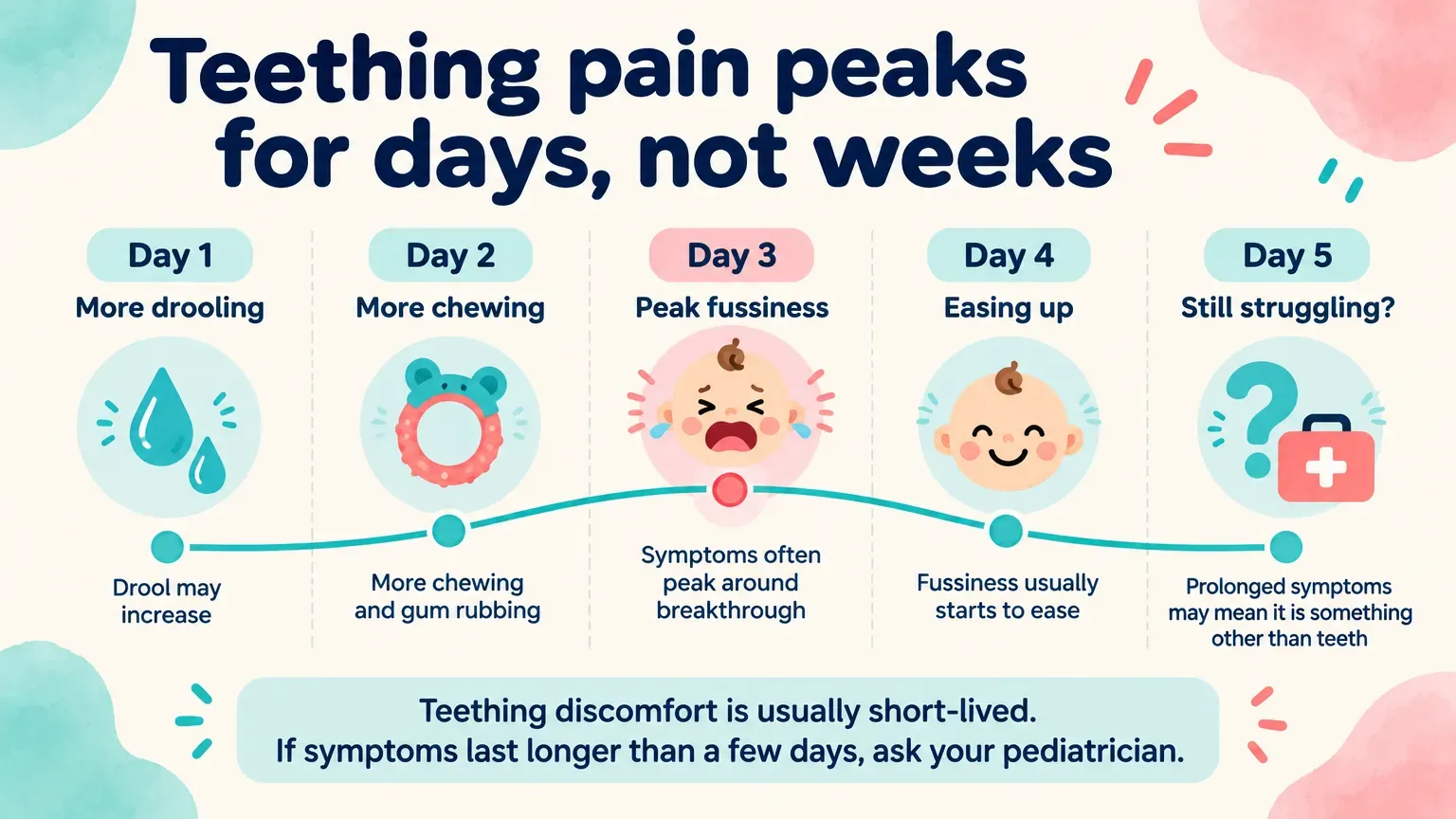
How long does teething pain last after the tooth appears? About a day of residual tenderness, then normal. A tooth that has fully broken through with a sharp edge can irritate the opposite gum or tongue briefly, but that is mechanical rubbing, not eruption pain, and it resolves as the mouth adjusts.
One common trap: parents date the start of teething from the first drool — sometimes weeks before eruption. Drooling alone is not pain, and a long drooly run-up does not mean weeks of suffering ahead. Count the pain window from the fussiness peak, not the first wet bib.
How long does teething fussiness last?
How long does teething fussiness last in babies? Same short window: irritability and crying tied to eruption were significant only around the breakthrough days in prospective tracking 1. A meta-analysis of teething signs found irritability among the symptoms genuinely linked to eruption — but as a brief flare, not a personality change 3.
Practical rule: if your baby is fussy for a few days, a tooth bump appears, and the mood lifts — that was teething. If fussiness lasts a week or more with no tooth, or comes with poor feeding, unusual sleepiness, or inconsolable crying, treat it as illness until proven otherwise 7.
Sleep deserves a special note. Night waking often starts before daytime fussiness peaks — tired babies with sore gums resist settling, and the quiet dark leaves nothing to distract from the ache. But teething-related night disruption also resolves within days of breakthrough. Weeks of worsening nights point to sleep regressions or illness instead; our four-month sleep regression guide covers the most common lookalike.
How long does teething fever last?
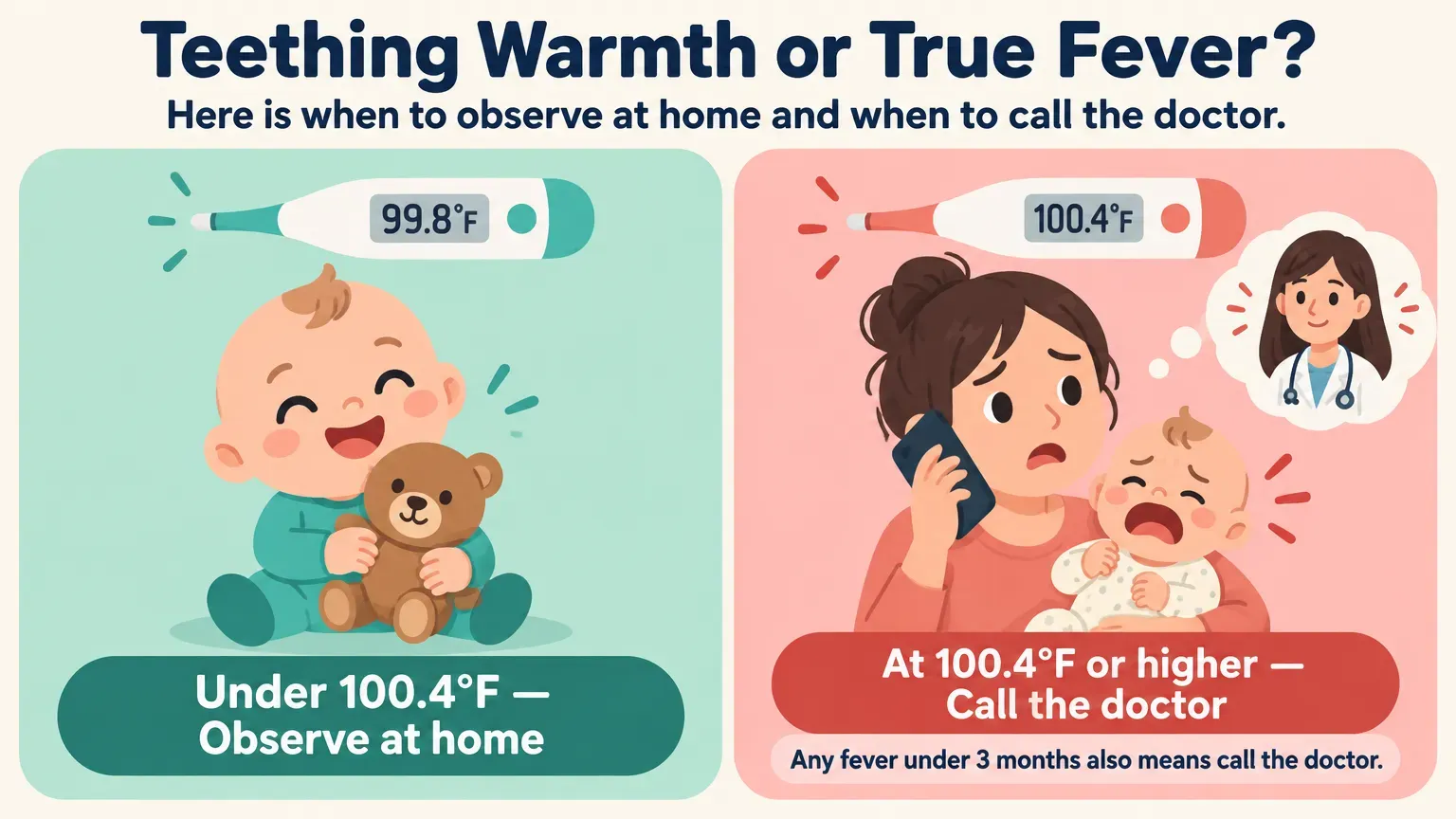
How long does teething fever last in babies — and how many days does teething fever last? Here is the key correction: teething does not cause true fever at all. The AAP symptom checker lists fever among the symptoms teething does not cause 4. What research actually found is a slight temperature rise — still below 100.4°F (38°C) — measurable on eruption day only 1. A follow-up clinical trial confirmed it: low-grade temperature elevation appeared on the day of eruption and nowhere else in the window 2.
So the honest timeline:
- Slight warmth under 100.4°F (38°C): eruption day, gone by the next day 12.
- True fever of 100.4°F (38°C) or higher, rectal: not teething, whatever day it appears 45. Treat it as its own illness.
- Fever lasting more than a day or two: call your pediatrician for guidance, especially with poor feeding or unusual sleepiness 6.
Fever plus a tooth means two things at once: a tooth and an infection. Common companions at teething age include colds (see can teething cause a runny nose and can teething cause congestion and cough), stomach bugs (see can teething cause diarrhea and can teething cause vomiting), and ear infections (teething vs. ear infection vs. cold).
The red lines: when duration means call the doctor
Duration itself is a diagnostic clue. Use these cutoffs:
- Fever of 100.4°F (38°C) or higher, rectal — call promptly; fever is not teething 56.
- Any fever in a baby under 3 months old — call the same day; young infants need direct guidance 5.
- Fussiness, poor feeding, or broken sleep lasting well beyond a few days with no tooth appearing — get evaluated rather than waiting out “teething” 7.
- Vomiting, watery diarrhea, or signs of dehydration (fewer than 6 wet diapers a day, no tears, dry mouth, sunken soft spot, unusual sleepiness) — none of these is teething, whatever the gums look like 8.
- You are simply worried — parental instinct counts, and a same-day call costs nothing 6.
Keep a dated log while you wait: symptom, temperature with method and time, feeds taken, wet diapers, and any tooth bumps you can see or feel. “Fussy 3 days, 101.2°F rectal at 2 PM, refusing bottle, 3 wet diapers, lower gum bump felt this morning” gets your pediatrician to the answer far faster than “teething for a while.”
Frequently asked questions
How long does teething last in babies overall?
The full eruption era runs from roughly 6 months to 2–3 years, but each tooth causes only a few days of active symptoms around breakthrough 1. Long calm gaps between teeth are normal.
How long does teething last before a tooth appears?
Noticeable symptoms typically start the day before eruption — extra drooling and chewing may begin a couple of days earlier 1. A weeks-long drooly run-up without fussiness is not pain; count from the fussiness peak.
How many days does teething pain last for molars?
Same pattern as other teeth — a short intense window of a few days around breakthrough — though molars can feel worse because there is more gum to push through 3. Weeks of molar misery deserves evaluation, not endurance.
How long does teething discomfort last at night?
Night waking clusters in the same few-day window as daytime fussiness and settles after breakthrough 1. Persistent weeks-long night disruption points to sleep regressions or illness rather than teeth.
My baby has had a fever for 3 days while teething — normal?
No. True fever is not caused by teething, and multi-day fever needs medical guidance regardless of what the gums are doing 46. Call your pediatrician.
Disclaimer: This article is for informational purposes only and does not constitute medical advice. Every baby is different. Always consult your pediatrician with questions about your baby’s fever, symptoms, or health.
Footnotes
-
Macknin ML, Piedmonte M, Jacobs J, Skibinski C, “Symptoms associated with infant teething: a prospective study,” Pediatrics 2000;105(4):747-752. Source ↩ ↩2 ↩3 ↩4 ↩5 ↩6 ↩7 ↩8 ↩9 ↩10 ↩11 ↩12
-
Shibly O, et al., “Signs and symptoms associated with primary tooth eruption: a clinical trial of nonpharmacological remedies,” BMC Oral Health 2015;15:88. Source ↩ ↩2 ↩3
-
Massignan C, Cardoso M, Porporatti AL, et al., “Signs and Symptoms of Primary Tooth Eruption: A Meta-analysis,” Pediatrics 2016;137(3):e20153501. Source ↩ ↩2 ↩3 ↩4
-
American Academy of Pediatrics (HealthyChildren.org), “Teething” (KidsDoc Symptom Checker). Source ↩ ↩2 ↩3 ↩4 ↩5
-
American Academy of Pediatrics (HealthyChildren.org), “Fever and Your Baby.” Source ↩ ↩2 ↩3 ↩4
-
American Academy of Pediatrics (HealthyChildren.org), “Fever: When to Call the Pediatrician.” Source ↩ ↩2 ↩3 ↩4 ↩5
-
Mayo Clinic, “Teething: Tips for soothing sore gums.” Source ↩ ↩2 ↩3
Keep reading