

Stage 1 vs Stage 2 Formula: Do Babies Actually Need to Switch at 6 Months?
By Simple Baby Tracker Editorial TeamBaby Care
Do babies need stage 2 formula at 6 months? Stage 1 vs stage 2 differences, what FDA, AAP, NHS and EU rules actually say, and when staying on stage 1 is fine.
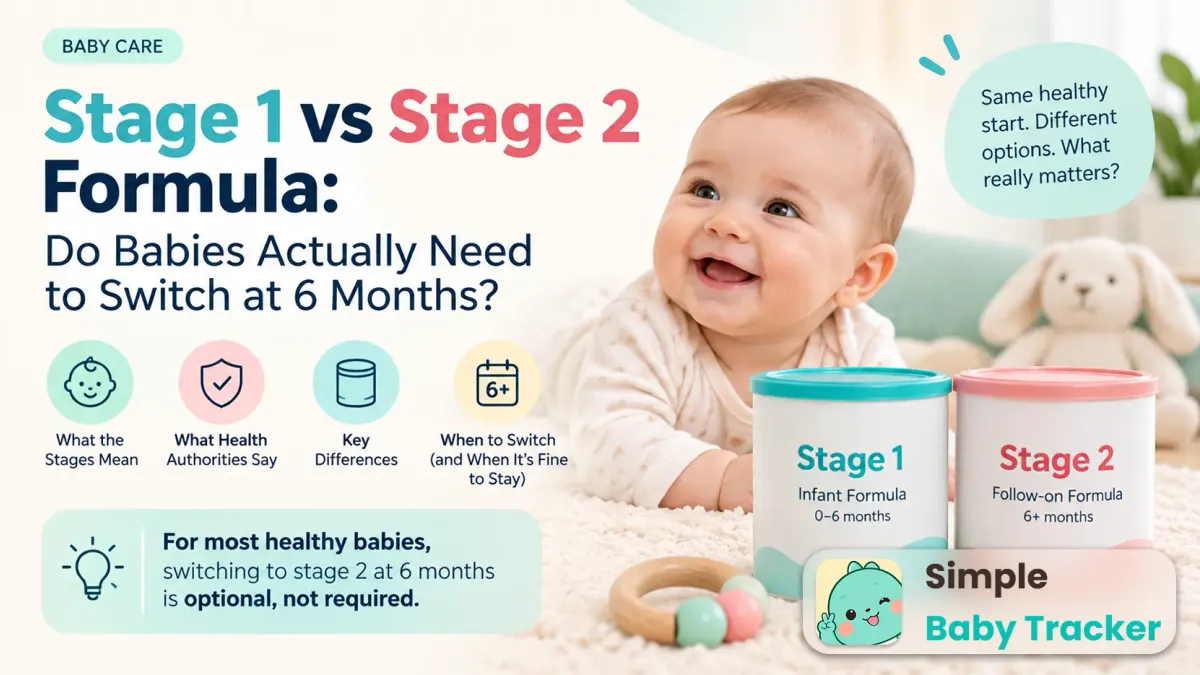
Key Takeaways
- For most healthy term infants, switching to stage 2 at 6 months is optional, not required. Standard iron-fortified infant formula covers the full first year 12.
- In the U.S., “stages” are manufacturer marketing segments, not FDA tiers. Every infant formula must meet the same FDA nutrient specifications at 21 CFR 107.100 3.
- In the UK and EU, follow-on formula is a separately regulated category for babies 6+ months, but the NHS states there is no benefit to switching: first infant formula works as the main drink until 1 year 4.
- Never use stage 2 or follow-on formula before 6 months, and talk to your pediatrician about blood in stool, poor weight gain, or allergy signs before any switch.
The short answer
No, most babies do not need to switch. If your baby is thriving on a stage 1 or first infant formula, you can keep using it through 12 months alongside age-appropriate solid foods, then transition to plain whole cow milk at 1 year. Stage 2 exists as an option, not a milestone your baby must hit on their 6-month birthday.
The confusion is understandable: the can says “Stage 2, 6+ months,” which reads like a prescription. It is not. The rest of this guide explains what the stages actually mean on each side of the Atlantic, what is genuinely different inside the can, and the short decision list for your family. For the broader starting point, our formula selection guide covers types, labels, and safe preparation.
What stage 1 and stage 2 actually mean
The same numbers mean different things in different regulatory systems. This is the single most important section in this article.
In the United States, the FDA does not define stage 1, stage 2, or stage 3 formulas. U.S. infant formula is regulated as a food with one set of nutrient specifications at 21 CFR 107.100, plus quality-control procedures at 21 CFR 106 3. Any product marketed as infant formula must meet those requirements and register with the FDA before sale. When a U.S. can says “Stage 2,” that is the manufacturer’s own labeling for an older-infant marketing segment, not a separate FDA safety tier. Nutritionally it must still satisfy the same federal rules as stage 1.
In the UK and the EU, the split is real in law but still not a required upgrade. EU Delegated Regulation 2016/127 sets separate compositional rules for infant formula (from birth) and follow-on formula (for infants 6+ months when complementary feeding begins) 5. The UK’s NHS guidance follows the same age line: follow-on formula is suitable only from 6 months and must never be given before that age 4. But the NHS position on necessity is unambiguous: research shows switching to follow-on formula at 6 months has no benefits, and first infant formula can continue as the main drink until 1 year 4.
So the honest translation of the label:
| What the label says | What it legally means | What your baby needs |
|---|---|---|
| U.S. “Stage 2, 6+ months” | Manufacturer segment; same FDA nutrient rules as stage 1 3 | Optional. Stage 1 through 12 months is fine 1 |
| UK/EU “Follow-on / Stage 2, 6+ months” | Separately regulated category under EU 2016/127, never before 6 months 5 | Optional. First infant formula works until 1 year; no proven benefit to switching 4 |
| “Toddler / Stage 3, 12+ months” | Not infant formula; different product class | Not needed. Plain whole cow milk plus a varied diet is the standard path from 12 months 2 |
Stage 1 vs stage 2: what is actually different?
Recipes differ by brand, so no universal nutrient table applies. But three patterns hold across most products:
- Iron is the headline difference, not a new ingredient. Follow-on and stage 2 recipes are typically positioned around the rising iron needs of older infants eating complementary foods. That does not make stage 1 iron-deficient: U.S. stage 1 formulas are already iron-fortified, and the AAP recommends iron-fortified formula for all infants who are not breastfed from birth to one year 1. If your baby’s formula says “Infant Formula with Iron,” the iron baseline is already covered.
- Protein balance may shift. UK first infant formula is whey-dominant, described by the NHS as easier to digest, while some later or “hungrier baby” recipes use more casein 4. A higher casein share is harder to digest, and the NHS notes there is no evidence hungrier-baby formulas help babies settle or sleep longer 4. A different protein ratio is a formulation choice, not an upgrade every baby needs.
- The regulatory wrapper changes; the safety floor does not drop. In the U.S., both stages clear the same FDA bar 3. In the EU, follow-on formula meets its own annex of compositional requirements 5. Either way, a stage 1 can used at 8 or 10 months is not expired, incomplete, or unsafe by virtue of the number on the label.
One practical warning: follow-on labels can look nearly identical to first infant formula on the shelf. The NHS specifically advises reading the label carefully to avoid buying the wrong stage by mistake 4. Check the age line every time, especially when someone else shops for you.
What the authorities actually say
Each authority below gets one sentence, because each has spoken plainly:
- FDA (U.S.): All infant formulas must meet federal nutrient specifications and quality controls; there is no separate “stage 2” nutrient tier in the regulation 3.
- AAP (U.S.): Iron-fortified formula is recommended for all infants who are not breastfed, or only partially breastfed, from birth to one year; low-iron formulas should not be used routinely 1.
- AAP on older-infant and toddler formulas: Standard infant formula plus age-appropriate foods covers the first year, and toddler formulas have not been shown to beat whole milk plus a varied diet from 12 months 2.
- NHS (UK): First infant formula is the only formula most babies need, can continue through the first year alongside solids from around 6 months, and switching to follow-on formula at 6 months has no demonstrated benefit 4.
- EU/EFSA: Follow-on formula has its own compositional rules for use from 6 months with complementary feeding, defined in Regulation 2016/127 following EFSA’s scientific opinion on essential composition 56.
- CDC (prep, both stages): Powdered formula is not sterile; measure water first, use the exact ratio, never dilute, and follow the 2-hour / 1-hour / 24-hour time limits 78.
Read together, the picture is consistent: the stages describe marketing and regulatory categories, while the feeding advice converges on one line — iron-fortified first/stage 1 formula works for the whole first year.
When staying on stage 1 is fine
Staying put is the right default when all of these are true:
- Your baby was full-term and is gaining weight along their curve.
- Feeds, stool, and spit-up patterns are within the ranges in our formula feeding chart and formula-fed poop guide.
- Your baby takes solids interest cues from around 6 months without replacing formula too fast. Our starting solids guide covers readiness signs.
- The current formula is affordable, available, and prepared exactly as labeled.
There is no developmental penalty for skipping stage 2. “No evidence of benefit” from the NHS is not hedging — it means researchers looked and did not find one 4.
When to talk to your pediatrician instead of switching on your own
Do not self-prescribe a stage change for any of these. Call first:
- Repeated vomiting, blood or mucus in stool, hives or swelling, wheezing, or eczema flares tied to feeds.
- Poor weight gain, fewer wet diapers, unusual sleepiness, or signs of dehydration.
- Suspected cow milk protein allergy or lactose intolerance. These are medical diagnoses; hydrolyzed, lactose-free, and specialty formulas are medical decisions, not shelf experiments 4.
- Preterm birth, low birth weight, or immune concerns that change preparation rules (boiled water, ready-to-feed preference) 7.
- Pressure to switch from advertising, family advice, or a brighter can. Bring the question, not the new can, to the visit.
Log feeds, ounces, spit-up, stool, rash, and weight for 2 to 3 days before the call. Concrete numbers turn vague worry into a diagnosable pattern, and our feeding tracker records a bottle with one tap.
If you do switch: how to do it safely
Sometimes a switch still makes sense: availability or WIC coverage changes, moving between powder and ready-to-feed for travel, or your pediatrician recommends a different recipe. The method matters more than the stage number.
- Confirm the target and the timing. Never use stage 2 or follow-on formula before 6 months 45. Confirm the exact product with your pediatrician.
- Keep the ratio exact. Measure water first, add powder with the provided scoop, and never dilute either formula to stretch it. Too much water lowers nutrition and can slow growth; too little strains kidneys and digestion 8.
- Transition gradually unless told otherwise. Mixing across several days is the common approach; an immediate change is for medical reasons on medical advice. Our formula selection guide details the one-variable-at-a-time method.
- Watch tolerance for several days. Short-term gassiness or stool texture change can occur. If vomiting, diarrhea, rash, or refusal persists beyond the window your pediatrician gave, call back rather than switching again on your own.
- Plan the 12-month exit, not a stage 3 detour. From 12 months, plain whole cow milk as part of a balanced diet is the standard next step for most toddlers, with no need to pass through toddler formulas 2. Our switching to whole milk guide covers the one-feed-at-a-time method.
Frequently asked questions
Can my baby stay on stage 1 formula after 6 months?
Yes. First or stage 1 infant formula works as the main milk drink through 12 months alongside complementary foods 41. There is no evidence that switching to stage 2 or follow-on formula at 6 months helps or harms 4.
Can I give stage 2 or follow-on formula before 6 months?
No. Follow-on formula must never be given to babies under 6 months 4, and EU rules define it for use only once complementary feeding begins 5. Before 6 months, use a first or stage 1 infant formula.
Is follow-on milk necessary? What does the NHS say?
Not necessary. The NHS states that first infant formula is the only formula most babies need, that it can continue until 1 year, and that research shows no benefit from switching to follow-on formula at 6 months 4.
What is the real difference between stage 1 and stage 2?
Mostly formulation positioning around older infants: often a different iron level or whey-to-casein balance, under the same U.S. FDA nutrient rules or the EU’s separate follow-on annex 35. Recipes vary by brand, so read the nutrition panel rather than assuming stage 2 is universally “more nutritious.”
Do I need toddler or stage 3 formula after 12 months?
No. The AAP position is that toddler formulas have not been shown to outperform plain whole cow milk plus a varied diet from 12 months 2. The UK guidance agrees: children 1 to 5 do not need formula milks including follow-on or toddler milks 4.
Will switching to stage 2 help my baby sleep longer or feel fuller?
There is no evidence for that claim. The NHS specifically notes that hungrier-baby style formulas with more casein have no evidence of better settling or longer sleep 4. Sleep changes around 6 months usually track development and solids, covered in our sleep schedule by age and 4-month regression guide.
Conclusion
The can says stage 2, but the authorities say optional. Keep these three lines:
- Stage 1 through 12 months is a complete, evidence-backed default 14.
- Stage 2 is a lawful product category, not a developmental requirement 35.
- Switch only for a concrete reason — availability, medical advice, or a planned form change — and switch safely with exact ratios and a few days of logs.
Keep the formula selection guide for label reading, the feeding chart for amounts, the formula amount calculator for the number at your baby’s weight, and the starting solids guide for the 6-month transition that actually matters.
Disclaimer: This article is for informational purposes only and does not constitute medical advice. Every baby is different. Always consult your pediatrician with questions about feeding, growth, allergy symptoms, or formula changes.
Footnotes
-
AAP, George J. Fuchs III, MD, FAAP and Steven A. Abrams, MD, FAAP, “Choosing a Baby Formula,” HealthyChildren.org. Source ↩ ↩2 ↩3 ↩4 ↩5 ↩6
-
AAP, “Older Infant-Young Child Formulas,” Pediatrics, October 2023. Source ↩ ↩2 ↩3 ↩4 ↩5
-
FDA, “Infant Formula Information for Parents and Caregivers,” U.S. Food and Drug Administration, content current as of February 26, 2026. Source ↩ ↩2 ↩3 ↩4 ↩5 ↩6 ↩7
-
NHS, “Types of formula,” nhs.uk, page last reviewed April 6, 2023. Source ↩ ↩2 ↩3 ↩4 ↩5 ↩6 ↩7 ↩8 ↩9 ↩10 ↩11 ↩12 ↩13 ↩14 ↩15 ↩16 ↩17 ↩18
-
European Commission, “Commission Delegated Regulation (EU) 2016/127 on infant formula and follow-on formula,” EUR-Lex. Source ↩ ↩2 ↩3 ↩4 ↩5 ↩6 ↩7 ↩8
-
EFSA, “Scientific Opinion on the essential composition of infant and follow-on formulae,” EFSA Journal 2014. Source ↩
-
CDC, “Infant Formula Preparation and Storage,” Infant and Toddler Nutrition, reviewed May 14, 2026. Source ↩ ↩2
-
FDA, “Handling Infant Formula Safely: What You Need to Know,” U.S. Food and Drug Administration, May 17, 2024. Source ↩ ↩2
Keep reading