

Formula Feeding Chart by Age: How Much Formula Milk From Newborn to 12 Months
By Simple Baby Tracker Editorial TeamBaby Care
How much formula milk for a 0-6 month baby? The quantity per feed and per day in ounces and mL, plus feeding frequency from the first days to 12 months.
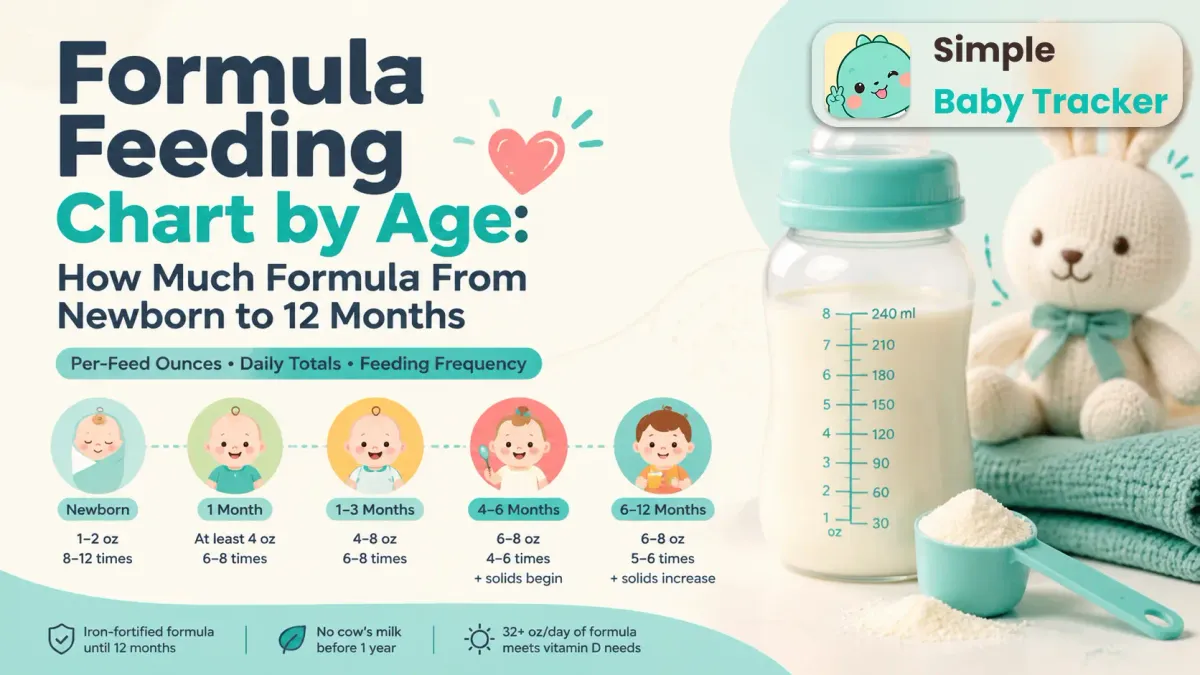
Key Takeaways
- Newborns start with 1 to 3 ounces per feed, 8 to 12 times in 24 hours, and reach at least 4 ounces per feed by the end of the first month.
- The working rule after that: about 2.5 ounces of formula per day for every pound of body weight, across 6 to 8 feeds.
- Across the full 0 to 6 months the quantity climbs from 1 to 4 ounces per feed in the first month to 6 to 8 ounces by 3 to 6 months, landing between 16 and 40 ounces (470 to 1,180 mL) a day.
- At 4 to 6 months most infants take 20 to 40 ounces a day and start showing readiness for solids; from 6 to 12 months, formula or solids about 5 to 6 times a day, with formula falling as solids rise.
- Iron-fortified formula until 12 months, no regular cow’s milk before 1, and 32 ounces a day is the vitamin D line.
The short answer
How much formula your baby needs is a moving target, but it moves along a predictable curve: small and frequent at first, bigger and spaced out later. Anchor on the table, then read the section for your baby’s age.
| Age | Per feed | Per day (approx) | Times per 24 hours |
|---|---|---|---|
| First days | 1 to 2 oz | 16 to 24 oz | 8 to 12 |
| End of first month | At least 4 oz | About 24 to 32 oz | 6 to 8 |
| 1 to 3 months | 4 oz, climbing toward 6 to 8 oz | Weight rule: 2.5 oz per lb | 6 to 8, decreasing |
| 4 to 6 months | 6 to 8 oz | 20 to 40 oz | 4 to 6, plus emerging solids |
| 6 to 12 months | 6 to 8 oz, falling as solids rise | Falling as solids rise | Formula or solids 5 to 6 times |
Per-feed figures for the first days and the 6-to-12-month pattern come from the CDC 1; the monthly ladder, daily totals, and the weight rule come from MedlinePlus and the AAP 23. Every baby is different, so treat the table as a starting range and let hunger cues and your pediatrician set the exact numbers. For the feed-frequency side of the same question, our newborn feeding guide covers both breast and bottle.
The one rule worth memorizing
On average, a baby needs about 2.5 ounces (75 mL) of formula a day for every pound (453 g) of body weight 32. A 10-pound baby lands around 25 ounces a day; a 14-pound baby around 35. It is a planning estimate, not a prescription: some days run higher during growth spurts, some lower, and your pediatrician’s growth curve is the final judge.
How much formula milk for a baby 0-6 months?
The rule above answers the question if you know your baby’s weight. If you would rather go by age, this is the quantity ladder for the first six months. The ranges are wide on purpose: a small 2-month-old and a large one do not drink the same bottle.
| Age | Formula milk per feed | Per day | Feeds per 24 hours |
|---|---|---|---|
| First 4 weeks | 1 to 4 oz (30 to 120 mL) | 16 to 32 oz (470 to 950 mL) | 6 to 12 |
| 1 to 3 months | 4 to 6 oz (120 to 180 mL) | About 24 to 32 oz (700 to 950 mL) | 6 to 8 |
| 3 to 6 months | 6 to 8 oz (180 to 240 mL) | 20 to 40 oz (600 to 1,180 mL) | 4 to 6 |
The per-feed figures and feed counts come from the CDC 1; the daily totals come from MedlinePlus and the AAP weight rule 23. The mL column is a straight conversion of the same figures, rounded to the nearest 10 mL.
Two cautions on the quantity. It is an amount to offer, not a target to finish: a baby who turns away from a half-empty bottle has had enough, and pressing the rest in overrides the fullness cues that keep feeding responsive. And the range matters more than the midpoint, so watch diapers and the growth curve rather than the ounces left on the counter.
If you would rather not do the arithmetic, our formula amount calculator takes your baby’s weight and returns a daily total and a per-feed split.
First days: small belly, small feeds
Your newborn’s belly is tiny, so each feed is small: 1 to 2 ounces every 2 to 3 hours if taking only formula, more when your baby shows hunger signs 1. Most formula-fed newborns feed 8 to 12 times in 24 hours.
MedlinePlus frames the same start slightly higher, 2 to 3 ounces per feed for a daily total of 16 to 24 ounces 2. The two ranges overlap, and the practical advice is identical: start small, offer more on hunger cues, and confirm the amount with your baby’s doctor in the first days.
Sleepy newborns may need waking to feed every 2 to 4 hours at first, and a formula-fed baby should not sleep more than 4 to 5 hours at night without feeding 4. Waking them for the feed is fine.
First month: reaching 4 ounces
Over the first weeks, your baby’s belly grows and each feed grows with it. By the end of the first month, your baby should be up to at least 4 ounces per feeding 2, with intervals stretching toward every 3 to 4 hours. Total feeds per day drift down from the newborn 8 to 12 toward roughly 6 to 8.
Feeds vary in length, long sometimes, short other times. Babies generally take what they need and stop when full.
1 to 6 months: the steady climb
From here the pattern is simple: fewer feeds, bigger bottles. Amounts climb toward approximately 6 to 8 ounces per feeding as the baby grows 2. At 4 to 6 months, most infants consume 20 to 40 ounces a day.
This is also when solids enter the picture. Do not give solid food before 4 to 6 months: your baby will not digest it well and may choke 4. Readiness signs include doubled birth weight, good head and neck control, sitting with some support, turning away to signal fullness, and interest in food when others eat. Our newborn schedule by week shows how the feeding rhythm looks just before this transition.
6 to 12 months: formula plus solids
Most 6-to-12-month-olds need formula or solid foods about 5 to 6 times in 24 hours 1. As solids gradually rise, formula gradually falls. Keep offering formula on hunger cues through the transition rather than cutting it on a schedule.
Two lines that hold all year: use iron-fortified formula, since the AAP recommends breast milk or iron-fortified formula until at least 12 months 2. And no regular cow’s milk before age 1: babies under 1 have a hard time digesting it 4.
One threshold to know: babies getting about 32 ounces or more of formula a day do not need extra vitamin D, because formula is fortified with it. Below that line, vitamin D drops starting shortly after birth 1.
12 months: switching to cow’s milk
At 12 months you can switch from formula to plain whole cow’s milk, not skim or reduced-fat 12. Do it gradually: replacing one formula feed with cow’s milk at a time helps your child transition. Toddler formulas have not been shown to beat whole milk plus a varied diet, so there is no need to detour through them.
How to tell your baby is getting enough
Three signals, same as with any feeding method:
- Hunger cues, early: hands to mouth, rooting toward the bottle, lip smacking, clenched hands. Crying is a late sign, so do not wait for it 5.
- Fullness cues: closing the mouth, turning away from the bottle, relaxing the hands. Let your baby decide when the feed ends; they do not need to finish the bottle.
- Diapers and weight: a steady stream of wet and dirty diapers plus a healthy weight curve at checkups. If you are worried in either direction, too little or too much, that visit is the place to ask.
Logging feeds with ounces for a few days turns vague worry into concrete numbers. Our feeding tracker records a bottle with one tap, and our guide to what to track in your baby’s first year explains which logs pair with it.
Frequently asked questions
How many ounces of formula does a newborn need?
In the first days, 1 to 2 ounces every 2 to 3 hours, 8 to 12 times a day, offering more on hunger signs. MedlinePlus describes the same start as 2 to 3 ounces per feed totaling 16 to 24 ounces a day. Start small and confirm with your pediatrician.
How do I calculate how much formula my baby needs?
Use about 2.5 ounces per day for every pound of body weight. A 12-pound baby lands around 30 ounces a day, split across that day’s feeds.
How much formula milk should a 0-6 month baby drink?
The quantity tracks weight, not the calendar. Roughly 1 to 4 ounces per feed in the first month, 4 to 6 ounces from 1 to 3 months, and 6 to 8 ounces from 3 to 6 months, at around 6 to 8 feeds a day. The daily total lands between 16 and 40 ounces depending on age and size; check it against the rule of about 2.5 ounces per pound.
How many mL of formula milk does a baby need per day?
About 165 mL of formula per kilogram of body weight per day, which is the same as 2.5 ounces per pound. A 4 kg baby lands near 660 mL a day and a 6 kg baby near 1,000 mL, split across that day’s feeds.
How much formula should a 6-month-old drink?
At 4 to 6 months most infants take 20 to 40 ounces a day. From 6 months, formula or solids about 5 to 6 times a day, with formula falling as solids rise.
When can my baby switch to cow’s milk?
At 12 months, switching gradually to plain whole milk. No regular cow’s milk before age 1.
Does my formula-fed baby need vitamin D drops?
Only below about 32 ounces of formula a day. At or above that, the fortification in the formula covers it. Ask your pediatrician if you are unsure.
Should I wake my baby to feed at night?
Early on, yes if feeds are due: newborns may need waking every 2 to 4 hours, and a formula-fed baby should not go more than 4 to 5 hours overnight without feeding. Once growth is on track, your pediatrician will tell you when to stop waking.
Disclaimer: This article is for informational purposes only and does not constitute medical advice. Every baby is different. Always consult your pediatrician with questions about your baby’s feeding, growth, or health.
Footnotes
-
CDC, “How Much and How Often to Feed Infant Formula,” Infant and Toddler Nutrition, reviewed April 21, 2026. Source ↩ ↩2 ↩3 ↩4 ↩5 ↩6
-
MedlinePlus (U.S. National Library of Medicine), “Infant formulas,” Medical Encyclopedia, reviewed April 5, 2025. Source ↩ ↩2 ↩3 ↩4 ↩5 ↩6 ↩7 ↩8
-
AAP, “Amount and Schedule of Baby Formula Feedings,” HealthyChildren.org, updated May 16, 2022. Source ↩ ↩2 ↩3
-
MedlinePlus (U.S. National Library of Medicine), “Feeding patterns and diet - babies and infants,” Medical Encyclopedia, reviewed July 1, 2025. Source ↩ ↩2 ↩3
-
CDC, “Signs Your Child Is Hungry or Full,” Infant and Toddler Nutrition, reviewed March 11, 2026. Source ↩
Keep reading