

What Is a Baby Note App? Everything to Track in Your Baby's First Year
Baby Care
A baby note app helps you log feeding, sleep, diapers, growth, and milestones. Here's what to track in your baby's first year and why it matters.
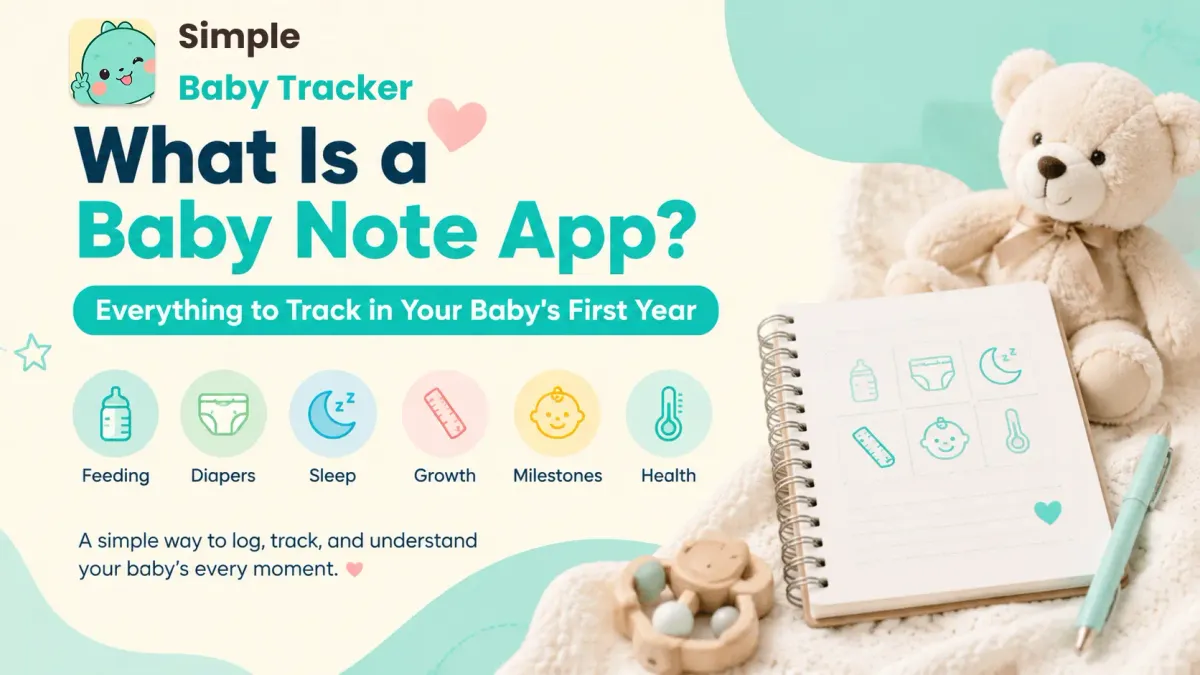
What is a baby note app?
A baby note app is a mobile application that lets you record the daily details of your baby’s care — feeding sessions, sleep patterns, diaper changes, growth measurements, and milestone moments. Instead of scribbling times on a napkin or trying to remember what happened at 3 AM, you tap a few buttons and the data is stored, timestamped, and ready to share with your partner or pediatrician.
The term “baby note” is often used interchangeably with “baby tracker” — both describe the same thing: a digital log for your baby’s daily care. The idea is simple: record what happened, when it happened, and get back to caring for your baby.
Why parents use a baby note app
The first year of parenting produces a flood of data that is impossible to keep in your head. Consider what a typical newborn’s day looks like:
- Feeding: 8 to 12 times in 24 hours, according to the CDC 1. Each feeding session means deciding which side or how much formula, and watching for hunger cues.
- Sleep: 16 to 17 hours per day, but in short segments of 1 to 2 hours at a time, reports Stanford Medicine Children’s Health 2. Most babies don’t sleep through the night until around 3 months.
- Diaper changes: a steady stream of wet and dirty diapers throughout the day — one of the clearest ways to tell if a baby is feeding well.
- Growth checks: weight, length, and head circumference tracked at every well-baby visit against CDC growth charts 3.
- Milestones: first smile, rolling over, sitting up — each one a small celebration that’s easy to forget when you’re sleep-deprived.
That’s over 50 individual data points per day, every day, for months. A baby note app is not about being obsessive — it’s about offloading the mental load so you can focus on your baby.
What to track in your baby’s first year
Every family tracks differently, but these are the most commonly logged categories:
Feeding
Feeding is the most frequent activity in a newborn’s day. The CDC recommends tracking:
- Breastfeeding: 8 to 12 times per day in the first weeks and months. Most exclusively breastfed babies feed every 2 to 4 hours. Some cluster feed (feeding as often as every hour) during growth spurts 1.
- Formula feeding: 8 to 12 times per day in the first days, starting with 1 to 2 ounces every 2 to 3 hours, then every 3 to 4 hours as they grow 4.
- Side (left/right) for breastfeeding, and amount for formula or expressed milk.
- Solid foods: introduced around 6 months, gradually replacing milk feeds.
Tracking feeding helps you answer the pediatrician’s first question — “how much is your baby eating?” — with confidence.
Diaper output
Wet and dirty diapers are a direct, everyday sign that a baby is getting enough to eat. Logging each change gives you an objective record of output to share with your pediatrician. A noticeable drop in wet diapers, or changes in stool color or frequency, is a reason to check in with them — and they can tell you the exact diaper counts to watch for at your baby’s age.
Tracking diaper changes also helps you spot diarrhea, constipation, or early signs of a urinary tract infection, while giving you confidence that feeding is on track.
Sleep
Newborns sleep 16 to 17 hours per day, but rarely more than 1 to 2 hours at a stretch 2. By 4 months, total sleep is 12 to 16 hours per day (including naps) 5. Most babies start sleeping through the night (6 to 8 hours) around 3 months, but the timeline varies widely.
A sleep log helps you identify your baby’s natural rhythm, recognize tiredness cues, and share accurate information with your pediatrician if sleep issues arise.
Growth
Pediatricians track three measurements at every well-baby visit: weight, length, and head circumference. These are plotted on CDC growth charts to monitor your baby’s development over time 3. Between visits, logging your own measurements using a home scale and measuring tape can help you spot trends early.
Milestones
The CDC’s “Learn the Signs. Act Early.” program defines developmental milestones across four domains: social/emotional, language/communication, cognitive, and physical movement 6. Key first-year milestones include:
- 2 months: smiles socially, coos, follows objects with eyes
- 4 months: rolls over, reaches for toys, laughs
- 6 months: sits without support, babbles, responds to name
- 9 months: crawls, pulls to stand, understands “no”
- 12 months: takes first steps, says a few words, waves bye-bye
Logging milestones as they happen gives you a detailed record to share with your pediatrician.
Health
Tracking your baby’s temperature when they’re sick, logging medications and doses, and recording vaccine dates helps you manage care and avoid accidental double-dosing. Some parents also track bath time, tummy time, and pump sessions.
How tracking helps at pediatrician visits
Pediatricians ask specific questions at every well-baby checkup:
- “How many times a day does your baby eat?”
- “How many wet diapers are they producing?”
- “Are they sleeping through the night?”
- “When did they start rolling over?”
A baby note app gives you instant, accurate answers instead of guesses. This is especially valuable during the first few months when the pediatrician is monitoring weight gain and feeding patterns closely. The American Academy of Pediatrics recommends that newborns see a pediatrician within 3 to 5 days after birth, and then at 1, 2, 4, 6, 9, and 12 months 7. Having a complete log for each visit helps the doctor make informed decisions.
What to look for in a baby note app
Not all baby note apps are the same. Here are features that matter for daily use:
- Quick input: you should be able to log a feed or diaper change in one or two taps — you won’t have time for forms at 3 AM.
- Offline-first: the app should work without an internet connection, syncing when you’re back online.
- Family sharing: both parents and caregivers should be able to log and view the same data without sharing a device.
- No ads, no subscription: a baby note app should serve parents, not advertisers. One-time purchase models are more honest than recurring subscriptions.
- Privacy: your baby’s data is sensitive. Look for an app that doesn’t sell or share data.
- Growth charts: built-in percentile charts turn your measurements into actionable insights.
Simple Baby Tracker is a free, offline-first, one-time-purchase baby note app for Android that covers all of the above. But the best app is the one you’ll actually use — try a few and see which feels natural.
Frequently asked questions
Is a baby note app the same as a baby tracker?
Yes. The terms are used interchangeably. “Baby note” emphasizes the record-keeping aspect, while “baby tracker” emphasizes the pattern-spotting feature. Both refer to the same category of app.
Do I need to track everything?
No. Track only what helps you — many parents focus on feeding and diapers in the first months, then add sleep and milestones later. The goal is to reduce mental load, not create a second job.
When should I stop tracking?
Most parents stop actively tracking between 6 and 12 months, when routines stabilize and the baby communicates needs more clearly. Others continue tracking growth and milestones up to the second birthday. Either approach is fine.
Can tracking make me anxious?
For some parents, tracking can become a source of anxiety if they obsess over numbers. The key is to use tracking as a tool — a reference, not a report card. If you find yourself stressed by the data, step back and track less.
Disclaimer: This article is for informational purposes only and does not constitute medical advice. Always consult your pediatrician with questions about your baby’s health, feeding, or development.
Footnotes
-
CDC, “How Much and How Often to Breastfeed,” Infant and Toddler Nutrition, reviewed April 2026. Source ↩ ↩2
-
Stanford Medicine Children’s Health, “Infant Sleep.” Source ↩ ↩2
-
CDC, “Positive Parenting Tips: Infants (0–1 years),” Child Development, reviewed February 2026. Source ↩ ↩2
-
CDC, “How Much and How Often to Feed Infant Formula,” Infant and Toddler Nutrition, reviewed April 2026. Source ↩
-
CDC, “About Sleep,” Sleep and Sleep Disorders, reviewed May 2024. Source ↩
-
CDC, “Learn the Signs. Act Early.,” Child Development. Source ↩
-
American Academy of Pediatrics, “AAP Schedule of Well-Child Care Visits,” HealthyChildren.org. Source ↩