

Is Powdered Baby Formula Sterile? Why It Can Contain Germs and How to Prepare It Safely
By Simple Baby Tracker Editorial TeamBaby Care
Powdered formula isn't sterile and can carry Cronobacter even when it looks fine. Who's at risk + CDC safe-prep steps at 158°F (70°C).
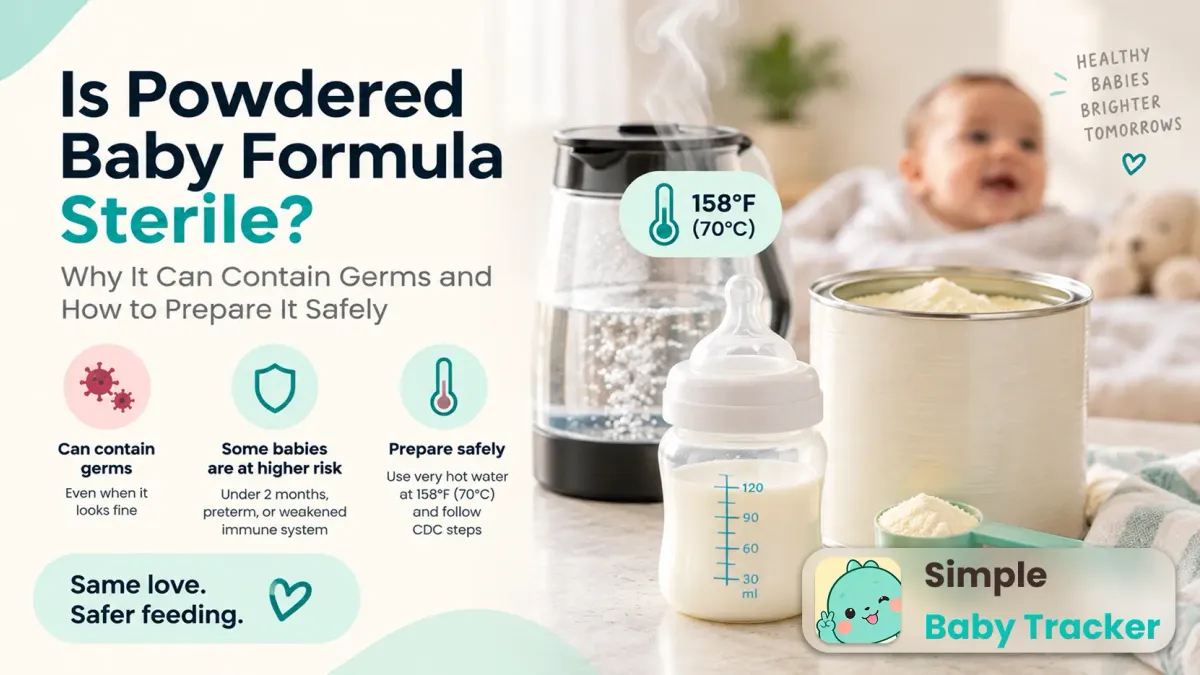
Key Takeaways
- Powdered infant formula is not sterile, even when the container is sealed. As the CDC puts it: “Powdered infant formula is not sterile and can sometimes have germs (such as Cronobacter)” 1. Liquid ready-to-feed formula, by contrast, is made to be sterile as packaged 2.
- Germs are invisible. A scoop that looks, smells, and tastes normal can still carry Cronobacter sakazakii or Salmonella, because contamination happens at microscopic levels during manufacturing or after opening at home 3.
- Babies at higher risk — under 2 months old, born prematurely (before 37 weeks), or with a weakened immune system — need extra precautions, and families should consider sterile ready-to-feed formula for them when possible 14.
- The core protective step for higher-risk babies (under 2 months, preterm before 37 weeks, or weakened immunity): mix powder with very hot water at around 158°F (70°C) — boil, then wait about 5 minutes before mixing (the CDC high-risk step); for most healthy term babies over 2 months with safe water, the CDC says follow the can label — and respect the time rules: use within 2 hours, within 1 hour once feeding starts, refrigerate immediately if not used right away and use within 24 hours 1.
The short answer
No — powdered baby formula is not sterile, and that is normal, not a sign of a defective can. The powder can sometimes contain germs even when it looks, smells, and tastes perfectly fine, which is why preparation matters more than brand. For most healthy term babies over 2 months old, careful preparation following the label and CDC steps keeps feeding safe. For newborns under 2 months, preterm babies, or babies with weakened immune systems, ask your pediatrician whether sterile liquid ready-to-feed formula is the better choice for the first weeks 124.
The rest of this guide explains which germs we’re talking about, why you can’t see them, who is most at risk, and the exact step-by-step preparation that kills them — with U.S. (CDC/FDA) guidance first and WHO/NHS (U.K./international) notes where they differ. If you’re still choosing a product, our guide to selecting baby formula covers types, iron, and label reading.
Powdered vs. liquid: which is sterile?
This is the single most useful distinction on the shelf:
| Form | Sterile as packaged? | What it means for you |
|---|---|---|
| Powdered formula | No — “not sterile and might have germs in it” 2 | CDC: follow the label for most infants; ~158°F/70°C boil-then-wait-~5-min mix only for higher-risk infants to kill Cronobacter 1. WHO/NHS: ≥70°C for every feed 56 |
| Liquid concentrate | Yes — “made to be sterile (without germs)” 4 | Still dilute exactly as labeled; safer option for higher-risk infants than powder 4 |
| Ready-to-feed (RTF) | Yes — sterile as packaged 2 | “Consider using liquid ready-to-feed formula, as this is the safest option for formula-fed infants” 4 |
One qualifier matters: liquid formula stays safe from Cronobacter when you follow the instructions on the container — once opened, handle it cleanly, refrigerate, and respect the label’s use-by timing 2. Sterile packaging is not a license to leave bottles out.
Why powder can contain germs even when it looks fine
Three facts explain the “looks fine” puzzle:
- The manufacturing process can’t sterilize powder. Spray-drying and dry-blending reduce germs but cannot guarantee sterility the way the heat treatment for sealed liquid formula does. The FDA states plainly that “powdered infant formula is not a sterile product,” and notes that required batch testing for Cronobacter and Salmonella “does not guarantee the product is free of Cronobacter” because contamination “can occur at very low levels and is not evenly distributed throughout the product, making it difficult to detect” 7.
- Contamination has two entry points. “Powdered infant formula can get contaminated in homes or in processing facilities that make it” 3. Factory-side contamination is rare and lot-specific; home-side contamination comes from damp scoops, wet hands, unclean bottles, or powder stored badly after opening.
- Bacteria are invisible at dangerous levels. A harmful dose of Cronobacter is microscopic — no change in color, smell, clumping, or taste reliably signals it. “Even when tins and packets of powdered infant formula are sealed, they can sometimes contain bacteria,” as the U.K. NHS puts it 5. Judging safety by appearance is the exact mistake this article exists to prevent.
This is also why clean water alone doesn’t solve it. Many U.S. parents mix powder with distilled or filtered water at room temperature and assume clean water equals safe bottle — but the risk is in the powder, not (only) the water. The hot-water step exists to sterilize the powder, not the water.
Which germs are we talking about?
Two bacteria account for essentially all powder-linked risk. Both are rare causes of illness but serious when they strike infants.
Cronobacter sakazakii
Cronobacter is the germ the CDC names first: infections in infants under 12 months “are often linked to powdered infant formula” 3. The FDA calls it a cause of “rare but possibly deadly infections in infants” that “can cause bloodstream and central nervous system infections, such as sepsis and meningitis” 89.
Symptoms in a baby under one year “usually start with a fever and poor feeding, excessive crying, or very low energy,” and “some babies may also have seizures” 3. The FDA’s parent alert adds poor feeding, irritability, temperature changes, jaundice, grunting breaths, or abnormal body movements as possible signs 9. Infections “usually occur in the first days or weeks of life,” and “infants less than 2 months old are most likely to develop meningitis” if infected 3.
When to act: “Babies with these symptoms should be taken to a medical provider as soon as possible” 3. Treat fever with poor feeding, unusual sleepiness, or inconsolable crying in a young infant as same-day urgent — call your pediatrician immediately or go to urgent care/ER. Do not wait to see if it passes.
Salmonella
Powdered formula “can provide a home for certain germs like Salmonella and Cronobacter,” and “Salmonella infections can be dangerous for infants” 8. Symptoms “usually include diarrhea, fever, and stomach cramps,” starting 6 hours to 6 days after exposure and usually lasting 4 to 7 days 10.
When to act: call your pediatrician for diarrhea or vomiting lasting more than 2 days, bloody stool, fever higher than 102°F (38.9°C), or any sign of dehydration — little or no peeing, very dark pee, dry mouth, or crying without tears. “Dehydration can happen quickly in young children,” so offer extra fluids as directed by your pediatrician 10.
How common is contamination? What the data actually says
Honest answer: for any given can, contamination is uncommon — but the true U.S. case count is unknown, so nobody can quote you a clean “1 in N cans” rate. Cronobacter only became nationally notifiable in 2024; before that, only a few states required reporting, and the CDC typically received only a handful of severe infant reports per year 3. Treat any precise-sounding incidence number you see elsewhere with suspicion unless it carries that context.
What is documented:
- Recalls are lot-specific, not brand-wide, and typically report no illnesses at the time of the alert. In December 2023, Reckitt/Mead Johnson voluntarily recalled 675,030 cans of Nutramigen hypoallergenic powder across six batches after Cronobacter sakazakii was confirmed in product samples — with no illnesses reported in connection with the recall 7. In May 2024, Dairy Manufacturers Inc. recalled Crecelac goat-milk and Farmalac powdered formulas for regulatory non-compliance, after which FDA testing found Cronobacter in a retail sample — again with no illnesses known at the time of the alert 9.
- The practical takeaway: check the lot number, not the brand name. If a recall touches your can, stop using it and follow the FDA notice. Bookmark the FDA’s recall search and check the lot/batch code printed on your container whenever news breaks.
Who is most at risk?
Take extra precautions — and seriously consider ready-to-feed — if your baby meets any of these descriptions. The CDC names three triggers for extra steps: “younger than 2 months old,” “born prematurely, meaning before 37 weeks of pregnancy,” or having “a weakened immune system” 1. The FDA’s list adds a fourth: babies “who are ill or receiving medical treatment, such as chemotherapy for cancer” 4.
For these babies, the CDC advises to “consider using liquid, ready-to-feed (RTF) formula when possible” 2, and the FDA ranks the options explicitly: ready-to-feed first (“the safest option”), liquid concentrate second, and powdered only with the boil-and-cool preparation below 4. Note on low birth weight: it does not appear as a standalone cutoff in the CDC/FDA high-risk lists — if your baby was small at birth, ask your pediatrician whether they count as higher-risk rather than assuming either way.
How to prepare powdered formula safely, step by step
This is the U.S. CDC/FDA method. (U.K./WHO differences are noted after — read both if you use a European brand like Kendamil.)
- Clean everything. Wash your hands with soap and water for at least 20 seconds. Wash bottles, nipples, and caps in hot soapy water (or dishwasher), and sterilize new or young-infant bottles per your pediatrician’s advice 4.
- Boil fresh water. Bring cold tap water (or water your pediatrician approved) to a rolling boil. If using bottled water, know that “bottled water isn’t sterile unless the label says it is” 4.
- Cool briefly — but not too long. For higher-risk babies (or when your label directs 70°C): let the boiled water cool in the pot no longer than about 5 minutes, so it is still very hot — around 158°F (70°C) — when it meets the powder. For routine feeds of healthy term babies over 2 months, follow the label instead. “It is important to mix the formula while the water is still very hot so that the heat can kill any germs” 2.
- Water first, then exact powder. Pour the hot water into a clean bottle first, then add the exact amount of formula the label lists. Use the provided scoop, level but unpacked, and never adjust the ratio unless your pediatrician told you to 24.
- Mix, then cool fast. Cap and shake or swirl, then cool the bottle under running cool water or in an ice bath until it reaches body temperature — “warm, not hot” by the wrist test (a few drops on the inside of your wrist) 12. Keep cooling water off the nipple.
- Feed or refrigerate immediately. “Use prepared infant formula within 2 hours of preparation and within one hour from when feeding begins” 1. If you won’t start within 2 hours, “put it in the refrigerator immediately” and use within 24 hours; throw it out if you can’t remember how long it’s been chilled 2.
- Never save a finished bottle. “Throw out any infant formula that is left in the bottle after feeding” — saliva introduces bacteria that refrigeration won’t make safe again 1.
Two never-dos the FDA and CDC state without exception: never warm a bottle in the microwave — it heats unevenly and leaves scalding hot spots 4 — and never make homemade formula or dilute/concentrate against the label 4. For amounts per feed at each age, see our formula feeding chart.
If you use a European brand or follow WHO/NHS guidance
The WHO/FAO guidelines (2007, still the international anchor) and the NHS (reviewed 2023) recommend 158°F (70°C) water for every powdered feed, not just high-risk babies — boil, then leave to cool no more than 30 minutes so it stays at or above 158°F (70°C) when mixed 56. That is stricter than the CDC’s tiered approach (routine label-following for healthy older infants, hot-water steps mainly for the high-risk groups) 1.
If your can is a U.K./European product, follow its label’s 70°C instruction — it reflects that universal-hot-water regime. And a note on specialty formulas: some metabolic or specialty products warn against heating above 100°F (37.8°C) to protect nutrients — for those, “carefully follow the label’s instructions” instead of the standard hot-water step, and confirm with your pediatrician 4.
What about Baby Brezza and auto formula makers?
Two different machines get conflated. A steam sterilizer-dryer (for empty bottles) is fine. A powder-dispensing machine (like the Baby Brezza Formula Pro, which mixes room-temperature water with powder on demand) does not reach 158°F (70°C), so it provides no Cronobacter kill step — and parent reports plus independent testing have raised separate concerns about dispensing accuracy (watery, under-concentrated bottles) when funnels clog or descaling lapses. If you use one: it is a convenience device, not a safety device. For a high-risk baby, prepare by hand with the hot-water steps above, and always verify the bottle’s concentration and temperature yourself.
Storage, bottles, and common mistakes
- Opened powder: “most infant formulas need to be used within 1 month of opening” — write the opening date on the lid, store cool and dry with the lid tight, and not in the refrigerator (moisture breeds contamination); never use past the Use By date 14.
- Batch prep (pitcher method): allowed only under the same clock — refrigerate immediately, use within 24 hours, and never combine a half-finished bottle back into the batch 12.
- Reheating: warm a chilled bottle under running warm water, never microwave; discard whatever the baby doesn’t finish within the hour 14.
- Freezing: don’t freeze prepared formula; freezing doesn’t reliably kill these germs and damages the emulsion.
- Travel: carry unopened powder plus cooled boiled water or ready-to-feed for outings; a bottle mixed at home and kept unrefrigerated has the same 2-hour clock.
Powdered vs. liquid: which should you choose?
| Factor | Powdered | Ready-to-feed |
|---|---|---|
| Sterility | Not sterile; hot-water prep required 1 | Sterile as packaged; safest option, especially for high-risk infants 4 |
| Cost & shelf life | Cheapest per ounce; 1 month after opening 1 | Priciest; follow opened-container timing on label |
| Convenience | Multi-step prep + cooling | Pour and serve; best for night feeds, travel, first weeks |
| Best for | Healthy term babies over 2 months with careful prep | Under 2 months, preterm, weakened immunity — or any family that wants the simplest safe default 2 |
Many families mix strategies: ready-to-feed for the first weeks or for night feeds, powder with proper hot-water prep afterward. Confirm the plan with your pediatrician.
Frequently asked questions
Is any baby formula sterile?
Yes — liquid concentrate and ready-to-feed are “made to be sterile (without germs)” as packaged 4. No powdered formula is sterile, from any brand, organic or not 1. “Clean label” marketing describes ingredients or farming, not sterility.
Can I just use room-temperature distilled water?
Distilled or filtered water is clean but doesn’t sterilize the powder — the germs of concern are in the powder itself. For routine feeds of healthy older infants, follow your can’s label; for high-risk babies, the CDC still wants the boil, 5-minute cool, and mix-while-very-hot sequence 12.
Does 158°F (70°C) water destroy nutrients?
The WHO reviewed limited data (one study discussed): vitamin C was the only vitamin significantly affected, and the tested powders were overfortified, so 3 of 4 still exceeded the label after boiling-water reconstitution — but the WHO made no firm nutrient-loss recommendation on that basis, and European pediatric experts raised vitamin concerns 6. Cool briefly then mix rather than mixing at a rolling boil, and for specialty/metabolic formulas that warn against heating above 100°F (37.8°C), follow the label instead 4.
How long can a prepared bottle sit out?
2 hours from preparation, and 1 hour from the first sip — whichever comes first. Refrigerate immediately if not starting within 2 hours; use refrigerated bottles within 24 hours; discard leftovers 12.
How do I check whether my formula is recalled?
Match the lot/batch code and Use By date on your container against the FDA notice — recalls are lot-specific. When in doubt, stop using the can and call the manufacturer or your pediatrician. Our formula selection guide explains label reading in detail.
Can I track feeds and prep times to stay within the windows?
Yes — logging when each bottle was mixed makes the 2-hour/24-hour rules much easier to follow, especially with night feeds. Our app’s feeding log timestamps every bottle so you can see at a glance whether a refrigerated bottle is still good.
Conclusion
Powdered formula isn’t sterile, and it doesn’t need to be scary — it needs a method. Remember the three lines: for higher-risk babies, hot water at around 158°F (70°C) with a 5-minute post-boil cool (routine feeds: follow the label; WHO/NHS use ≥70°C for every feed), the 2-hour / 1-hour / 24-hour clocks, and ready-to-feed for the youngest and most vulnerable. Keep the formula feeding chart for amounts and the selection guide for label questions.
Disclaimer: This article is for informational purposes only and does not constitute medical advice. Every baby is different. Always consult your pediatrician with questions about feeding, formula choice, symptoms, or recalls.
Footnotes
-
CDC, “Infant Formula Preparation and Storage,” Infant and Toddler Nutrition, reviewed May 14, 2026. Source ↩ ↩2 ↩3 ↩4 ↩5 ↩6 ↩7 ↩8 ↩9 ↩10 ↩11 ↩12 ↩13 ↩14 ↩15 ↩16 ↩17 ↩18
-
CDC, “Preventing Cronobacter Illness in Infants,” reviewed September 29, 2025. Source ↩ ↩2 ↩3 ↩4 ↩5 ↩6 ↩7 ↩8 ↩9 ↩10 ↩11 ↩12 ↩13 ↩14
-
CDC, “About Cronobacter Infection,” reviewed September 29, 2025. Source ↩ ↩2 ↩3 ↩4 ↩5 ↩6 ↩7
-
FDA, “Handling Infant Formula Safely: What You Need to Know,” U.S. Food and Drug Administration, May 17, 2024. Source ↩ ↩2 ↩3 ↩4 ↩5 ↩6 ↩7 ↩8 ↩9 ↩10 ↩11 ↩12 ↩13 ↩14 ↩15 ↩16 ↩17 ↩18
-
NHS, “How to make up baby formula,” reviewed August 31, 2023. Source ↩ ↩2 ↩3
-
WHO/FAO, “Safe preparation, storage and handling of powdered infant formula: guidelines,” 2007 (ISBN 9789241595414). Source ↩ ↩2 ↩3
-
FDA, “Reckitt/Mead Johnson Nutrition Voluntarily Recalls Certain Nutramigen Hypoallergenic Powdered Infant Formula,” Constituent Update, December 31, 2023 (updated January 10, 2024). Source ↩ ↩2
-
FDA, “Tips for Safely Preparing Powdered Infant Formula” (infographic, PDF). Source ↩ ↩2
-
FDA, “FDA Alerts Parents and Caregivers to Cronobacter Safety Concerns with Crecelac Goat-Milk Infant Formula,” safety alert, May 2024 (updated July 31, 2024). Source ↩ ↩2 ↩3
-
CDC, “Salmonella: Signs and Symptoms,” reviewed October 4, 2024. Source ↩ ↩2
Keep reading