

Starting Solids at 6 Months: First Foods, Schedule, and Safety
By Simple Baby Tracker Editorial TeamBaby Care
When to start solids, which first foods to offer, how to introduce allergens, and what to avoid. Based on CDC, NHS, and MedlinePlus guidance.
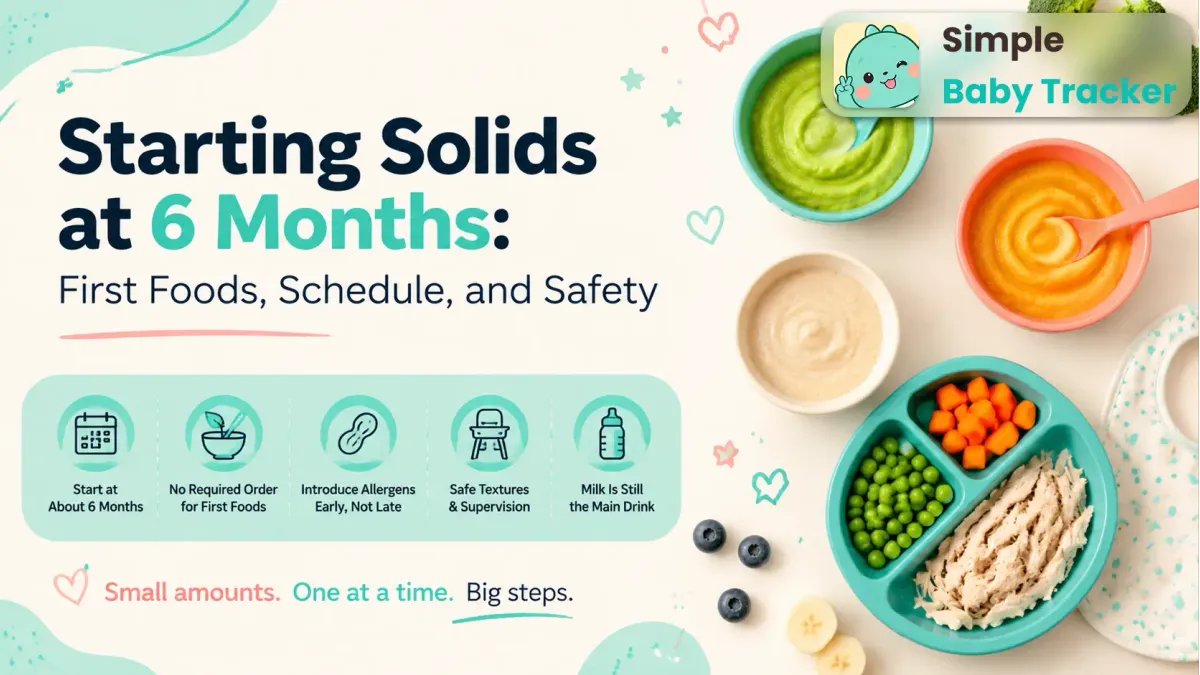
Key Takeaways
- Start solids at about 6 months, not before 4 months, when your baby shows readiness signs like sitting with support and good head control.
- No required order for first foods: by 7 to 8 months aim for variety across vegetables, fruits, meat and proteins, dairy without added sugars, and whole grains.
- Introduce one single-ingredient food at a time, waiting 3 to 5 days between new foods, and include allergenic foods early rather than delaying them.
- Milk stays the main nutrition through year one. Honey, added sugars, high-salt foods, cow’s milk as a drink, and juice all wait.
The short answer
At about 6 months, milk alone stops being enough and your baby is developmentally ready for more. Solids at this stage are called complementary foods for a reason: they complement milk, not replace it. Start with a small amount once a day, build variety week by week, and keep milk feeds going on demand 1.
| Stage | What to offer | How |
|---|---|---|
| About 6 months | Smooth purees: vegetables, fruits, iron-fortified cereals mixed with milk | Small amount, once a day; one single-ingredient food at a time |
| 6 to 7 months | Thicker, lumpier textures plus soft finger foods | Move on from smooth purees as soon as baby copes; let them self-feed with a spoon |
| 7 to 8 months | Variety across all groups: veg, fruit, meat and proteins, plain dairy, grains | New food every few days; allergenic foods included |
| 9 to 12 months | Family foods in baby-safe textures | Milk feeds after solids; variety across all groups |
The timing and method below come from the CDC 2; the day-to-day feeding detail from the NHS 1. The two agree on everything that matters.
When to start: readiness, not birthday alone
The Dietary Guidelines for Americans and the AAP recommend introducing foods other than milk at about 6 months, and introducing them before 4 months is not recommended 2. Every child differs, so confirm readiness first: sitting up alone or with support, head and neck control, opening the mouth when food is offered, swallowing rather than pushing food back out, bringing objects to the mouth, and moving food from the front to the back of the tongue.
MedlinePlus states the same gate from the other side: no solid food until 4 to 6 months, since younger babies cannot digest it well and may choke 3.
First foods: no required order
For most children, foods do not need to come in a certain order 2. By 7 or 8 months, aim for foods from every group: vegetables, fruits, meat or other proteins, dairy without added sugars like plain yogurt and cheese, and whole grains like infant cereals. If you use infant cereals, rotate fortified oat, barley, and multigrain instead of serving only rice cereal, since rice-only diets can raise arsenic exposure 2.
One sequencing tip worth borrowing from the NHS: start with less-sweet vegetables like broccoli, cauliflower, and spinach before the sweet ones. Early exposure to a range of tastes, bitter included, helps prevent fussy eating later 1. Protein foods, meat, fish, eggs, beans, lentils, tofu, suit from around 6 months and bring the iron and zinc babies need. Cow’s milk products like plain yogurt and cheese can come before 12 months; cow’s milk as a drink waits until after.
How to introduce: one at a time, allergens included
Let your baby try one single-ingredient food at a time at first, so you can spot problems like allergies. Wait 3 to 5 days between each new food 2. The NHS phrases the same rule for allergenic foods specifically: introduce them one at a time, in very small amounts, so any reaction is visible 1.
Introduce potentially allergenic foods alongside everything else instead of delaying them: eggs, shellfish, nut butters, and wheat. Serve nuts, peanuts, and seeds crushed or ground, never whole. Once an allergenic food is tolerated, keep offering it as part of the usual diet to minimize allergy risk. One exception: if your child has severe eczema or an egg allergy, talk with your doctor about when and how to introduce peanut foods 2.
Textures: lumpy by 7 months
Start with mashed, pureed, or strained foods that are very smooth. Coughing, gagging, or spitting up at first is normal adjustment, not rejection 2. Then move to thicker, lumpier food as ability develops, offer soft finger foods early for texture experience and hand-eye coordination, and keep offering lumps from around 6 to 7 months even if acceptance takes time. Shop-bought pouches and jars should stay occasional rather than everyday food, squeezed onto a spoon instead of sucked from the pouch. Baby-led weaning and spoon feeding are both fine: there is no single right way, as long as the diet ends up varied 1.
Milk stays the main event
To begin with, your baby still gets most energy and nutrients from breast milk or formula, so keep offering it on demand, as the main drink through the first year. Since a baby’s tummy is tiny and fills fast, offer milk feeds after solids rather than before 1.
At mealtimes, offer sips of water from an open or free-flow cup without a valve: it teaches sipping and protects teeth 1. Our formula feeding chart shows how milk amounts taper as solids rise month by month.
Foods and drinks to avoid
The CDC’s avoid-list for the first year 4:
- Honey before 12 months: it can cause botulism, a severe food poisoning. Not in food, water, formula, or on the pacifier.
- Added sugars: infants and young children have no room for them. Check labels on yogurts, cereals, and snacks.
- High-salt foods: processed meats, some canned foods, salty packaged toddler snacks. Babies’ kidneys cannot handle much sodium.
- Cow’s milk as a drink before 12 months: it risks intestinal bleeding and overloads tiny kidneys with protein and minerals.
- Juice before 12 months: no fruit or vegetable juice at all; after 12 months it is unnecessary, and the AAP caps 100% juice at 4 ounces a day for ages 1 to 3.
- Caffeine before 24 months, high-mercury fish, and unpasteurized milk or juice: all off the table.
- No salt or sugar in cooking either: babies need neither added to food or cooking water 1.
Choking safety
Texture and supervision prevent most scares 5. Cook food to the right shape, size, and texture for your baby’s development, and avoid small, hard, or sticky foods that are difficult to chew and swallow.
At the table: baby sits upright in a high chair, never lying down, crawling, or walking with food. Skip eating in the car or stroller, keep mealtimes calm and unrushed, and watch your child at all times while eating. Foods that most often cause trouble include whole grapes and cherry tomatoes, raw hard vegetables, whole nuts and seeds, spoonfuls of nut butter, hot dogs and sausages, large chunks of cheese or meat, popcorn, hard candy, and marshmallows: cut, mash, or hold these until your child is ready 5. Ask your pediatrician what to do if your child chokes, before you need the answer.
Logging the messy middle
First-food weeks generate questions pediatricians love specifics on: which foods, what reactions, how milk feeds shifted. Jot each new food with its start date and you hold the 3-to-5-day gaps without thinking. Our feeding tracker logs solids alongside milk in one tap, and our guide to what to track in your baby’s first year shows which logs answer the 6-month checkup questions.
Frequently asked questions
When should I start my baby on solids?
At about 6 months, once readiness signs appear, and never before 4 months. Sitting with support, head control, and swallowing rather than pushing food out are the gates.
What are the best first foods?
There is no required order. Vegetables, fruits, meats, plain dairy, and iron-fortified cereals all qualify. Many parents start with vegetables, and rotating cereal grains beats rice-only.
How do I introduce allergenic foods safely?
One at a time, in very small amounts, alongside other foods from around 6 months. Nuts and seeds crushed or ground, never whole. Keep offering tolerated allergens regularly. Severe eczema or egg allergy: ask your doctor about peanuts first.
How much solid food does a 6-month-old need?
Only a small amount once a day to start. Milk remains the main nutrition, so offer milk after solids and build amount and variety week by week.
Can my baby drink water or cow’s milk?
Sips of water from an open cup at meals, yes. Cow’s milk as a drink waits until 12 months, though small amounts in cooking or mixed into food are fine from 6 months.
Do I need to make baby food from scratch?
No. Home cooking, baby-led finger foods, and spoon feeding all work. Shop-bought pouches and jars should stay occasional rather than everyday, squeezed onto a spoon rather than sucked from the pouch.
Disclaimer: This article is for informational purposes only and does not constitute medical advice. Every baby is different. Always consult your pediatrician with questions about your baby’s feeding, growth, or health.
Footnotes
-
NHS, “From around 6 months,” Best Start in Life, modified June 12, 2026. Source ↩ ↩2 ↩3 ↩4 ↩5 ↩6 ↩7 ↩8
-
CDC, “When, What, and How to Introduce Solid Foods,” Infant and Toddler Nutrition, reviewed April 14, 2026. Source ↩ ↩2 ↩3 ↩4 ↩5 ↩6 ↩7
-
MedlinePlus (U.S. National Library of Medicine), “Feeding patterns and diet - babies and infants,” Medical Encyclopedia, reviewed July 1, 2025. Source ↩
-
CDC, “Foods and Drinks to Avoid or Limit,” Infant and Toddler Nutrition, reviewed April 14, 2026. Source ↩
-
CDC, “Choking Hazards,” Infant and Toddler Nutrition, reviewed March 11, 2026. Source ↩ ↩2