

How Much Spit-Up Is Normal? Spit-Up vs. Vomit and When to Call the Doctor
By Simple Baby Tracker Editorial TeamFeeding
How much spit-up is normal by age? The spit-up vs vomit difference, what color and frequency mean, GER vs GERD, and the red flags that need a prompt call.

Key Takeaways
- Spit-up is small (1–2 mouthfuls), effortless, and content — half of young babies do it, and it peaks around 4 months before fading by 12–18 months 12.
- Vomit is forceful, larger-volume, and distressing. The dividing line is effort + mood: easy dribble with a happy baby versus retching with a miserable one 13.
- Color is the fastest triage: milky or clear is routine; blood-streaked, green/yellow bile, or black warrants a prompt call, and forceful vomiting in a 2–8-week-old needs same-day evaluation for pyloric stenosis 134.
- Log frequency, volume, color, and weight trend. Our reflux tracker keeps each episode beside feeds and weight, so the pediatrician sees the pattern — not a 3 AM estimate.
How much spit-up is normal?
More than you think. Spitting up small amounts of breastmilk or formula — 1 or 2 mouthfuls at a time, with no effort or crying — is a normal symptom in half of young babies 1. The AAP describes it plainly: reflux (spit-up, gastroesophageal reflux or GER) is the movement of stomach contents into the esophagus, and sometimes out through the mouth and nose 2.
Why it happens is mechanical, not pathological. The lower esophageal sphincter — the muscle gate between stomach and esophagus — is immature in infants, and babies spend most of their time horizontal with a liquid diet and a small stomach 3. Spit-up is the overflow valve doing its job.
The timeline is predictable and reassuring:
| Age | What to expect |
|---|---|
| Birth–3 months | Frequent small spit-ups after many feeds; half of young babies do it 1 |
| ~4 months | Peak frequency for most babies 23 |
| 6–7 months | Noticeable improvement as babies sit upright and eat solids 23 |
| 12–18 months | Resolved for nearly all babies 23 |

Volume perception is where parents get fooled. A tablespoon of milk spread across a shoulder looks like half the feed. Unless you measure, every spit-up looks enormous. The useful calibration: normal spit-up is 1–2 mouthfuls per episode, effortless, and the baby stays comfortable and keeps gaining weight 1.
If you are still finding the feeding rhythm itself, our newborn feeding guide covers amounts and intervals, and the formula feeding chart by age gives the ounce ranges.
Spit-up vs. vomit: the one-table difference
Parents use both words for everything that comes up. Clinicians do not. The distinction rests on three observables — effort, volume, and mood:
| Spit-up (GER) | Vomiting | |
|---|---|---|
| Effort | None — flows out effortlessly, sometimes with a burp 1 | Retching, gagging, abdominal heaving 13 |
| Volume | Small — 1–2 mouthfuls 1 | Larger — part or most of the feed 3 |
| Baby’s mood | Content before, during, and after 1 | Distressed, crying, uncomfortable 3 |
| Frequency | After many feeds, routine | Less frequent but forceful episodes |
| Weight trend | Steady gain continues 14 | Poor gain or loss is the red flag 34 |
Two edge cases deserve their own names because they change management:
Projectile vomiting — vomit that shoots out forcefully, landing feet away rather than dribbling down the chin. In a 2–8-week-old, especially with hunger right after vomiting and visible stomach ripples, this is the classic picture of pyloric stenosis (a thickened stomach outlet), which needs same-day evaluation and a surgical fix 34. Do not “wait and see” projectile vomiting in a young infant.
GERD — gastroesophageal reflux disease, the point where reflux causes trouble beyond the laundry. True GERD problems occur in less than 1% of infants 5: choking on spit-up, acid heartburn with crying many times a day and visible unhappiness between episodes, blood in spit-up, or poor weight gain 15. Spit-up alone, in a thriving baby, is GER — a plumbing phase, not a disease 23.

Color and frequency: reading what comes up
Color triages faster than any other feature. Memorize this ladder:
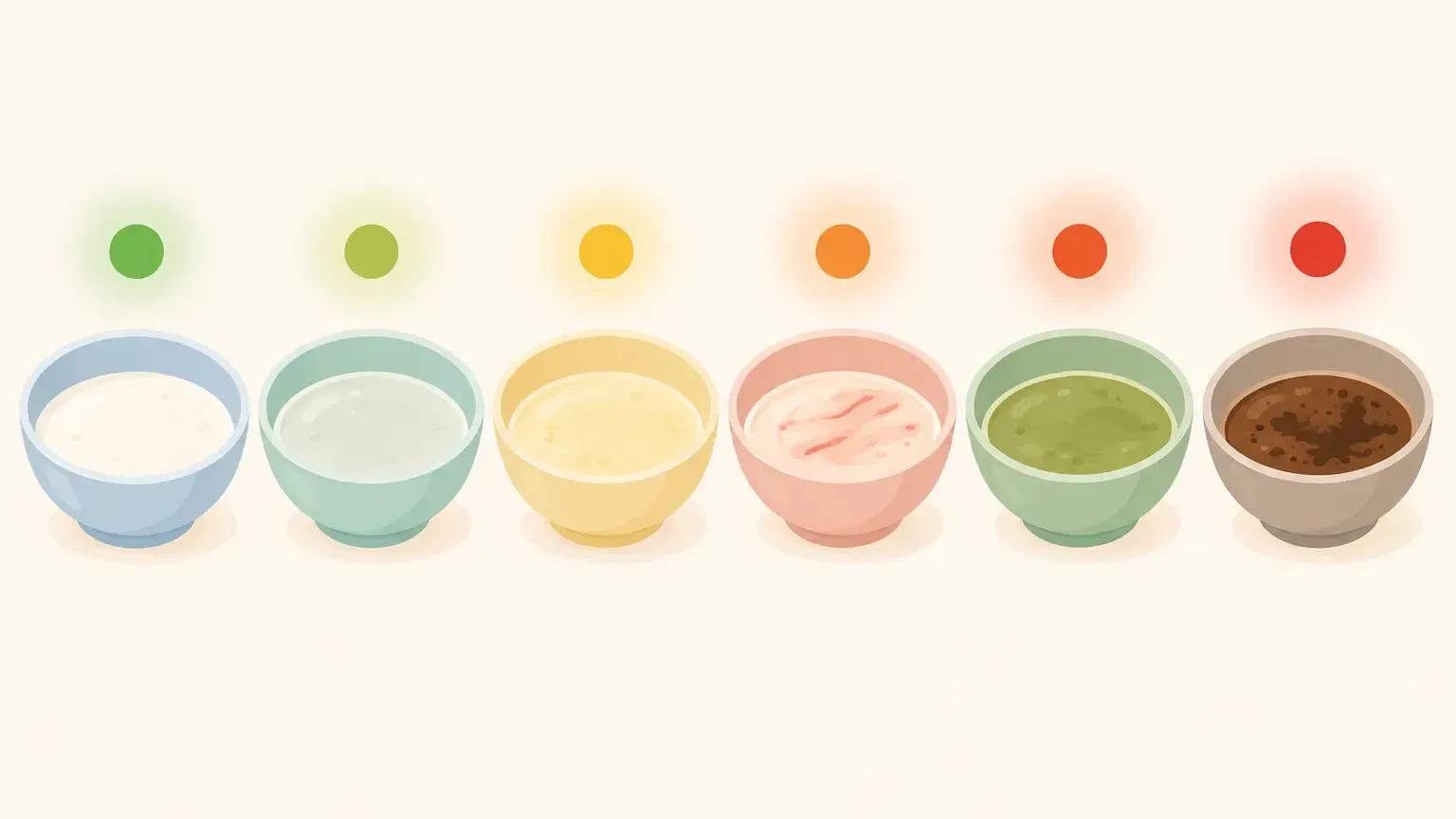
- Milky white / clear. Routine. Fresh milk or curdled milk with stomach acid — both normal 13.
- Yellow-tinged. Usually swallowed mucus or saliva mixed in. Common during colds; by itself, not alarming.
- Blood-streaked or pink. Often a cracked maternal nipple (breastfed) or minor esophageal irritation from frequent spit-up. Small streaks after a difficult feed can wait for the next visit; persistent or larger amounts get a prompt call 14.
- Green / bright yellow bile. Bile means contents from beyond the stomach — the small intestine. Persistent green vomit is never routine and needs prompt evaluation for intestinal blockage 34.
- Dark brown / black (“coffee grounds”). Digested blood. Same-day call 4.
- Red blood, more than streaks. Same-day call 4.
Frequency matters only alongside volume and growth. Daily spit-up after most feeds in a gaining, happy 3-month-old is textbook normal 12. What changes the meaning: spit-up that increases sharply after weeks of stability (possible overfeeding jump, new formula intolerance, or illness), or any frequency paired with poor weight gain, refusal to feed, or distress 13.
Overfeeding is the most fixable amplifier. A baby pushed past fullness spits the surplus — watch for feeding volumes above the age ranges in our formula feeding chart, feeds offered before hunger cues, or a bottle flow so fast the baby gulps air (see our guide to paced bottle feeding).
What actually reduces spit-up (and what does not)
Honest framing first: nothing eliminates normal spit-up; the sphincter matures on its own schedule. These measures reduce volume and frequency:
-
Smaller, more frequent feeds. Less per feed means less to overflow. Keep total daily intake in range — redistribute, do not restrict 13.
-
Burp mid-feed and after. Pausing halfway to release swallowed air leaves more room for milk. Our burp tracker makes the pause a logged habit rather than a forgotten intention.

-
Hold upright 20–30 minutes after feeds. Gravity assists the immature gate. Upright on a shoulder, not a car seat (seated slumping compresses the stomach) 13.

-
Check bottle flow. A nipple that pours rather than drips floods the stomach faster than the gate can manage — size down before changing anything else.
-
Avoid tight diapers and waistbands right after feeds. Mechanical pressure on a full stomach pushes contents up 3.
What does not help, or needs a doctor first:
- Thickened feeds or formula switches without pediatric guidance. Sometimes recommended for GERD, never a DIY first step — the wrong switch trades one problem for another (see our guide to selecting formula).
- Acid medicines for uncomplicated spit-up. Guidelines reserve them for diagnosed GERD with troublesome symptoms, not for laundry-volume reflux 4.
- Cereal in the bottle as a folk remedy. Not recommended without medical direction, and a choking hazard with the wrong nipple 3.
Most spit-up needs no treatment at all — just bibs, patience, and the calendar. It peaks around 4 months and resolves as the baby sits, stands, and eats solids 23.
When to call the doctor
Routine mention at the next visit: frequent spit-up in a thriving, comfortable baby 1. Prompt or same-day call for any of these:
- Projectile vomiting, especially at 2–8 weeks old (possible pyloric stenosis) 34.
- Green/yellow bile vomit that persists 34.
- Blood beyond small streaks, or dark brown/black vomit 4.
- Poor weight gain or weight loss, or consistently refusing feeds 134.
- Distress signals: crying many times a day with unhappiness between episodes, arching, choking on spit-up, chronic cough or wheeze 15.
- Dehydration signs: fewer than 4–6 wet diapers a day, no tears, sunken soft spot, unusual sleepiness.
- Any vomiting with fever, lethargy, bulging soft spot, or a swollen/tender belly — emergency, not a feeding question.
Bring the log, not the laundry. Dated entries — time, approximate volume (mouthfuls vs. most-of-feed), color, forcefulness, mood after, and weight trend — turn “she spits up a lot” into a pattern the pediatrician can act on in seconds. That is exactly what our reflux tracker records beside each feed, with weight in the same timeline via the growth tracker: one shared record every caregiver sees, so night-shift episodes stop vanishing by morning.
Frequently asked questions
How many times a day is normal for spit-up?
There is no number — normal is defined by size, effort, mood, and growth, not count. Small effortless episodes after many feeds in a gaining, happy baby are textbook 1. Frequency alone becomes meaningful only when it spikes after stability or pairs with poor gain or distress.
Does spit-up mean my baby is overeating?
Often, yes, and it is the easiest cause to test. Volumes above the age ranges, feeds before hunger cues, or a too-fast bottle nipple all push surplus up 3. Redistribute into smaller, more frequent feeds and re-check over a few days before suspecting anything else.
Should I switch formula for spit-up?
Not as a first step. Frequent spit-up alone in a thriving baby is GER, not formula failure 2. Talk to your pediatrician before switching — the selection logic in our formula guide applies, and the wrong switch trades spit-up for constipation or worse.
Is spit-up through the nose dangerous?
Usually not — it looks alarming but the nose and mouth connect, so overflow exits both ways. Choking, blue color, or breathing difficulty with spit-up is different: that is a GERD red flag, call promptly 15.
When do babies outgrow spitting up?
Most improve markedly once sitting upright and eating solids (around 6–7 months) and resolve by 12–18 months 23. Spit-up persisting past 18 months, or worsening after improvement, deserves a visit.
Disclaimer: This article is for informational purposes only and does not constitute medical advice. Every baby is different. Always consult your pediatrician with questions about your baby’s feeding, vomiting, growth, or health.
Footnotes
-
AAP (Barton Schmitt, MD, FAAP), “Reflux (Spitting Up),” HealthyChildren.org symptom checker. Source ↩ ↩2 ↩3 ↩4 ↩5 ↩6 ↩7 ↩8 ↩9 ↩10 ↩11 ↩12 ↩13 ↩14 ↩15 ↩16 ↩17 ↩18 ↩19 ↩20 ↩21 ↩22 ↩23
-
AAP, “Gastroesophageal Reflux (GER) & Gastroesophageal Reflux Disease (GERD),” HealthyChildren.org. Source ↩ ↩2 ↩3 ↩4 ↩5 ↩6 ↩7 ↩8 ↩9 ↩10
-
MedlinePlus (U.S. National Library of Medicine), “Spitting up – self-care,” Medical Encyclopedia. Source ↩ ↩2 ↩3 ↩4 ↩5 ↩6 ↩7 ↩8 ↩9 ↩10 ↩11 ↩12 ↩13 ↩14 ↩15 ↩16 ↩17 ↩18 ↩19 ↩20 ↩21 ↩22 ↩23 ↩24 ↩25
-
NICE Quality Standard QS112, “Quality statement 9: red-flag symptoms and suggested actions,” Gastro-oesophageal reflux in children and young people. Source ↩ ↩2 ↩3 ↩4 ↩5 ↩6 ↩7 ↩8 ↩9 ↩10 ↩11 ↩12 ↩13
-
Seattle Children’s Hospital, “Reflux (Spitting Up)” / “Spitting Up – Reflux,” conditions A–Z. Source ↩ ↩2 ↩3 ↩4