

Baby Wake Windows by Age: How Long Your Baby Can Stay Awake
By Simple Baby Tracker Editorial TeamBaby Care
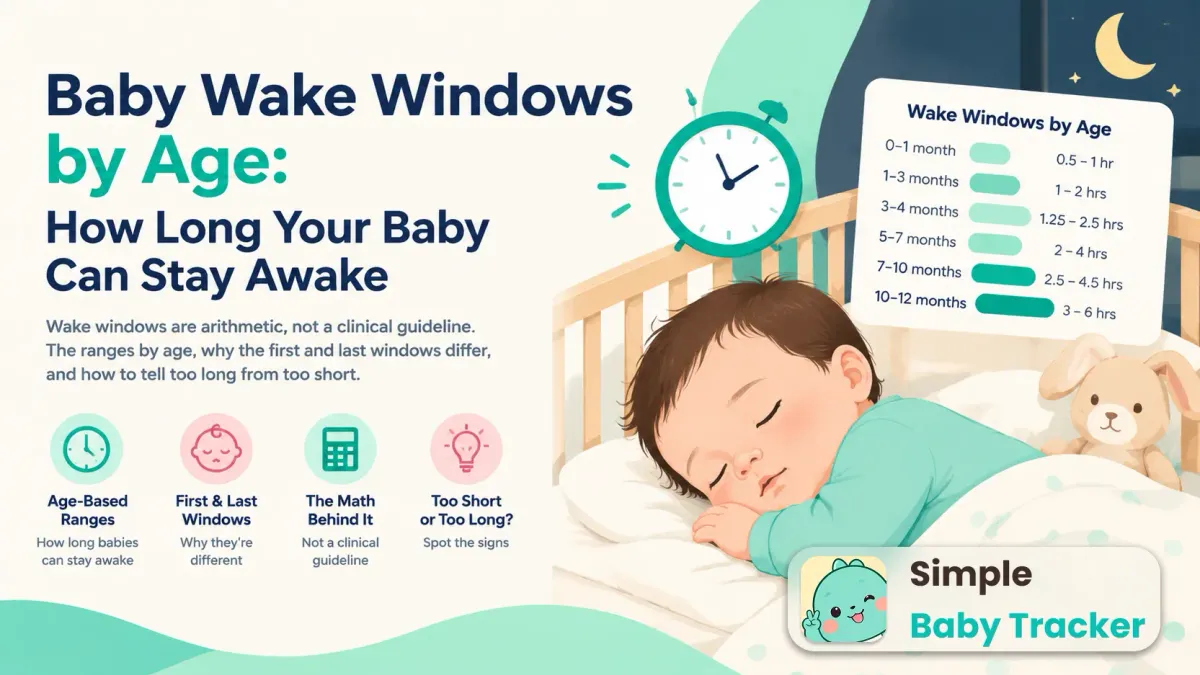
Wake windows are arithmetic, not a clinical guideline. The ranges by age, why the first and last windows differ, and how to tell too long from too short.
Key Takeaways
- A wake window is the time a baby stays awake between sleeps. No guideline or major health publisher gives one: not the NHS, the AAP, NICE, the AASM, or Stanford Children’s 12345.
- The tables in circulation are arithmetic, not research. Take 24 hours, subtract the sleep a baby needs, divide by the number of awake stretches, and you get roughly the published range 67.
- The first window of the day is the shortest and the one before bed is the longest. A single number per age hides that, and the last window is where most bedtime battles start 8.
- The largest dataset, 175,593 infants and 10.7 million logged days, found that total sleep falls because daytime sleep falls. Logged night sleep barely moved between 3 and 18 months 8.
- Newborns are the exception. In the first weeks the clock sometimes tells you to wake a baby for a feed, never to keep one awake 9.
The short answer
A wake window is a scheduling tool, and a useful one, as long as you know what it is. It tells you roughly when a baby is likely to be ready to sleep again. It tells you nothing about health, and it does not describe a requirement.
| Age | Published wake window 7 | Total sleep in 24 hours |
|---|---|---|
| Birth to 1 month | 30 minutes to 1 hour | 16 to 18 hours 21 |
| 1 to 3 months | 1 to 2 hours | 16 to 17 hours early on 3 |
| 3 to 4 months | 1 hour 15 minutes to 2.5 hours | 12 to 16 hours from 4 months 4 |
| 5 to 7 months | 2 to 4 hours | 12 to 16 hours 4 |
| 7 to 10 months | 2.5 to 4.5 hours | 12 to 16 hours 4 |
| 10 to 12 months | 3 to 6 hours | 12 to 16 hours 4 |
Look at the shape of that table. The ranges widen as babies get older, which is the honest part: a 2-hour window at 6 months and a 3-hour window at 6 months can both be right. Note also the gap. The published table jumps from 3 to 4 months straight to 5 to 7 months. Nothing official covers 12 to 18 months, which is one reason parents search for that age range so often.
What a wake window is, and where the term came from
A wake window runs from the moment a baby wakes to the moment they are put down for the next sleep. It includes the feed, the diaper change, the commute, and the twenty minutes of rocking. That last detail matters more than it sounds: if a feed takes 40 minutes and the window is 90, most of the window is gone before anyone has left the chair.
The vocabulary comes from sleep consulting, not from pediatrics. It is convenient shorthand for something real, which is that sleep pressure builds the longer a baby is awake. But the term carries an implied precision that the evidence does not support, and that gap is worth understanding before you build a day around it.
What the guidelines say, and what they leave out
Five sources shape infant sleep advice. None of them mentions wake windows.
- The NHS gives averages and no intervals: around 18 hours for a newborn, around 15 hours at 6 to 12 months, 12 to 15 hours after the first birthday 1.
- The AAP says newborns sleep 16 to 17 hours a day, in stretches of 1 to 2 hours, and that different babies have different sleep needs 2.
- Stanford Children’s Health lists the same totals by age and describes signs of sleep readiness, which are rubbing eyes, yawning, looking away, and fussing 3.
- The American Academy of Sleep Medicine recommends 12 to 16 hours per 24 hours from 4 to 12 months, and 11 to 14 hours from 1 to 2 years 4. It recommends totals, not intervals.
- NICE covers safe sleep in its postnatal guidance and says nothing about awake time or daytime schedules 5.
That silence is not an oversight. A 2017 review of sleep regulation in young children states the position plainly: “There is little experimental evidence that guides sleep recommendations, rather normative data and expert recommendations” 6.
So where do the tables come from? The most widely cited one is published by a hospital system, not a guideline panel, and it gives ranges rather than targets 7. That is a reasonable thing for a clinician to publish. It is a different kind of claim from a vaccination schedule, and it should be held more loosely.
The numbers come from arithmetic, not from research
Here is the calculation nobody puts on the graphic.
Wake time available in a day is 24 hours minus the sleep a baby needs. Divide that by the number of awake stretches, which is the number of naps plus one. The answer is an average wake window.
Take 3 months. The largest infant sleep dataset puts total sleep at 14.8 hours and naps at 3.9 per day 8. That leaves 9.2 hours awake, spread over 4.9 stretches, which is 1.9 hours each.
The published range for 1 to 3 months is 1 to 2 hours 7. So the arithmetic lands near the top of the range, and the table turns out to be a rounded version of the same division.
Two things follow from that.
The formula is more useful than the table. You can run it with your own baby’s numbers. If your 7-month-old sleeps 13 hours and takes 3 naps, that leaves 11 hours awake over 4 stretches, which is 2 hours 45 minutes. If they sleep 14 and take 2 naps, it is 3 hours 20 minutes. Same age, different answer, and both are defensible.
The average is a fiction. A real day is not four equal windows. The first is short, the middle ones are medium, and the last is long. Averaging them produces a number that fits no actual hour of the day.
The first window and the last window are different
This is the part the tables flatten, and it is where most of the frustration lives.
| Moment | What it tends to be | Why |
|---|---|---|
| First window after waking | The shortest of the day | Sleep pressure is at its lowest after a long night 6 |
| Middle windows | Close to the published average | Ordinary accumulation of time awake |
| Last window before bed | The longest, often by an hour or more | Bedtime needs enough pressure to carry the night |
For a 9-month-old on two naps, a day might run 2.5 hours, then 3, then 3.5 to 4. A parent who applies a single “3 hours” to all three will put the baby down too late in the morning and too early at night. That produces a short first nap and a bedtime fight, in that order.
After 12 months the arithmetic stretches further. At 18 months the dataset puts total sleep at 12.5 hours with one nap 8. That leaves 11.5 hours awake over two stretches, or just under 6 hours each, split into something like 5 before the nap and 6.5 before bed. This is why the 18-month bedtime fight is usually a timing problem rather than a discipline problem.
The largest dataset we have
The best evidence on how infant sleep actually changes comes from a 2026 analysis in Sleep Medicine: sleep logs from 175,593 infants, covering 10.7 million days, collected through a tracking app 8.
Its findings are more interesting than a wake-window chart.
| Measure | 3 months | 18 months |
|---|---|---|
| Total sleep | 14.8 hours | 12.5 hours |
| Daytime sleep | 226 minutes | 101 minutes |
| Naps per day | 3.9 | 1.0 |
| Night sleep (derived) | about 11.0 hours | about 10.8 hours |
Read the last row carefully. Across 15 months, total sleep fell by 2.3 hours, and almost all of that came out of the day. Logged night sleep barely changed. The lengthening of wake windows is not a story about babies needing less sleep overall. It is a story about naps disappearing, one at a time.
The study also found that when a nap was dropped, the remaining naps lengthened enough to recover 88 to 89 percent of the lost sleep. The two-to-one transition was less efficient, at 79 percent, which fits what parents report: that stretch is the hardest one.
Two more results worth keeping. Bedtime regularity improved fastest before 9 months, and individual differences in bedtime regularity were highly stable across age, with correlations of 0.73 to 0.77 8. In plain terms, a baby who is regular at 4 months tends to still be regular at 18. And the authors’ own conclusion is a warning against the chart: “Substantial inter-individual variability underscores the importance of individually tailored guidance” 8.
The limits are real. These are parents who chose to log sleep in an app, which selects for organized, engaged, likely well-resourced families. Logs also tend to record consolidated sleep rather than every brief waking. The numbers describe a pattern, not a standard.
Too short or too long: what each looks like
The clock is a starting point. The baby is the instrument.
| If the window is too short | If the window is too long |
|---|---|
| Takes 20 minutes or more to settle, most days | Falls asleep within minutes in the car, stroller, or during a feed |
| Plays happily in the crib instead of winding down | Naps that stop at 20 to 30 minutes |
| Wakes at the 30-minute mark, most naps | Wired, giggly, clumsy, or unusually loud before bed |
| Bedtime becomes a party | Crying that escalates when you try to soothe |
| More night waking, not less |
The too-long column is counterintuitive, and it is the one parents miss. A baby who is past their window often does not look sleepy. They look busy. A baby in that state is harder to settle than one who is merely tired, which is why the fix is usually an earlier nap rather than a longer wind-down.
The overtired spiral, and the cortisol story
You have probably read that an overtired baby releases cortisol, and that cortisol keeps them awake, which makes them more overtired, which releases more cortisol. It is a tidy loop, and it is repeated on hundreds of parenting sites.
Parts of it are solid. Sleep pressure does build with time awake and dissipate during sleep, through a homeostatic process that interacts with the circadian clock 6. Cortisol does rise when a baby is distressed. What is not established is the causal claim in the middle: that cortisol is what prevents an overtired infant from falling asleep. No infant study has shown that.
The observable part is enough to act on. A baby who has been awake past their comfortable limit is harder to settle, and the next sleep is often shorter. You do not need the mechanism to fix the pattern.
What helps, in order:
- Shorten the next window, not the current one. If today went long, put the baby down 20 to 30 minutes earlier for the next sleep.
- Cut stimulation before you cut the routine. Dim the room, stop the play, drop your voice. A tired baby is easily overloaded.
- Feed before the window closes, not after. A hungry baby at the end of a window is two problems at once.
- Do not chase a lost nap into bedtime. If the last nap was skipped and bedtime is 90 minutes away, move bedtime earlier rather than stretching to hit a target.
Why newborns are the exception
Wake windows as a concept do not apply to a newborn in the way they apply to a 6-month-old, and the reason is physiological. Circadian rhythm is not established at birth, and babies do not have regular sleep cycles until around 6 months 23. A newborn’s day is not organized into windows. It is organized into feeds.
In the first weeks, the clock sometimes points the other way. The CDC advises waking a sleepy newborn every 2 to 4 hours to feed, because in the early weeks long gaps between feeds can slow weight gain 9. You will not find a guideline telling you to keep a newborn awake to build sleep pressure, and you should be suspicious of any advice that does.
The numbers: newborns feed 8 to 12 times in 24 hours, and they sleep around 16 to 18 hours 21. Those two facts leave very little room for a schedule, which is why the newborn feeding guide treats on-demand feeding as the default rather than a compromise.
One practical rule for the first three months: never use a wake window to delay a feed or to keep a hungry baby awake. Use it, if at all, only to notice when a baby who has just eaten might be ready to sleep again.
How to use this without a stopwatch
The window tells you when to start watching. The baby tells you when to act.
- Learn the early cues first. Rubbing eyes, yawning, looking away, fussing 3. The first two are early. Fussing is late.
- Give yourself a 15-minute buffer. Aim to start the wind-down 15 minutes before the window ends, not at the end of it.
- Track one thing for a week. Not every minute. Just the time of waking and the time of the next sleep, for the last window of the day, which is the one that most affects bedtime.
- Judge the pattern, not the day. One short nap is noise. Four short naps in a row is information.
- Put the chart down if it is making things worse. If you are clock-watching every ten minutes and arguing about a 20-minute overrun, the tool has stopped helping. The guide to tracking without data anxiety covers that trade-off directly.
If you do want a record, the useful one is start and end times per sleep, kept for a week. That is what a clinician will ask for, and it is impossible to remember accurately. Our sleep tracker logs a sleep in two taps and totals the day, so the pattern is visible without a spreadsheet.
When it is not a wake window problem
Some sleep disruption has a cause that no schedule will fix. If a baby who was settling well suddenly is not, look for these before adjusting windows.
| What you notice | What it might be | What to do |
|---|---|---|
| Waking 20 to 30 minutes after lying flat, arching, or frequent spitting up | Reflux | Discuss with a clinician |
| Waking with a cry, tugging an ear, worse when lying down | Ear infection | Same-day assessment |
| Sudden night waking with a new nap resistance around 3 to 4 months | A developmental sleep reorganization, not a window error | Wait it out; the pattern usually settles |
| Only sleeping while held, waking on transfer | A contact-sleep pattern, not an awake-time problem | Work on the transfer, not the clock |
| Fighting the third nap at 6 to 7 months | Often undertired, and windows need stretching | Add 15 minutes before dropping the nap |
| Loud snoring, pauses in breathing, sweating while asleep | Possible sleep-disordered breathing | Ask a clinician; this is not a schedule issue |
The first two are covered in the spit-up guide and the ear infection guide. Two patterns get mistaken for a wake-window error more than any other, and they have their own guides: the 4-month sleep regression and contact naps. The 3-to-2 nap transition covers the nap drop that really is a timing change.
Frequently asked questions
How long should a newborn be awake between naps?
Thirty minutes to an hour is the usual range in the first month 7. Many newborns are awake only long enough to feed and be changed. That is normal, and there is nothing to stretch.
What is the wake window at 2 months?
Roughly 1 to 2 hours 7. At that age the window is short enough that the feed takes up most of it. For many babies, “awake time” and “feeding time” are close to the same thing.
Is a 2-hour wake window too short for a 6-month-old?
It might be. The published range at 5 to 7 months is 2 to 4 hours, which is deliberately wide 7. If a 6-month-old plays happily for 20 minutes after being put down, the window is probably too short. Stretch it by 15 minutes for a few days and see whether settling improves.
Should the last wake window before bed be longer?
Yes, usually by an hour or more compared with the first window of the day. At 18 months, the arithmetic gives just under 6 hours of awake time per stretch on one nap 8. If bedtime takes an hour, check the length of the last window before changing anything else.
What is the wake window at 18 months?
Around 5 to 6.5 hours, split unevenly, with the longer stretch before bed. No guideline publishes a figure for this age, so it comes from dividing the awake hours in the largest dataset rather than from a recommendation 8.
What happens if my baby’s wake window is too short?
Usually a baby who is not tired enough: playing in the crib, taking a long time to settle, or treating bedtime as playtime. The fix is to add 15 minutes to that window and watch what changes over three or four days, not one.
Disclaimer: This article is for informational purposes only and does not constitute medical advice. Wake windows are a scheduling heuristic, not a clinical standard, and they do not replace attention to feeding cues or your baby’s individual pattern. Talk to your pediatrician about persistent sleep disruption, poor weight gain, breathing pauses during sleep, or a baby who is difficult to rouse.
Footnotes
-
NHS, “Helping your baby to sleep,” accessed October 2026. Source ↩ ↩2 ↩3 ↩4
-
American Academy of Pediatrics, “Sleep,” HealthyChildren.org, accessed October 2026. Source ↩ ↩2 ↩3 ↩4 ↩5
-
Stanford Medicine Children’s Health, “Infant Sleep,” accessed October 2026. Source ↩ ↩2 ↩3 ↩4 ↩5
-
Paruthi S, Brooks LJ, D’Ambrosio C, et al., “Recommended Amount of Sleep for Pediatric Populations: A Consensus Statement of the American Academy of Sleep Medicine,” Journal of Clinical Sleep Medicine, June 2016. Source ↩ ↩2 ↩3 ↩4 ↩5 ↩6
-
Bathory E, Tomopoulos S, “Sleep Regulation, Physiology and Development, Sleep Duration and Patterns, and Sleep Hygiene in Infants, Toddlers, and Preschool-Age Children,” Current Problems in Pediatric and Adolescent Health Care, February 2017. Source ↩ ↩2 ↩3 ↩4
-
Cleveland Clinic, “What Are Baby Wake Windows? And How Long Should They Be?” accessed October 2026. Source ↩ ↩2 ↩3 ↩4 ↩5 ↩6 ↩7
-
Paavonen EJ, de Bie K, “Circadian rhythm maturation in infancy: a large-scale analysis of sleep-wake pattern development from 3 to 18 months based on longitudinal data,” Sleep Medicine, September 2026. Source ↩ ↩2 ↩3 ↩4 ↩5 ↩6 ↩7 ↩8 ↩9
-
CDC, “How Much and How Often to Breastfeed,” Infant and Toddler Nutrition, reviewed April 2026. Source ↩ ↩2