

The 3-to-2 Nap Transition: Signs, Schedules, and How to Get Through It
By Simple Baby Tracker Editorial TeamBaby Care
Most babies drop from three naps to two around 8 to 9 months. How to tell readiness from a bad week, sample schedules for both sides, and how to fix the split nights that come with it.

Key Takeaways
- Most babies fully drop the third nap around 8 to 9 months. Nap-fighting at 6 to 7 months usually means wake windows need stretching, not that the nap should go 1.
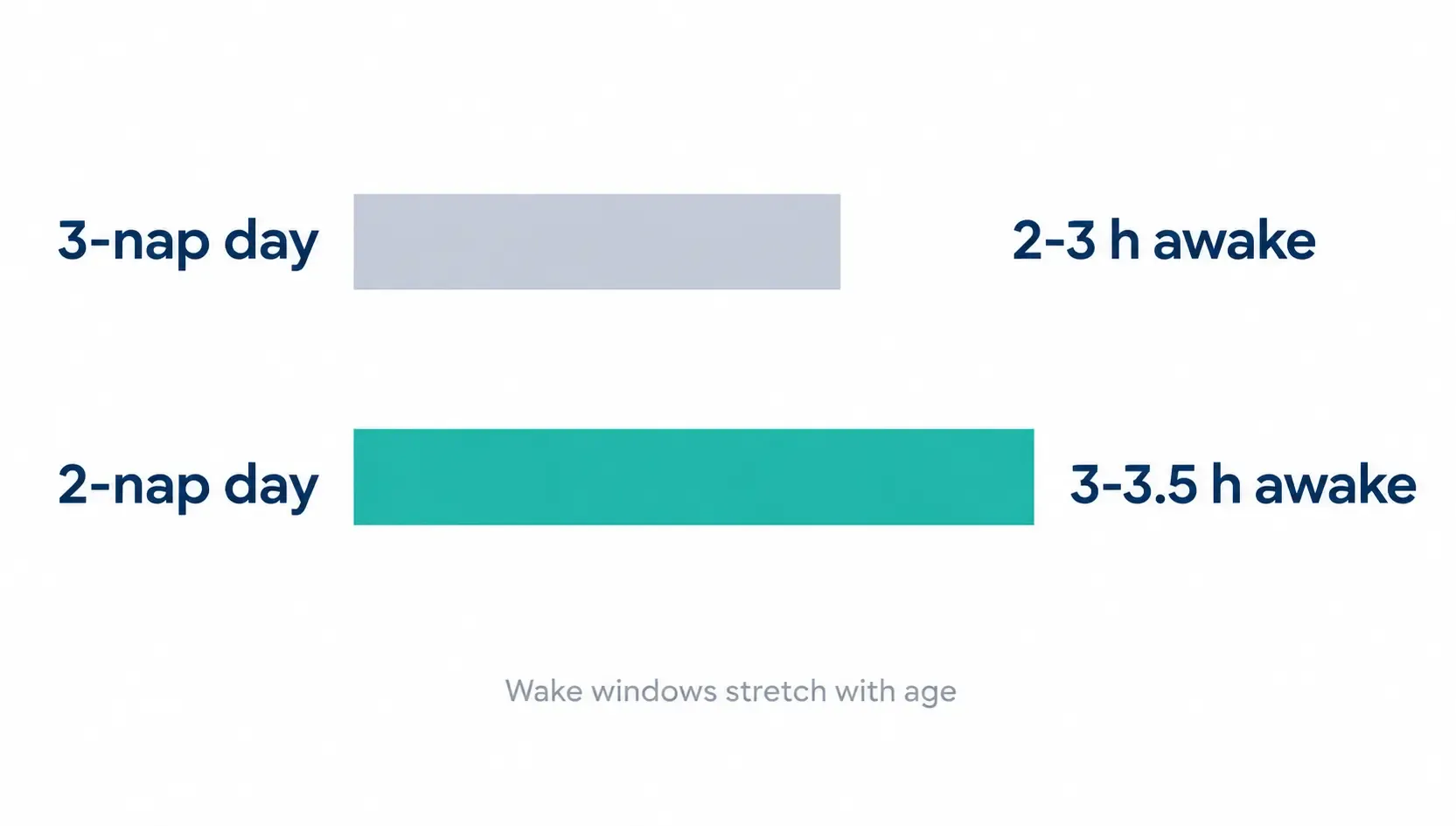
- The maths of the transition: a three-nap day runs on wake windows of 2 to 3 hours, while a two-nap day needs your baby to stay awake about 3 to 3.5 hours at a stretch 23.
- The clearest readiness signal is a pattern, not a day: the third nap skipped for a week, shorter naps, bedtime resistance, and night sleep shrinking below 10 hours on a three-nap schedule 4.
- Actigraphy research confirms the tradeoff is real: in 50 toddlers, longer daytime naps correlated strongly with shorter night sleep (r = −0.57) and later sleep onset 5.
- Expect a messy middle of mixed two-nap and three-nap days for a week or two, with an earlier bedtime covering the gaps — but not earlier than 6:00 PM 6.
Just as three naps start to feel predictable, your baby starts fighting them. The last catnap of the day becomes a 30-minute wrestling match, bedtime slides later, and then — paradoxically — your baby starts waking at night or at 5 AM. Welcome to the 3-to-2 nap transition, the choppiest schedule change between the 4-month sleep regression and the move to one nap.
The good news: this transition is mechanical, not mysterious. Your baby can now stay awake longer, so the day no longer fits three sleeps plus a full night. Once you see that clearly, every decision — stretch, cap, drop, or revert — follows from it.
For the background numbers behind this guide (total sleep by age and how nights consolidate across the first year), see our baby sleep schedule by age. This post covers only the transition itself.
Why this happens now
Total sleep falls steadily across the first year while night sleep grows. Newborns sleep 16 to 17 hours a day in tiny stretches; by 4 to 12 months the recommendation is 12 to 16 hours per 24 hours, including naps 789. Babies do not even have regular sleep cycles until about 6 months 910, which is why the months right after that are prime transition territory: the machinery for consolidated sleep has just come online, and wake windows are lengthening fast.
Cleveland Clinic’s paediatric guidance puts numbers on that stretch: wake windows of 2 to 4 hours at 5 to 7 months, widening to 2.5 to 4.5 hours at 7 to 10 months 3. Somewhere in that widening, three naps stop fitting. The day has only so many hours: three naps plus three to four wake windows plus 10 to 12 hours of night sleep is more sleep than a 12-to-16-hour budget allows 7. Something has to give, and it is the shortest, lightest sleep of the day — the late-afternoon catnap.
That is also why this transition so often looks like a sleep problem first. Before parents change the schedule, the extra daytime sleep comes out of the night instead: shorter nights, long happy wakings at 2 AM, and pre-dawn starts. The schedule is the diagnosis.
When it happens
Most babies are ready to fully drop the third nap by 8 to 9 months 1. The range around that matters: at 6 to 7 months it is very common for babies to start resisting the last nap, but that is more often a sign that wake windows and nap lengths need adjusting than a signal to drop the nap 1. In practice:
- 6 to 7 months: fussing at the third nap usually means stretch the wake windows first. Keep three naps.
- Around 8 to 9 months: consistent nap resistance plus the night-sleep signs below means the transition is on.
- Later than 9 months: some babies hold the catnap longer, especially with early mornings or short naps. No rush — follow the pattern, not the calendar.
One useful threshold: if night sleep has consistently shortened to less than 10 hours on a three-nap schedule, daytime sleep needs are shifting and two naps may restore longer nights 4.
Readiness signs — and what to rule out first
No single bad day means anything. Look for a pattern over 7 to 14 days: the same sign most days despite well-timed offers of sleep. And before you act on any sign, rule out the impostors in the right-hand column — teething, illness, hunger, and the separation anxiety that commonly disrupts sleep from about 6 months 1110 can all mimic readiness for a few days.
| Sign | What it looks like | What to rule out first |
|---|---|---|
| Fighting the third nap | Takes 30+ minutes to fall asleep for the catnap, or skips it outright, most days | Wake windows too short — stretch before-nap awake time first 1 |
| Shorter naps overall | The first two naps shrink instead of consolidating | Overtiredness, hunger, teething discomfort 11 |
| Bedtime resistance | Wired or playful at bedtime despite looking tired earlier | Too much daytime sleep; bedtime too early for the new windows |
| Split nights | Happy and awake for an hour or more overnight, every night or every few | Too many hours in bed for the sleep budget; late third nap 12 |
| Early wakings | Up for the day before 6 AM, rested and cheerful | Bedtime too early; night sleep hitting its ceiling 12 |
| Night sleep under 10 hours | Nights consistently shorter on a three-nap schedule | Short-term disruption (illness, milestones); needs a week of data 4 |
Two or three of these, persisting for a week or more, is readiness. One of them for two days is a bad week — hold the schedule.
Sample schedules: both sides of the transition
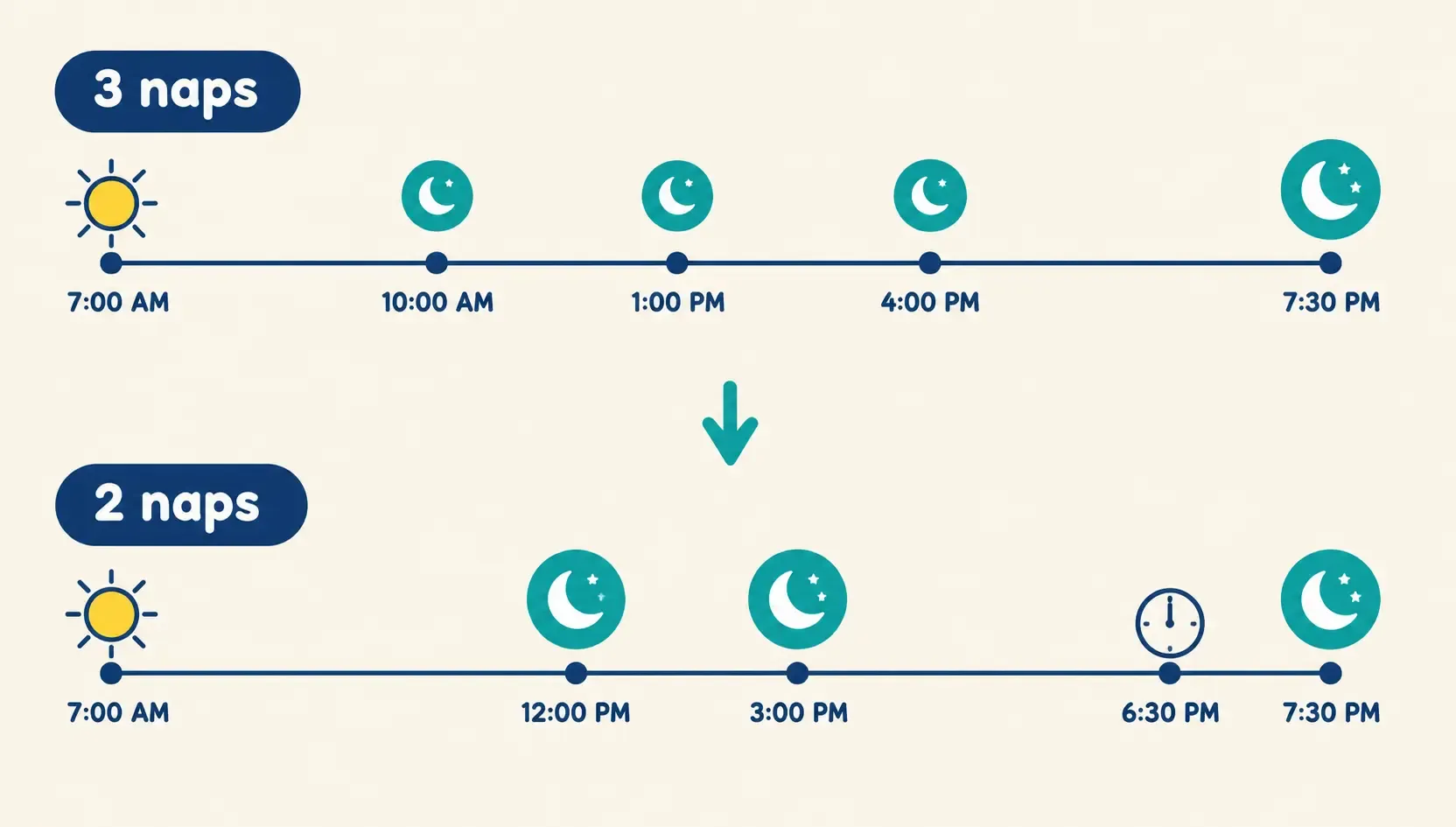
Sleep needs vary by child, so treat these as templates, not prescriptions. Both assume roughly a 7:00 AM wake-up; shift the whole frame to your baby’s natural morning time.
Three naps (before — for a baby around 7 to 8 months) 1:
| Time | Activity |
|---|---|
| 7:00 AM | Wake for the day |
| 9:15–10:30 AM | Nap 1 (about 1.25 hours; ~2.25 hours awake first) |
| 1:00–2:15 PM | Nap 2 (about 1.25 hours; ~2.5 hours awake) |
| 4:45–5:15 PM | Nap 3, short catnap (~30 minutes; ~2.5 hours awake) |
| 8:00 PM | Asleep for the night (~2.75 hours after last waking) |
Two naps (after) 1:
| Time | Activity |
|---|---|
| 7:00 AM | Wake for the day |
| 9:45–11:15 AM | Nap 1 (about 1.5 hours; ~2.75 hours awake first) |
| 2:30–4:00 PM | Nap 2 (about 1.5 hours; ~3.25 hours awake) |
| 7:30 PM | Asleep for the night (~3.5 hours after last waking) |
Notice the three structural changes: naps move later and get longer, wake windows stretch to about 3 to 3.5 hours 2, and bedtime moves earlier — because the day’s last waking is now mid-afternoon instead of early evening. That early bedtime is load-bearing. Protect it.
The step-by-step transition plan
Step 1: Stretch before you drop. Lengthen each wake window by 15 to 20 minutes over several days. Often the third nap starts working again once enough sleep pressure has built — proof your baby was undertired, not ready 16. Only move on if resistance persists on stretched windows.
Step 2: Shrink the third nap, don’t just delete it. Cap the catnap at 30 minutes, or offer it “on the go” — a stroller walk or carrier — so it doesn’t anchor the evening. If your baby falls asleep in a stroller or carrier, the AAP recommends moving them to a flat, firm sleep surface 113. If the catnap still doesn’t happen after about 30 minutes of trying, call it and move bedtime earlier instead.
Step 3: Cover skipped naps with an early bedtime. On any day the third nap is skipped, move bedtime 30 to 60 minutes earlier than usual 6. Aim for no earlier than 6:00 PM — earlier than that tends to seed early wakings rather than prevent overtiredness 6.
Step 4: Shift the remaining naps later, gradually. Move the first nap later by about 15 minutes every few days, letting the second nap slide with it. As the two naps occupy more of the day, the catnap naturally stops fitting while keeping at least 10 hours of night sleep 6. Babies who already stay awake nearly 3 hours before the first nap can often make the quicker switch: push both naps later, drop the catnap, and bring bedtime forward in one move 1.
Step 5: Live in the messy middle for 1 to 2 weeks. A mix of two-nap and three-nap days is normal during the transition. Offering three naps every few days — or one catch-up day a week — helps an easily-overtired baby adjust to the longer windows 6. Once naps settle into their new times, allow a week or more for them to lengthen; consolidation into two longer naps takes time and patience 6.
Troubleshooting: split nights and early wakings
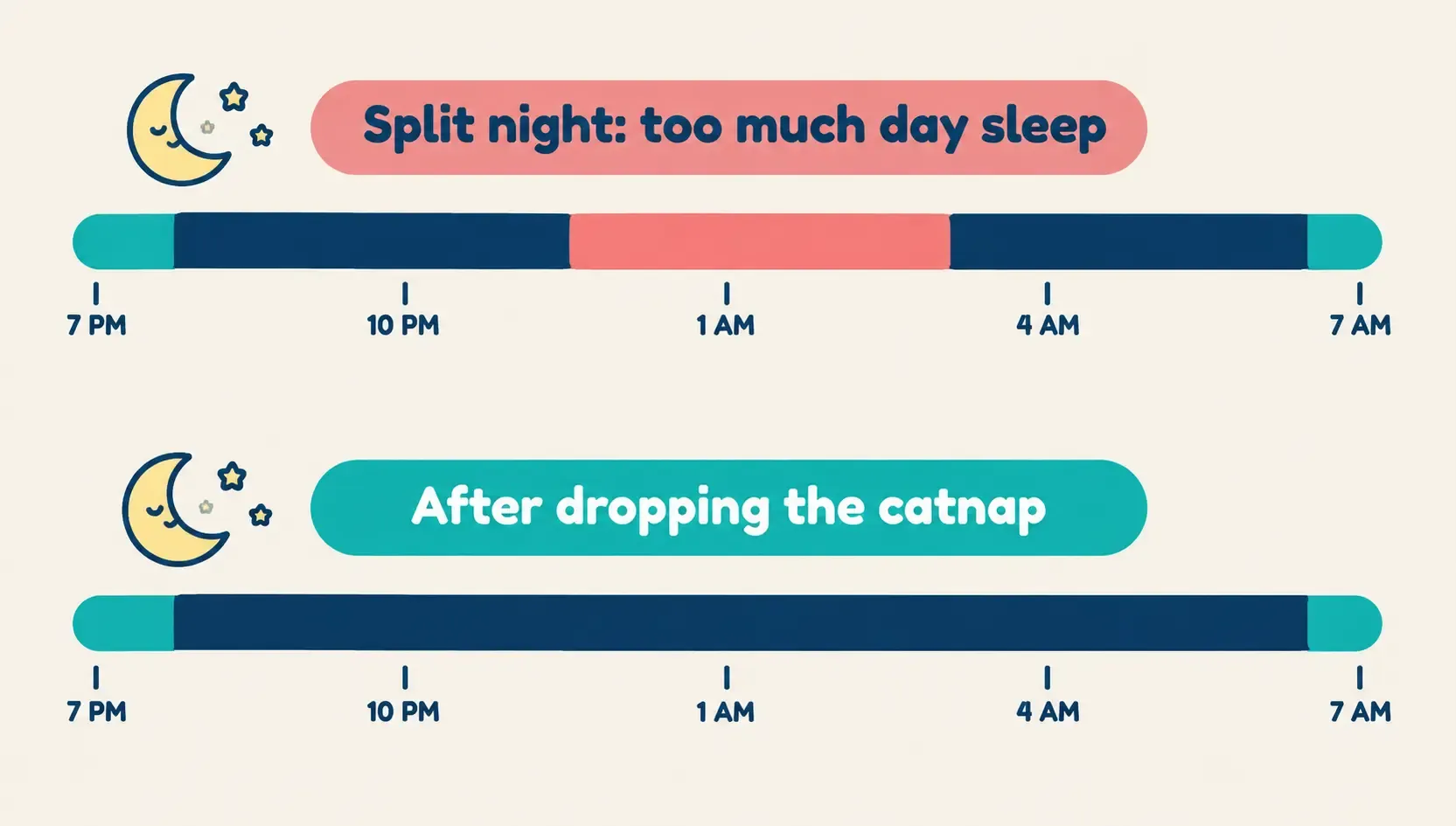
These two are the classic transition side effects, and they share one cause: more time in bed than your baby’s sleep budget can fill. Sleep scientists describe split nights as a split between the two sleep drives — sleep pressure runs out mid-night while the circadian rhythm holds the morning wake time, leaving a cheerful, wide-awake baby at 2 AM 12. No amount of rocking fixes it, because it is biological, not behavioural: the baby can’t sleep, not won’t 12.
If split nights appear:
- Condense the night. This is counterintuitive but central: shift bedtime slightly later and hold a consistent morning wake time (wake the baby if needed) with morning light exposure, which locks in the circadian drive 12. Expect the wakings to persist for a few days — the drives take 4 to 7 days of consistency to merge again 12.
- Fix the day that feeds the night. The most common cause is poor napping plus extra-early bedtimes compounding over several days: each early night works once, but by the third day pressure dissipates mid-night 14. Lengthen naps where you can and stop stacking early bedtimes.
- Check for night disruption. New motor skills (standing, crawling), illness, and stimulating night feeds can also trigger split nights 14. Give new skills lots of daytime practice; keep night interactions dark, brief, and boring.
If early wakings appear:
- First check bedtime: a 6:00 PM bedtime plus 11 hours of night sleep is a 5:00 AM morning. That is maths, not a problem. Nudge bedtime later in 15-minute steps rather than fighting the wake-up.
- The tradeoff runs both directions. Actigraphy data from 50 toddlers found longer daytime naps correlated with shorter night sleep (r = −0.57) and later sleep onset — and, symmetrically, late-ending naps shortened the night too 5. If mornings creep earlier, cap total daytime sleep or end the last nap earlier rather than adding more day sleep.
When to revert to three naps
Dropping the nap and watching everything get worse for more than a few days is information, not failure. Go back to three naps for a few days if:
- Your baby cannot comfortably stay awake 3+ hours and melts down every evening despite a 6:00–6:30 PM bedtime.
- Nights get shorter on two naps, not longer, for over a week.
- Illness, travel, or a burst of teething pain hits mid-transition — disruption mimics unreadiness, so wait it out on the old schedule 11.
- Your baby is under 7 months. Early resistance at this age is usually a window problem 1.
Reverting is normal. Many babies flip between two and three naps for weeks before settling, and the transition often completes in stages rather than on a single day 6.
How logging naps confirms readiness
Memory is a poor instrument for this decision — nobody reliably remembers Tuesday’s catnap timing on Friday night. A written log over 7 to 14 days turns vibes into a pattern: third nap skipped on how many days? Night sleep averaging above or below 10 hours? Bedtime resistance clustering on three-nap days specifically? That is exactly the kind of low-effort, high-signal record a sleep log without the anxiety spiral is for — a few taps, no scoring, just the timeline. And because evenings are usually a two-person operation, a shared record means both parents (or a carer at handover) see the same pattern rather than debating it from memory.
Frequently asked questions
What age do babies go from 3 naps to 2?
Most babies fully drop the third nap around 8 to 9 months, with 6- to 7-month-olds often showing early resistance that usually resolves by stretching wake windows rather than dropping the nap 1. Follow the pattern over a week or two, not the birthday.
Which nap gets dropped?
The third nap — typically a short 30-minute late-afternoon catnap. The remaining two naps spread across the day, get longer, and bedtime moves earlier 1.
How long does the transition take?
Expect a messy middle of mixed two-nap and three-nap days lasting a week or two, plus another week or more for the two naps to lengthen once they settle into their new times 6. Split-night fixes, if needed, take 4 to 7 days of consistent schedule to work 12.
Should I cap my baby’s naps?
During the transition, capping the third catnap at about 30 minutes is standard practice, and capping total daytime sleep can help if nights are shrinking — longer day sleep measurably shortens and delays night sleep 56. Avoid capping the two main naps while they are still consolidating, though; they need the chance to lengthen 6.
What if night sleep gets worse on two naps?
Give it a week, check the two usual culprits (bedtime too early or too late for the new windows, overtired evenings), and revert to three naps for a few days if nights stay shorter rather than longer 6. Also rule out illness, teething, and the separation anxiety that commonly disrupts sleep from about 6 months 1110. If frequent night waking persists for weeks with no settling, talk to your paediatrician.
How early is too early for bedtime?
On skipped-nap days, 30 to 60 minutes earlier than usual is the right cover — but avoid going earlier than 6:00 PM, which tends to create early-waking cycles rather than prevent overtiredness 6. If bedtime keeps landing before 6 PM, that is itself a sign to restore the catnap for a while longer.
Do wake windows really matter more than the clock?
They are the same thing viewed differently. At 7 to 10 months the typical window is 2.5 to 4.5 hours 3, and a two-nap day specifically needs about 3 to 3.5 hours of awake time per stretch 2. Watch your baby’s sleepy cues — rubbing eyes, yawning, looking away, fussing 10 — and check them against the clock. Both together beat either alone.
The short version: stretch first, shrink the catnap second, drop it third — and let an earlier bedtime carry the evenings while the two remaining naps learn to be longer. The data you need is already in your days; write enough of it down to see the pattern, keep nights dark and mornings consistent, and give every change a week before judging it. Then check the pattern alongside feeds and night sleep in your usual sleep record — and if a carer covers bedtime, make sure the plan survives the handover rather than living in one parent’s head.
Disclaimer: This article is for informational purposes only and does not constitute medical advice. Every baby is different. Always consult your paediatrician with questions about your baby’s sleep, feeding, or health.
Footnotes
-
Huckleberry, “How to manage the transition from three naps to two naps,” medically reviewed by Alan Salem, M.D., F.A.A.P. (full drop of third nap by 8–9 months; resistance at 6–7 months usually needs window adjustment, not nap-dropping). Source ↩ ↩2 ↩3 ↩4 ↩5 ↩6 ↩7 ↩8 ↩9 ↩10 ↩11 ↩12
-
Huckleberry, “How to manage the transition from three naps to two naps” (three-nap wake windows typically 2–3 hours; two-nap schedule needs comfortable wakefulness of about 3–3.5 hours at a time). Source ↩ ↩2 ↩3
-
Cleveland Clinic, “What Are Baby Wake Windows? And How Long Should They Be?” (paediatrician-reviewed wake-window table: 5–7 months 2–4 hours; 7–10 months 2.5–4.5 hours). Source ↩ ↩2 ↩3
-
Huckleberry, “How to manage the transition from three naps to two naps” (readiness signs: resisting or skipping naps especially the third, shorter naps, bedtime resistance, early waking and split nights; night sleep consistently under 10 hours on three naps suggests shifting). Source ↩ ↩2 ↩3
-
Nakagawa M et al., “Daytime nap controls toddlers’ nighttime sleep,” Scientific Reports 2016;6:27246 (actigraphy, n=50 toddlers ~1.5 years: nap duration negatively correlated with nighttime sleep duration, r = −0.57, p < 0.001, and positively with sleep onset time; late nap-end time also shortened night sleep). Source ↩ ↩2 ↩3
-
Huckleberry, “How to manage the transition from three naps to two naps” (gradual method: first nap ~15 minutes later every few days; naps take a week or more to lengthen; skipped-nap bedtime 30–60 minutes earlier but no earlier than 6:00 PM; mixed two-/three-nap days normal). Source ↩ ↩2 ↩3 ↩4 ↩5 ↩6 ↩7 ↩8 ↩9 ↩10 ↩11 ↩12 ↩13
-
CDC, “About Sleep,” Sleep and Sleep Disorders (infants 4–12 months: 12–16 hours including naps; newborns 0–3 months: 14–17 hours). Source ↩ ↩2
-
Paruthi S et al., “Recommended Amount of Sleep for Pediatric Populations: A Consensus Statement of the American Academy of Sleep Medicine,” Journal of Clinical Sleep Medicine 2016;12(6):785–786 (infants 4–12 months: 12–16 hours per 24 hours including naps, on a regular basis; based on review of 864 published articles). Source ↩
-
Stanford Medicine Children’s Health, “Infant Sleep” (newborns 16–17 hours per day in 1–2 hour stretches; 4–12 months 12–16 hours; no regular sleep cycles until about 6 months; most babies sleep 6–8 hour stretches from about 3 months). Source ↩ ↩2
-
Stanford Medicine Children’s Health, “Infant Sleep” (night waking often returns at about 6 months as normal separation anxiety; sleep-readiness signs include rubbing eyes, yawning, looking away, fussing; put baby down drowsy but awake). Source ↩ ↩2 ↩3 ↩4
-
NHS, “Helping your baby to sleep” (at 6–12 months some babies sleep around 15 hours, most of it at night; night feeds may no longer be necessary; teething discomfort or hunger may wake babies at night). Source ↩ ↩2 ↩3 ↩4
-
Baby Sleep Science (Erin Flynn-Evans, PhD, MPH), “The ‘Split’ Night” (split nights stem from too many hours in bed separating sleep pressure from circadian rhythm; fix by condensing the night with consistent wake time plus morning light; resolution takes 4–7 days of consistency). Source ↩ ↩2 ↩3 ↩4 ↩5 ↩6 ↩7
-
Stanford Medicine Children’s Health, “Infant Sleep,” summarising AAP safe-sleep guidance (ABCs: alone, back, crib; firm flat surface; room-sharing in a separate bed for at least the first 6 months). Source ↩
-
Baby Sleep Science (Erin Flynn-Evans, PhD, MPH), “The ‘Split’ Night” (two primary causes: poor napping with compounding extra-early bedtimes, and night disruption from motor-skill practice, illness, or stimulating feeds). Source ↩ ↩2