

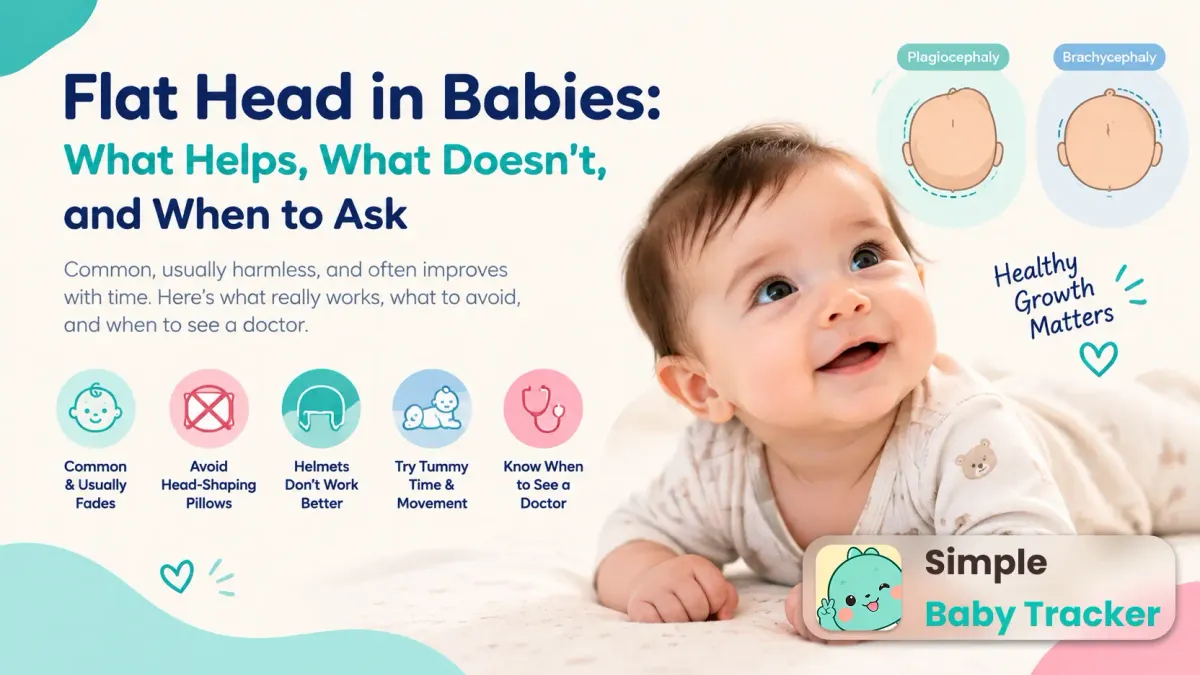
Flat Head in Babies: What Helps and When to Ask
By Simple Baby Tracker Editorial TeamBaby Care
19.7% of babies in one cohort had a flat spot at 4 months, and most fade. What the helmet trial found, why head pillows are risky, and when to ask.
Key Takeaways
- A flat spot is common and usually positional. In a cohort of 200 infants followed from birth, 19.7% had one at 4 months and 3.3% at 2 years 1.
- It is a shape problem, not a brain problem. The AAP describes positional plagiocephaly as “solely an aesthetic condition, with no credible medical evidence suggesting that it affects brain development” 2.
- Head-shaping pillows are sold as the fix, and they have no controlled evidence behind them. Safe-sleep guidance says the sleep surface should be clear of everything but a fitted sheet 3.
- Helmets do less than the marketing implies. In a randomized trial of 84 infants, full recovery was 26% with a helmet and 23% without 4.
- The cause worth treating is a tight neck muscle. About 85% of babies with torticollis have a positional skull deformity, and physical therapy is the first-line treatment 56.
The short answer
Most flat spots are a pressure problem, and pressure problems fade as the baby grows. The skull bones stay soft and movable through the first year. That is why a preferred sleeping position can leave a mark, and why the shape keeps changing after the mark appears. Between 4 and 12 months the head grows fast. The baby learns to roll and sit, and the flattened area spends less time against the mattress 7.
| Age | Share of infants with a flat spot |
|---|---|
| 6 weeks | 16.0% |
| 4 months | 19.7% |
| 8 months | 9.2% |
| 12 months | 6.8% |
| 2 years | 3.3% |
Those figures come from one group of 200 infants in New Zealand, measured from digital photographs against fixed thresholds rather than from a parent’s impression 1. The curve matters more than any single number. It rises to a peak at 4 months, then falls, and no treatment was assigned to anyone in the study.
If you have read that “up to half of babies” get a flat head, that figure is also real, and it is measuring something slightly different. The AAP puts the incidence in 6-month-olds at 20% to 50%, and describes that as an estimate 2. The cohort figure comes from photographs measured against fixed thresholds 1. Neither study set out to reconcile the two.
The useful question is not whether the flat spot is there. It is whether it is positional or something else, and whether anything you do changes where it ends up. On the first question, the AAP’s own guidance to parents is blunt: common positional deformities do not require surgery 5.
What a flat head actually looks like
There are two shapes. They come from different habits, and the ear position is the quickest way to tell them apart 57.
| What you see from above | Plagiocephaly | Brachycephaly |
|---|---|---|
| Outline | Parallelogram, one side flat | Symmetrical, whole back flat |
| Ears | One ear sits further forward on the flat side | Ears level with each other |
| Forehead | May bulge on the flat side | May bulge across the front |
| Usual driver | Head turned to the same side | Long stretches flat on the back |
Look from directly above, with the hair damp and flattened, and compare where the ears sit relative to each other. That top-down view is what a clinician checks, and a phone photo captures it well 5.
About 20% of positional deformities are set before birth, in the womb or during the trip through the birth canal 5. The rest appear in the first 4 to 12 weeks. At that age a baby cannot sit up or turn over, so most of the day is spent on the back of the head 5. Twins and triplets often start with a molded shape because of crowding. Premature babies are more likely again: their skull bones are softer, and hospital time is spent flat 5.
Why it happens now, and why it is not your fault
Babies sleep on their backs, which is exactly what they should do. A soft skull held against a mattress for most of the day will take the shape of that arrangement.
The longer version includes a historical trade. Flat heads became much more common after the 1990s shift to back sleeping, and that shift was right. Supine sleeping reduced deaths from sudden infant death syndrome 3. The flattening was the cost 2. Nobody should be talked out of back sleeping to protect a head shape. The NHS says this outright: do not change your baby’s sleeping position 7.
The same cohort tracked which babies developed a deformity and which did not, and the risk list at 4 months is worth reading closely 1.
| Risk factor at 4 months | What it means in practice |
|---|---|
| Male sex | More common in boys, for reasons that are not fully explained |
| Firstborn | The association is consistent; the reason is not established |
| Limited passive neck rotation at birth | The neck already had a preference on day one |
| Limited active head rotation at 4 months | The preference persisted rather than resolving |
| Supine sleeping at birth and 6 weeks | The recommended position, and the main pressure source |
| Lower activity level | Less self-generated movement to unload the head |
| Unsuccessful attempts to vary head position | Parents tried, and the baby turned back |
Most of those are not choices a parent makes. The seventh is the interesting one. Parents who tried to change the head position and failed had higher risk, which suggests the intent was right and the execution did not take. A baby with a strong rotation preference will often return to the familiar side within minutes. That is why the neck section below matters more than it looks.
The pillow question
Type “flat head baby” into a plain English Google search and the autocomplete box offers a product before it offers a definition. That is one observation, not a study of demand, and it matches what the ranking pages do: product first, explanation second.
Start with the hazard, because it is not theoretical. The AAP’s 2022 safe-sleep guidance says an infant’s sleep environment “should be clear of everything but a fitted sheet.” The surface should be firm, flat and non-inclined, with no other bedding or soft objects 3. The FDA lists pillows and infant positioners among products marketed with SIDS-prevention claims. It says positioners should not be used. The agency also states that it is aware of infant deaths from these products, which commonly include wedges designed to elevate a baby’s head 8.
Then the mechanism. A pillow shaped to cradle the skull is meant to spread pressure away from the flat spot. But the flat spot forms from months of the same contact patch, and a pad under the head changes the surface without changing the habit. It also only operates during sleep, which is the part of the day you have been told, correctly, not to rearrange.
| The claim | What would have to be true | What is actually known |
|---|---|---|
| “Redistributes pressure away from the flat spot” | A soft pad changes where the skull bears weight for hours a night | We found no published controlled study measuring head shape after pillow use |
| “Prevents flat head” | Fewer new flat spots in babies who use one | We found no published controlled comparison; soft objects are what safe-sleep guidance removes 38 |
| “Safe because it is shaped for a baby” | The shape eliminates suffocation risk | Wedges are what the FDA warns about 8; soft objects are what the AAP removes 3 |
The trade is a small nightly risk against an unmeasured benefit. That is a bad trade at any price. It is worse when the thing it is meant to fix usually resolves on its own.
What actually changes the shape
The levers that help are habits, not products.
Tummy time, awake and watched. The WHO recommends at least 30 minutes a day in a prone position for babies who are not yet mobile, spread across the day while they are awake 9. A systematic review pooled 16 articles covering 4,237 infants. Tummy time was positively associated with gross motor and total development, with prevention of brachycephaly, and with the ability to move while prone, supine, crawling and rolling 10. The review found an indeterminate association for plagiocephaly, the lopsided kind. Tummy time still earns its place on development grounds. The back-of-head bald spot guide covers the same pressure problem from the hair side.
Turn the head, not the baby. Alternate which end of the crib the head goes to. Move the mobile to the other side, and approach from the side the baby does not favor. The head still goes down on the back; only the rotation changes 7.
Swap the side you feed and carry on. A baby held on the same arm every day gets the same neck stretch every day. Alternating is free 7.
Cut container time. Car seats, swings, bouncers and strollers all hold the head in one position. The NHS advice is to take the baby out as soon as you arrive rather than letting them finish the nap in the seat 7. If you are still deciding on a car seat setup, the newborn insert guide covers the fit question. A small head slumps when the insert is wrong for the seat.
| Lever | Dose | Strength of evidence |
|---|---|---|
| Supervised tummy time | 30 minutes a day, split into short sessions | Moderate for development and brachycephaly; indeterminate for plagiocephaly 10 |
| Alternating head position at sleep | Every sleep | Low, mechanism is plausible and risk is zero 7 |
| Alternating feed and carry sides | Every feed | Low, same reasoning 7 |
| Less time in seats and swings | As little as the day allows | Low, but consistent with container-time guidance 7 |
None of these has a randomized trial behind it either. The difference is that none of them adds a hazard. They cost nothing, and they help in other ways even when the head shape does not budge.
The neck is the part you can actually fix
Congenital muscular torticollis is a tight or imbalanced neck muscle that holds the head tilted and limits rotation to one side. It is present shortly after birth, and it is the single most useful thing to check. About 85% of babies with torticollis have a positional skull deformity 5. The flattening is the visible symptom of a mechanical problem you can treat.
You can screen for it at home. Lay the baby on their back, keep the shoulders flat on the surface, and turn the chin gently toward each shoulder. One side may stop short, or the baby may arch and resist. Never push past resistance. If one side stops short, stop there and raise it at the next visit rather than repeating the movement at home.
Watch feeding too: a baby who only latches comfortably on one side, or who always faces the window, is showing you the same preference. A head tilt that appears suddenly with a fever is a different problem, and the ear infection guide covers it.
Physical therapy is the first-line treatment. The 2024 clinical practice guideline from the American Physical Therapy Association sets out the stretching and positioning program parents carry out at home, and recommends early referral 6. The NHS refers babies with tight neck muscles to a physical therapist who teaches the exercises 7.
This is also the reason a helmet is not the first question. The trial below excluded babies with torticollis, and a helmet does not loosen a tight neck.
What the helmet trial found
The strongest evidence on helmets comes from a randomized trial published in the BMJ in 2014. It enrolled 84 infants aged 5 to 6 months with moderate to severe skull deformation. Both groups were followed to 24 months 4.
The protocol was a custom helmet for 23 hours a day for six months. Most families stopped earlier: wear ended at a mean age of 10 months 4.
| Outcome at 24 months | Helmet | No helmet |
|---|---|---|
| Full recovery | 26% | 23% |
| Skin irritation | 96% | Not applicable |
| Cost per infant, parallel analysis | €1,401 | €157 |
The difference in the primary outcome was minus 0.2 points on the asymmetry index, with a confidence interval from minus 1.6 to 1.2. The trial had predefined a 4-point difference as clinically meaningful, so the result was null on both counts. Side effects were near universal among helmet wearers. Skin irritation affected 96%, unpleasant odor 76%, and sweating 71%. Seventy-seven percent of parents said the helmet got in the way of cuddling 4.
Three out of four infants in the trial still fell short of the study’s full-recovery threshold at 2 years, in both arms. Helmets are not the difference between a perfect head and a flat one. In this group, most heads stayed slightly asymmetric either way, and parents in both arms reported high satisfaction.
The authors’ conclusion is unusually direct: “we discourage the use of a helmet as a standard treatment for healthy infants with moderate to severe skull deformation” 4. The trial excluded babies with torticollis, preterm birth, and very severe deformity, and it was not powered to prove the two approaches equivalent. A specialist recommending a helmet for a severe case is working outside what this study can answer, and that referral is a different conversation.
When it is not positional
Craniosynostosis is the early fusion of one or more skull sutures, and it affects about 1 in 2,500 babies in the United States 11. It is uncommon, it is treatable with surgery, and it is the reason head shape gets checked at well visits 12. The AAP published a clinical report in 2020 specifically to help clinicians separate the two conditions 13.
| Sign | Positional flattening | Possibly craniosynostosis |
|---|---|---|
| Overall shape | Flat on one side, or evenly at the back | Long and narrow, like a rugby ball |
| Forehead | Mild bulge on the flat side | Pointy or triangular |
| Change over weeks | Responds to position changes | Fixed, or getting more pronounced |
| Soft spot | Closes on its usual schedule | Disappears before the first birthday |
One-sided flattening appears in both conditions. The ear position and the forehead shape are what separate them 13.
Some findings deserve a same-week appointment rather than a wait-and-see 712:
- A head that keeps flattening despite position changes
- A head that looks long and narrow, or a forehead that looks pointy or triangular
- A ridge you can feel over a suture 13
- The soft spot on top closing before the first birthday
- Concern about the size of the head, not just its shape
Most of those will turn out to be positional. The exceptions are the ones where timing matters. A baby who is feeding poorly or hard to rouse needs urgent care for a different reason, and that takes priority over any question about head shape.
Does it affect the brain?
No. This is the question parents ask most quietly, and the answer is clearer than most of the internet suggests. Positional flattening is cosmetic: the skull changes shape, and the brain inside grows normally 57.
The AAP put it more formally when it announced its 2020 clinical report. A baby with a flattened head “can be reassured that this is solely an aesthetic condition, with no credible medical evidence suggesting that it affects brain development or causes any other medical condition” 2.
The helmet trial adds an indirect check. If reshaping the skull improved development, the helmet group should have pulled ahead. It did not. Motor scores on the Bayley scales were 97.2 with a helmet and 99.0 without at 2 years, and the difference was not statistically significant 4.
What is worth tracking
Everything worth tracking fits in a phone note.
Take a photo from directly above once a month, same light, same distance, hair damp. Measure head circumference at every visit and plot it rather than comparing single values. Note which way the head turns when the baby settles, and how many minutes of tummy time actually happened. If a neck preference shows up, note which shoulder stops short.
Our growth tracker keeps head circumference on the same chart as weight and length. That is how a crossing percentile becomes visible instead of being one number in a notebook. The growth chart guide explains what a percentile actually means, and the month-by-month milestones guide covers the head control and rolling that change the pressure pattern.
Frequently asked questions
Will my baby’s flat head correct itself?
Usually. In the cohort that followed infants from birth, 19.7% had a flat spot at 4 months and 3.3% at 2 years, with no treatment assigned 1. The NHS puts the usual timeline at 1 to 2 years 7. “Correct” is doing some work in that sentence: many heads end up slightly asymmetric and nobody notices.
How long does it take to improve?
The fastest change happens between 4 and 12 months, when head growth is rapid and the baby starts rolling and sitting. The cohort’s prevalence fell from 19.7% to 9.2% between 4 and 8 months 1. If nothing has changed by 12 months despite position changes, ask for a review.
Are flat head pillows safe?
No. Safe-sleep guidance says the sleep surface should be clear of everything but a fitted sheet. The FDA also warns that pillows and wedges in a sleep space carry a suffocation risk 38. We found no published controlled evidence that they change head shape, which leaves a nightly risk against a benefit nobody has measured.
When should I see a doctor about head shape?
Make an appointment if the flattening is getting worse despite position changes. The same goes for a head that is not growing along its curve, a head that looks long and narrow, a forehead that looks pointy or triangular, or a soft spot that closes before the first birthday 712.
Disclaimer: This article is for informational purposes only and does not constitute medical advice. Head shape varies widely between babies, and the statistics here describe groups rather than your child. Follow the guidance from your own pediatrician or health visitor. Seek urgent care for a baby who is hard to wake or feeding poorly, and book a visit if the head is not growing.
Footnotes
-
Hutchison BL, Hutchison LAD, Thompson JMD, Mitchell EA, “Plagiocephaly and brachycephaly in the first two years of life: a prospective cohort study,” Pediatrics, October 2004. Source ↩ ↩2 ↩3 ↩4 ↩5 ↩6
-
American Academy of Pediatrics, “AAP Releases Clinical Report: Differentiating Infant Head Shape Abnormalities,” 31 August 2020. Source ↩ ↩2 ↩3 ↩4
-
American Academy of Pediatrics, “Sleep-Related Infant Deaths: Updated 2022 Recommendations for Reducing Infant Deaths in the Sleep Environment,” Pediatrics, July 2022. Source ↩ ↩2 ↩3 ↩4 ↩5 ↩6
-
van Wijk RM, van Vlimmeren LA, Groothuis-Oudshoorn CGM, Van der Ploeg CPB, IJzerman MJ, Boere-Boonekamp MM, “Helmet therapy in infants with positional skull deformation: randomised controlled trial,” BMJ, May 2014. Source ↩ ↩2 ↩3 ↩4 ↩5 ↩6
-
HealthyChildren.org (AAP), “When a Baby’s Head is Misshapen: Positional Skull Deformities,” accessed October 2026. Source ↩ ↩2 ↩3 ↩4 ↩5 ↩6 ↩7 ↩8 ↩9
-
Sargent B, Coulter C, Cannoy J, Kaplan SL, “Physical Therapy Management of Congenital Muscular Torticollis: A 2024 Evidence-Based Clinical Practice Guideline From the American Physical Therapy Association Academy of Pediatric Physical Therapy,” Pediatric Physical Therapy, October 2024. Source ↩ ↩2
-
NHS, “Flat head syndrome (plagiocephaly and brachycephaly),” reviewed 16 January 2026. Source ↩ ↩2 ↩3 ↩4 ↩5 ↩6 ↩7 ↩8 ↩9 ↩10 ↩11 ↩12 ↩13 ↩14
-
US Food and Drug Administration, “Recommendations for Parents/Caregivers About the Use of Baby Products,” accessed October 2026. Source ↩ ↩2 ↩3 ↩4
-
World Health Organization, “To grow up healthy, children need to sit less and play more,” 24 April 2019. Source ↩
-
Hewitt L, Kerr E, Stanley RM, Okely AD, “Tummy Time and Infant Health Outcomes: A Systematic Review,” Pediatrics, June 2020. Source ↩ ↩2
-
Centers for Disease Control and Prevention, “Craniosynostosis,” accessed October 2026. Source ↩
-
NHS, “Craniosynostosis,” reviewed 25 July 2023. Source ↩ ↩2 ↩3
-
Dias MS, Samson T, Rizk EB, Governale LS, Richtsmeier JT; Section on Neurologic Surgery, Section on Plastic and Reconstructive Surgery, “Identifying the Misshapen Head: Craniosynostosis and Related Disorders,” Pediatrics, September 2020. Source ↩ ↩2 ↩3