

Why Is My Baby Losing Hair? Bald Spots Explained (2026 Guide)
By Simple Baby Tracker Editorial TeamBaby Care
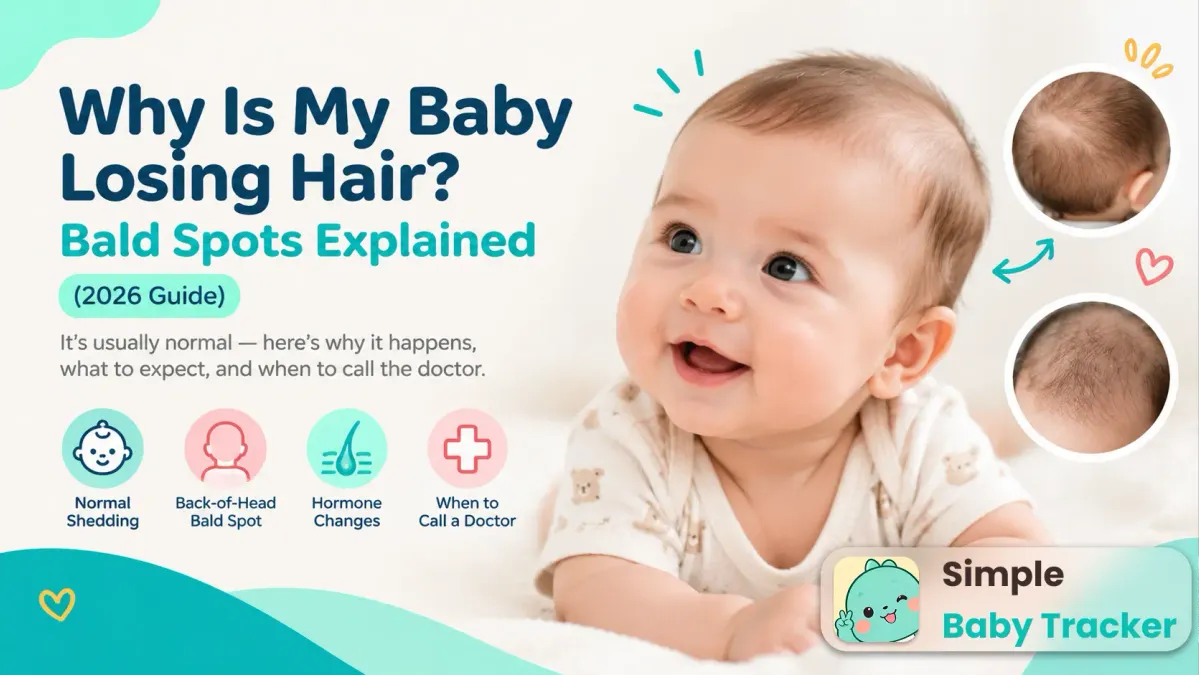
Most newborn hair loss is normal — shedding peaks around 3 months and regrows by 6 to 12 months. Here's why it happens, back-of-head bald spots, and when to call the doctor.
Key Takeaways
- Almost all newborns lose some or all of their hair; it is normal and expected, with shedding peaking around 3 months and regrowth between 6 and 12 months 12.
- The back-of-head bald spot is friction alopecia from lying supine — it grows back once the baby sits up; back sleeping stays non-negotiable 23.
- Hormone withdrawal drives newborn shedding: maternal hormones fade around 3 months and take head hair with them; it grows back within weeks 4.
- Call the doctor for scaly/red patches with hair loss (possible ringworm), no regrowth by 12 months, or sudden patchy loss with broken hairs 256.
Short answer: it falls out, then it grows back
“Almost all newborns lose some or all of their hair. This is normal and to be expected,” states the American Academy of Pediatrics 1. The baby hair of many newborns falls out during the first 6 months, peaking at 3 months, and is replaced by permanent hair that comes in between 6 and 12 months 2. Mothers often shed some hair at the same time — same hormonal trigger, different head 2.
So the default assumption for a balding 2-month-old is: biology, not disease. The rest of this guide covers the three normal patterns, then the exceptions that deserve a call.
Why newborn hair falls out
Hormone withdrawal. In the womb, the baby rides on the mother’s hormones, which keep hair in its growth phase. After birth that supply fades; around 3 months of age the maternal hormones are gone, and sometimes they take head hair along with them 4. Cleveland Clinic’s pediatrician notes the hair grows back within weeks — the follicles aren’t damaged, they’re just resetting 4.
The newborn hair cycle. Babies are born with soft lanugo or fine early hair that is physiologically scheduled to shed. The shedding phase in newborns is always normal, and this baby hair is then replaced by permanent hair 2. The European Academy of Dermatology’s pediatric task force adds useful nuance: the fetal hair cycle runs on its own synchronized clock, which is why the occipital (back-of-head) patch appears even in babies whose positioning doesn’t explain it — they propose the term “transient neonatal hair loss” for this physiological shedding 7.
Newborns vary enormously at baseline. About 30% of neonates are born with very thin hair and may look bald; others arrive with a full head. Both are normal, and neither predicts adult hair — some hairy newborns end up with sparse adult hair and vice versa 7. Hair color commonly changes too: pale infant hair often pigment later, and texture shifts during the first 6 to 9 months as thin early hair converts to normal infantile hair 7.
The back-of-head bald spot
The classic: a clean oval worn smooth at the occiput, showing up around 3 to 6 months. The standard explanation is friction — head-turning against crib mattresses, playpens, and infant seats rubs the patch bare 23. (The EADV leaflet notes the physiology runs deeper than friction alone, but the appearance, timing, and outcome described are the same 7.)
What to do:
- Nothing about sleep position. Back sleeping is the only safe sleep position; never change it to save hair 4. The spot fades once the baby rolls, sits up, and spends less of the day supine — regrowth typically completes within 6 to 12 months of sitting 23.
- More supervised tummy time after 1 month. It builds shoulder strength, rounds out the head, and incidentally unloads the bald patch — always under adult supervision 23. The flat head guide covers the skull-shape side of the same pressure problem.
- Call if hair doesn’t grow back within 6 months after the baby learns to sit 23.
Friction alopecia isn’t only a baby phenomenon — repeated severe friction can cause hair loss at any age — but in infants it is near-universally benign and self-resolving 2.
Lanugo: the all-over newborn fuzz
Separate from scalp hair: lanugo, the soft fine coating grown in utero to anchor vernix (the protective waxy layer that keeps the fetus warm, hydrated, and shielded from amniotic fluid) 4. Most fetuses shed it before 36 to 37 weeks, which is why it shows mostly on preterm babies — and why very preterm babies keep it longest, until they approach full-term development 4.
It falls out within a few weeks after birth. No care needed beyond gentle bathing with an infant cleanser — and never attempt hair removal on a baby; newborn skin is far too sensitive 4.
Tight hairstyles: the preventable cause
Once hair grows in, tension becomes the enemy. Tight braids, ponytails, cornrows, and dreadlocks break hairs at the hairline — traction alopecia, also called mechanical alopecia 23. The peer-reviewed pediatric review adds the diagnostic details: look for the “fringe sign” (retained rim hairs) and follicle tenting, with early perifollicular redness progressing to permanent scarring if traction continues 6.
The fix is simple: loosen or change the style. If tight styles are avoided, hair returns to normal; if tight braiding continues for years, the loss can become permanent 2. Cleveland Clinic’s guidance is blunter for babies: use a soft headband for styling, avoid tight hairstyles on a sensitive infant scalp 4.
Red flags: when hair loss needs a doctor
Most shedding is benign, but these patterns are not “wait and see”:
- Scaly, red, or itchy patches with hair loss — the main cause of patchy loss needing medical treatment is scalp ringworm (tinea capitis), treated with oral antifungal medication 235. Seattle Children’s lists ringworm suspicion (round patch with scales, redness, itching) as a call-during-office-hours trigger 3.
- Swollen, pus-filled boggy plaques (kerion) — an inflammatory reaction to the fungus; needs prompt care and can scar without treatment 56.
- No regrowth by 12 months for general newborn shedding 2, or chronic unexplained patchy/thinning loss 3.
- Red, very swollen scalp in the area of loss — contact the doctor within 24 hours 3.
- Smooth, sharply defined bald patches with “exclamation mark” hairs — the classic picture of alopecia areata, an autoimmune cause that a pediatrician or dermatologist should evaluate 6.
- Hair loss plus odd nails, strange teeth, or family skin disorders — possible genetic hair conditions worth a dermatology referral 7.
The broad pediatric review emphasizes that most childhood alopecia is non-scarring (tinea capitis, alopecia areata, telogen effluvium, traction), but tinea and chronic traction can scar if left untreated — another reason scaly or tense-style patches shouldn’t wait 6.
How tracking helps
Hair changes are slow — exactly the kind of thing memory misjudges. A monthly photo in your baby log turns “is it getting worse?” into a side-by-side answer, and gives the pediatrician a timeline if a red-flag pattern appears. Note the date the shedding started, where (all-over vs. occipital patch vs. defined spots), and any scalp symptoms alongside. Shared via the family code, both parents watch the same regrowth — and our tracking without data anxiety guide keeps the habit to seconds.
Frequently asked questions
My 2-month-old was born with lots of hair and now it’s falling out in clumps. Normal?
Yes — the classic course. Shedding peaks around 3 months and permanent hair comes in between 6 and 12 months 2. Clumps on the sheet are alarming but routine.
Will the bald spot on the back of her head go away?
Yes, once she sits up and spends less time supine — allow 6 to 12 months after sitting 23. Keep back sleeping; add supervised tummy time.
Should I shave my baby’s head to make hair grow thicker?
No evidence behind this tradition. The shedding cycle runs on hormones and follicle timing, not on what’s cut above the scalp 27. Gentle handling beats shaving.
My baby’s new hair is a different color and texture. Is that normal?
Completely. Color, amount, distribution, and texture all commonly change across the first year; pale hair often pigments later 7.
When do I call vs. wait?
Wait: diffuse shedding under 6 months, occipital bald spot, no scalp symptoms. Call: scaly/red/itchy patches, swelling or pus, sharply defined smooth patches, or no regrowth by 12 months 2356.
Disclaimer: This article is for informational purposes only and does not constitute medical advice. Always consult your pediatrician or a pediatric dermatologist about your baby’s hair loss or scalp changes.
Footnotes
-
HealthyChildren.org (AAP), “Hair Loss (Alopecia) in Children,” by Keri Wallace, MD, FAAP. Source ↩ ↩2
-
Children’s Hospital Colorado, “Hair Loss” (Schmitt Pediatric Guidelines). Source ↩ ↩2 ↩3 ↩4 ↩5 ↩6 ↩7 ↩8 ↩9 ↩10 ↩11 ↩12 ↩13 ↩14 ↩15 ↩16 ↩17 ↩18 ↩19
-
Seattle Children’s Hospital, “Hair Loss” (Schmitt Pediatric Guidelines, reviewed 2025). Source ↩ ↩2 ↩3 ↩4 ↩5 ↩6 ↩7 ↩8 ↩9 ↩10 ↩11 ↩12
-
Cleveland Clinic, “Why Is My Baby Hairy? Newborn Body Hair Explained,” Apr. 2024. Source ↩ ↩2 ↩3 ↩4 ↩5 ↩6 ↩7 ↩8
-
Cleveland Clinic, “Tinea Capitis: Symptoms, Causes & Treatment.” Source ↩ ↩2 ↩3 ↩4
-
Xu L, Liu KX, Senna MM, “A Practical Approach to the Diagnosis and Management of Hair Loss in Children and Adolescents,” Frontiers in Medicine, 2017. Source ↩ ↩2 ↩3 ↩4 ↩5 ↩6
-
EADV Pediatric Dermatology Task Force, “Hair in the neonate,” Patient Information Leaflet, 2019. Source ↩ ↩2 ↩3 ↩4 ↩5 ↩6 ↩7