

When to Remove the Newborn Insert From a Car Seat
By Simple Baby Tracker Editorial TeamBaby Care
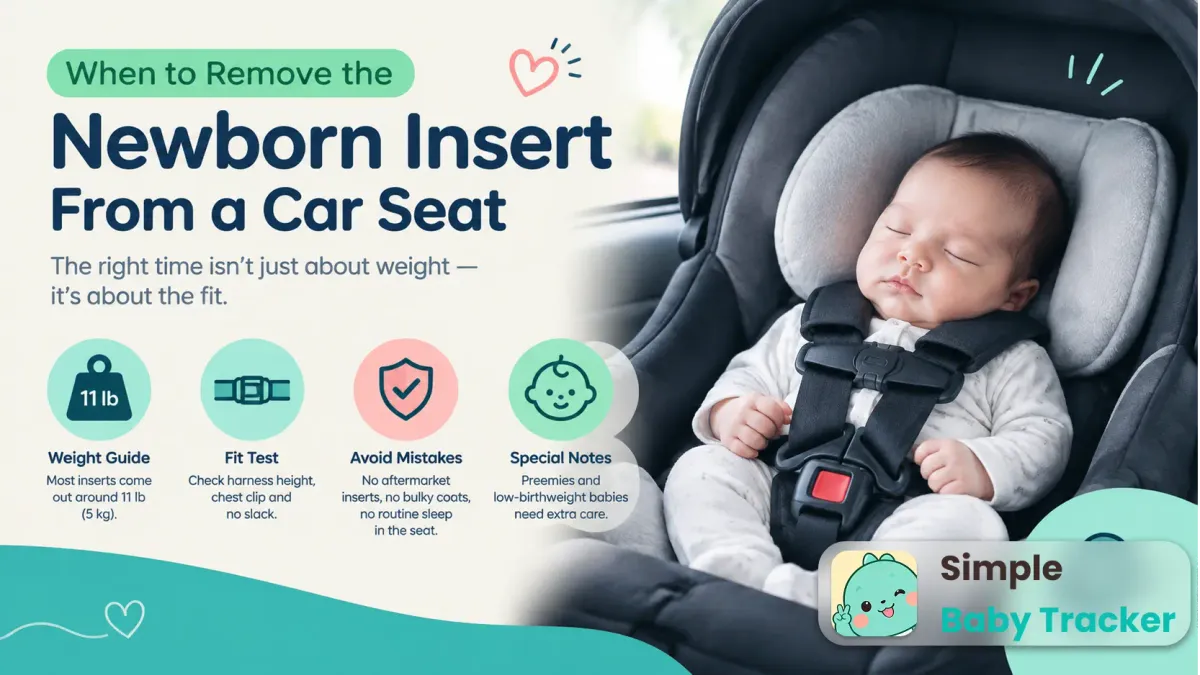
Newborn inserts are sized-out, not aged-out: most come out around 11 lb, but the fit test decides. Brand-by-brand thresholds, the harness check, and the mistakes to avoid.
Key Takeaways
- Most infant-seat inserts come out at about 11 lb (5 kg) — Nuna, UPPAbaby, Chicco and Doona all name that number — but the fit test overrules the scale 1234.
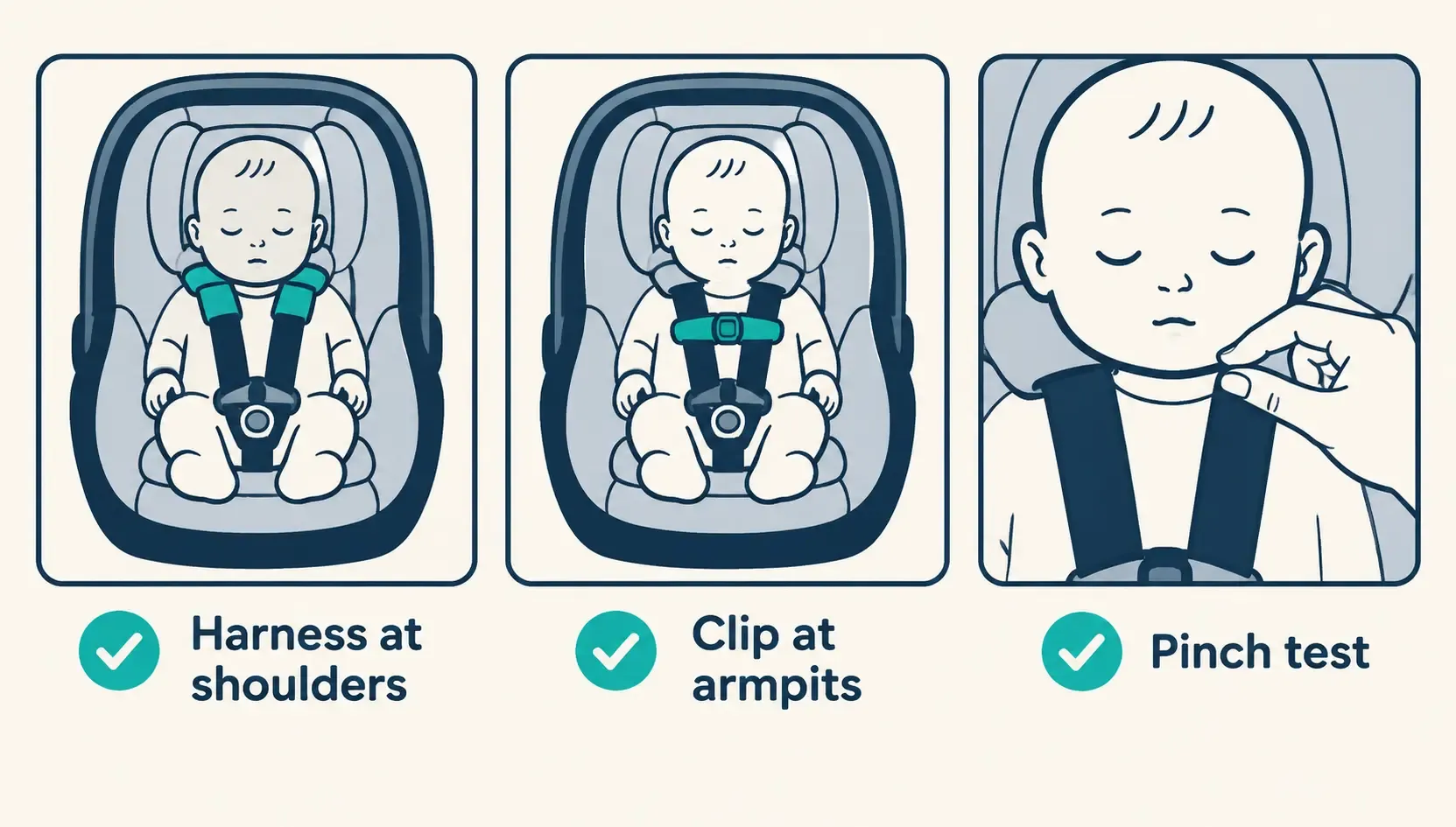
- The fit test is three checks: harness straps at or just below the shoulders, chest clip level with the armpits, and no pinchable slack in the strap 56.
- Some brands give no weight number at all. Graco ties its body pillow to the bottom two harness slots, and Evenflo calls its pillows optional support — in both cases fit decides 56.
- Never add an aftermarket insert. Every manual forbids padding the maker did not test, and misuse is common: an estimated 46% of car seats and boosters are misused 756.
- A car seat is for travel, not routine sleep. In a 10-year study of 11,779 sleep-related infant deaths, 348 (3%) occurred in sitting devices 8.
The newborn insert is the padded cocoon that makes a big car seat fit a tiny baby. It narrows the seat, lifts the baby so the harness sits correctly, and keeps a floppy head from tipping forward over the airway.
It is also temporary, and leaving it in too long is as wrong as taking it out too early. An insert that no longer fits bunches the harness, pushes the baby’s head forward, and adds slack exactly where crash forces travel. The rule most parents want — one age, one weight — does not quite exist, because the answer is split between the manual’s number and the baby’s body. This guide gives you both.
The background rule is worth stating first: the American Academy of Pediatrics recommends children ride rear-facing as long as possible, until they reach the highest weight or height allowed by their seat’s maker — a policy reaffirmed in February 2025 910. The insert question sits inside that rule. The seat stays rear-facing; only the extra padding comes out.
Why the insert exists at all
An infant car seat is certified for babies from about 4 lb, but a 4-pounder and an 11-pounder are very different passengers. Federal standard FMVSS 213 sets design and crash-performance requirements for the seat itself, yet it specifies no minimum occupant weight and does not address the special needs of preterm or low-birthweight infants 6. The insert bridges that gap: extra positioning support, crash-tested with that specific seat, for the smallest occupants.
That last clause is doing the heavy lifting. The insert is part of the seat’s tested system. Graco’s manual warns against using accessories or parts other than those provided by Graco, saying their use could alter the performance of the seat 5. Evenflo’s manual says the same thing more bluntly: do not attach additional padding, toys or other devices not made by Evenflo, because items not tested with the restraint could injure the child 6. Anything a third party sells to “improve” the fit — strap covers, head pillows, seat liners — was never in the crash test. If it did not come in the box or from the maker’s parts store, it does not go in the seat.
The short answer: about 11 lb, confirmed by fit
For four of the six big infant-seat brands, the manual names a number, and it is the same number: 11 lb (5 kg), roughly the size of a 2- to 3-month-old. Doona even adds the age gloss itself, describing its insert as lasting from birth up to 11 lb / 5 kg (approx. 3 months) 4.
But weight is the proxy, not the test. Nuna’s wording is the clearest statement of the real rule: the low-birthweight pillow must be removed “once a snug fit can be achieved without it,” at approximately 11 lb 1. Read that twice. The scale tells you when to check; the fit tells you when to act. A long, lean 10-pounder with good head control may pass the fit test before the number, and a small 12-pounder may still need the support. The number gets you to look. The three checks below make the decision.
The fit test: three checks, every ride
These checks come straight from the manuals, and they apply with or without the insert in place.
1. Harness height. Rear-facing straps must sit at or just below the child’s shoulders — never above. Graco states it plainly (“at or just below”), and Evenflo prints the same instruction beside its harness diagram 56. If removing the insert drops the baby so the straps sit above the shoulders, the insert goes back in.
2. Chest clip position. The retainer clip sits level with the armpits — Graco’s checklist reads “Chest Clip Even With Armpits,” and Evenflo diagrams it as “place at armpit level” 56. A clip on the belly lets the straps slide off the shoulders; a clip at the neck presses on the throat.
3. The pinch test. Tighten the harness, then try to pinch a fold of webbing at the collarbone. Graco’s version: if your fingers slide off the straps without pinching them, the harness is tight enough 5. Evenflo-equipped seats add the visible counterpart: the harness must lie snug and flat, with the top of the head at least 1 inch (25 mm) below the top of the seat back 6.
Run all three after removing the insert. If any one fails, the insert (or at least part of it — see the staged-removal note below) stays.
Brand-by-brand removal thresholds
This is the table to bookmark. Every number below comes from the maker’s own manual or product page — not from a forum, not from a retailer listing.
| Brand | Seat | Remove the insert at | Source |
|---|---|---|---|
| Nuna | PIPA series | Low-birthweight pillow out at 11 lb, once a snug fit works without it (same 11-lb rule in the PIPA urbn manual); head and body supports used “as necessary” for small babies | Nuna insert manual 111 |
| UPPAbaby | Mesa / Mesa Max | Infant insert designed for 4–11 lb (1.8–5 kg) | Mesa Max manual 2 |
| Chicco | KeyFit 30 | Removable head and body positioner for newborns weighing 4–11 lb | Chicco product page 3 |
| Doona | Doona / Doona+ | Infant insert from birth up to 11 lb / 5 kg (approx. 3 months) | Doona spare-parts page 4 |
| Graco | SnugRide 35 | No weight given — body pillow used with the bottom two harness-slot sets only; remove by pulling it from behind the straps | SnugRide 35 manual 5 |
| Evenflo | LiteMax series | No weight given — optional head and body pillows “used to help support your child”; use only Evenflo-made parts | LiteMax manual 6 |
Two patterns matter here. First, the 11-lb consensus covers most of the market, so if your seat is a Nuna, UPPAbaby, Chicco or Doona, that number is your check-engine light. Second, Graco and Evenflo deliberately give no number — the harness-slot rule (Graco) and the snug-fit rule (Evenflo) replace it. For those seats, a baby who has outgrown the bottom slots has outgrown the pillow, whatever the scale says 56.
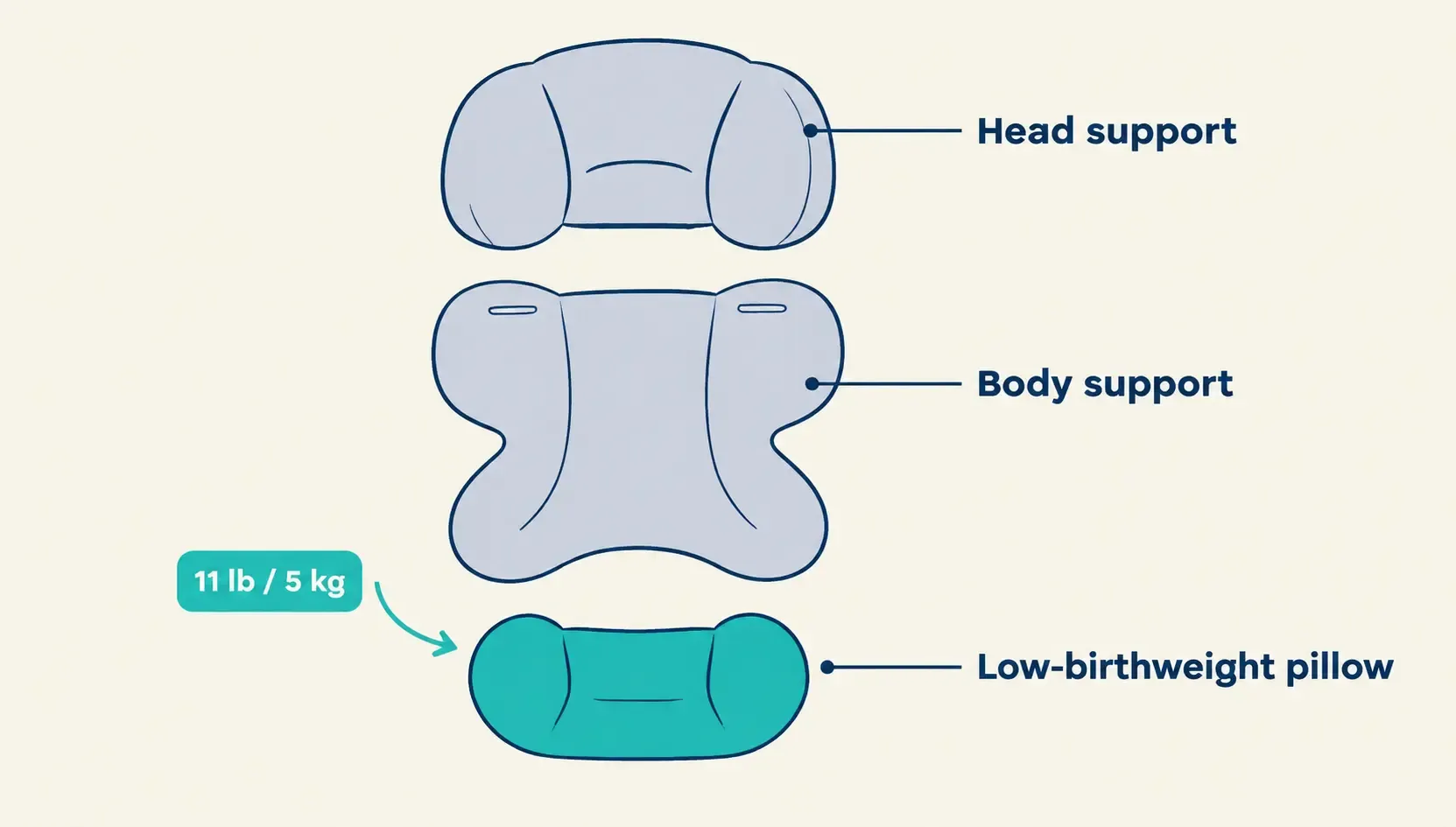
A practical detail: on multi-piece inserts, removal can be staged. Nuna’s system separates into head support, body support and low-birthweight pillow, and the pillow has its own explicit 11-lb removal rule while the supports stay “as necessary” 1. If the full insert fails the fit test but the head support alone passes it, keeping just the head piece is exactly what the staged design is for — provided the manual allows that combination.
Preemies and low-birthweight babies: special rules
Small babies carry extra risk in car seats, and the manuals say so directly. Evenflo requires the AAP’s recommended evaluation for all infants born before 37 weeks and all newborns weighing less than 5 lb at birth, before their first car trip: hospital staff observe the infant in the restraint for 90 to 120 minutes (or the duration of travel, whichever is longer), checking for breathing difficulty or heart-rate problems, with the seat reclined at its approved vehicle angle 6.
That hospital observation is the well-known car-seat tolerance screening — sometimes called the car-seat challenge — and it exists because preterm and low-birthweight infants are at added risk of breathing difficulty and heart problems when placed in a restraint 612. The AAP’s guidance on safe transportation of preterm and low-birthweight infants notes that correctly used car seats are 71% effective at preventing crash fatalities in infants, while setting out the screening criteria for babies born before 37 weeks or under 2,500 g 12.
Three rules follow for these families: keep every piece of the insert in until the team says otherwise, minimise the number and length of car trips in the early weeks, and have a caregiver ride in the back seat to watch the baby’s breathing and colour 6. If your hospital did not run the screening, ask your paediatrician before the first long drive.
The four mistakes that actually hurt babies
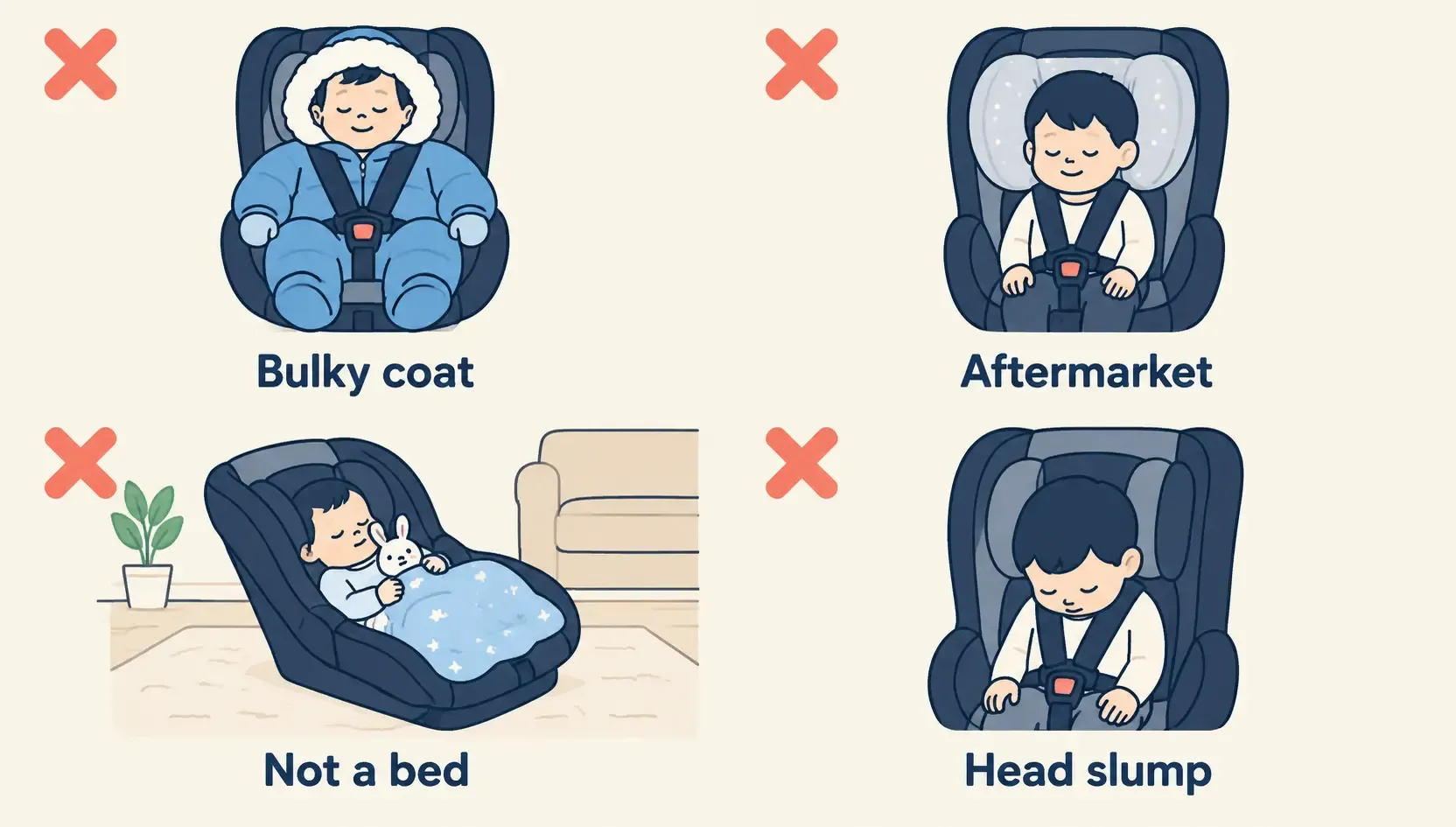
Aftermarket inserts and strap covers. Covered above, but it bears repeating because the products look so official. They are not crash-tested with your seat, both manuals forbid them, and overall car-seat misuse runs at an estimated 46% — with the small extra products contributing their share 756.
Bulky winter coats and snowsuits. NHTSA’s winter guidance is explicit: bulky coats interfere with the harness, creating hidden slack that compresses in a crash 13. Dress the baby in thin layers, tighten the harness to pass the pinch test, then lay the coat or a blanket over the top. The insert does not fix a puffy-coat fit problem — it hides it.
Head slumping forward. A chin-to-chest head position can narrow a newborn’s airway — the mechanism behind positional asphyxia, which accounts for a share of the deaths researchers have documented in sitting devices 14. The insert’s job is partly to prevent this by keeping the baby positioned back and the head from tipping. If the head still flops forward after correct tightening, check the seat’s recline angle first (too upright causes breathing difficulty; too reclined risks ejection — Graco warns about both 5), then suspect the insert needs to come back in or the seat needs re-levelling, not a rolled blanket tucked beside the head. Only maker-approved positioning parts belong in the seat 6.
Using the car seat as a bed. The manuals limit the seat to travel: Evenflo warns that potential adverse health effects from excessive use have been documented, that daily time in the restraint should be limited as much as possible, and that the seat must never be used as a sleeping environment at home 6. The epidemiology backs the warning. One retrospective review linked sitting and carrying devices — car seats, bouncers, swings, strollers, slings — to infant deaths by positional asphyxia and strangulation on straps 14. A later 10-year study of 11,779 sleep-related infant deaths found 348 (3%) occurred in sitting devices, most of them in car seats used for routine sleep rather than travel 8. The related sleep-schedule guidance covers where newborns should actually nap; the car seat is transport between those places, not one of them.
Frequently asked questions
My baby is 10 lb but looks squished — can I remove the insert early?
Run the three-check fit test without it. If the straps sit at or below the shoulders, the clip is at armpit level and no slack pinches, the fit has spoken — Nuna’s own wording makes a snug fit without the pillow the trigger, with 11 lb as the approximate point 15. If any check fails, the insert stays regardless of weight.
My baby is 12 lb and still seems loose without it — what now?
Keep the insert in and re-check weekly. Weight thresholds are one-directional floors for checking, not ceilings for removal; the manuals for Graco and Evenflo work this way entirely, with fit as the only criterion 56. Also confirm the harness is fully tightened — apparent looseness is often slack, not size.
Do I remove all the pieces at once?
Only if the manual treats them as one piece. Where the maker separates them — Nuna’s head support, body support and low-birthweight pillow, for instance — each piece follows its own rule, and the pillow’s 11-lb rule can trigger while the supports stay 1. Never improvise combinations the manual does not show.
Can I use a different brand’s insert, or a rolled towel instead?
No to the first, and effectively no to the second. Only the parts your seat’s maker provided or lists as replacements are crash-tested with that seat; both Graco and Evenflo forbid anything else 56. If positioning fails with the approved parts correctly used, the answer is a different seat or a clinician’s advice — not padding.
Does removing the insert change the harness slots?
Often, yes. Removing padding drops the baby lower in the shell, which can move the correct slot down a position. Re-check strap height (at or below the shoulders rear-facing) after every insert change, and re-check the chest clip too 56.
How long can my newborn stay in the car seat at a stretch?
Keep it as short as possible. For preterm and low-birthweight infants the manuals prescribe minimised trips with a back-seat observer; for every baby the seat is travel equipment, not a sleeper 68. Plan stops on long drives the way you plan feeds — which is also why a shared feeding and sleep log beats memory when two parents split driving shifts.
The short version
Find your seat in the table, note its number — probably 11 lb — and treat that number as a reminder to run the fit test, not as the decision itself. Straps at or below the shoulders, clip at the armpits, no pinchable slack: pass all three without the insert and it stays out; fail any one and it goes back in. Nothing aftermarket ever goes in, puffy coats come off before tightening, and the seat stays a travel device rather than a nap spot.
One habit makes all of this easier across caregivers: write down what changed and when. The date the insert came out, which pieces, the baby’s weight that day — that is a handover note that keeps grandparents and childcare on the same setup, and one less thing to reconstruct from memory at the next weigh-in. Logging it next to feeds and naps turns “I think we took it out last month” into a fact.
Disclaimer: This article is for informational purposes only and does not constitute safety, medical or legal advice. Your car seat’s manual is the final authority for your model — thresholds and part names change, so confirm the current instructions for your exact seat, and consult your paediatrician about preemies, low birth weight, or any breathing concerns.
Footnotes
-
Nuna Baby Essentials, “PIPA Series Organic Cotton Insert User Manual” (US). (Insert provides a snug fit for small babies; low-birthweight pillow for even smaller babies “MUST be removed once a snug fit can be achieved without it, at approximately 11 lb”; head support straps only in the top two harness slots; harness straps at or just below the shoulders.) Source ↩ ↩2 ↩3 ↩4 ↩5 ↩6
-
UPPAbaby, “Mesa Max Product Manual” (US, Sep. 2023). (Weight requirements 4–35 lb; height 32 in or less; “The Infant Insert is designed for children who weigh: 4–11 lbs (1.8–5 kg)”.) Source ↩ ↩2
-
Chicco USA, “KeyFit 30 ClearTex Infant Car Seat” product page. (“Removable head and body positioner accommodates newborns weighing 4–11 lb.”; seat rated 4–30 lb for newborns as small as 4 lb.) Source ↩ ↩2
-
Doona, “Infant Insert” spare-parts page (US). (“From birth up to 11 lbs / 5 kg (approx. 3 months)”; near-flat ergonomic position supporting the baby’s posture.) Source ↩ ↩2 ↩3
-
Graco Children’s Products, “SnugRide 35 Infant Car Seat Owner’s Manual” (PD284963A, Nov. 2014). (Seat for children 4–35 lb and 32 in or less; body pillow “use with bottom 2 sets of harness slots only”; harness at or just below shoulders; chest clip even with armpits; “if your fingers slide off the harness straps without pinching, it is tight enough”; do not use accessories or parts other than those provided by Graco; AAP/NHTSA rear-facing guidance cited.) Source ↩ ↩2 ↩3 ↩4 ↩5 ↩6 ↩7 ↩8 ↩9 ↩10 ↩11 ↩12 ↩13 ↩14 ↩15
-
Evenflo Company, “LiteMax 35 / SafeMax Rear-facing Child Restraint Owner’s Manual” (25701574, Feb. 2020) and “LiteMax Sport Owner’s Manual” (25701634, Aug. 2021). (Rear-facing 4–35 lb, 17–32 in, head at least 1 in below seat-back top; harness at or just below shoulders, chest clip at armpit level; optional head/body pillows to help support the child; “DO NOT attach additional padding, toys or other devices not made by Evenflo”; seat meets FMVSS 213, which has no minimum weight limit; preterm/low-birthweight evaluation required for birth before 37 weeks or under 5 lb — 90–120 minute observation; seat for travel only, never as a home sleeping environment.) Source ↩ ↩2 ↩3 ↩4 ↩5 ↩6 ↩7 ↩8 ↩9 ↩10 ↩11 ↩12 ↩13 ↩14 ↩15 ↩16 ↩17 ↩18 ↩19 ↩20
-
U.S. National Highway Traffic Safety Administration, National Center for Statistics and Analysis. “Results of the National Child Restraint Use Special Study” (NCRUSS, 2011 data, 4,167 vehicles). (Estimated overall car-seat and booster-seat misuse 46%.) Source ↩ ↩2
-
Liaw P, Moon RY, Han A, Colvin JD. “Infant Deaths in Sitting Devices,” Pediatrics, 2019;144(1):e20182576. (10-year study of 11,779 sleep-related infant deaths; 348 — 3% — occurred in sitting devices.) Source ↩ ↩2 ↩3
-
Durbin DR, Hoffman BD, et al.; AAP Council on Injury, Violence, and Poison Prevention. “Child Passenger Safety,” Pediatrics, 2018;142(5):e20182460. Policy statement reaffirmed February 2025. (Children should remain rear-facing as long as possible, until they reach the highest weight or height allowed by the seat’s manufacturer.) Source ↩
-
HealthyChildren.org (American Academy of Pediatrics), “Rear-Facing Car Seats for Infants & Toddlers.” (The AAP recommends all infants and toddlers ride rear-facing until they reach the highest weight or height allowed by their car safety seat manufacturer.) Source ↩
-
Nuna Baby Essentials, “PIPA urbn User Manual” (US). (Low-birthweight insert inside the body support for even smaller babies “must be removed once the child reaches 11 lb”.) Source ↩
-
Bull MJ, Engle WA; AAP Committee on Injury, Violence, and Poison Prevention and Committee on Fetus and Newborn. “Safe Transportation of Preterm and Low Birth Weight Infants at Hospital Discharge,” Pediatrics, 2009;123(5):1424–1429. (Properly used restraints 71% effective against crash fatalities in infants; screening criteria: birth before 37 weeks or below 2,500 g.) Source ↩ ↩2
-
U.S. National Highway Traffic Safety Administration, “Keep Your Little Ones Warm and Safe in Their Car Seats.” (“Don’t let bulky coats interfere with the car seat harness”; heavy winter coats cause a loose-fitting harness.) Source ↩
-
Batra EK, Midgett JD, Moon RY. “Hazards Associated With Sitting and Carrying Devices for Children Two Years and Younger,” Journal of Pediatrics, 2015. (Retrospective review of CPSC-reported deaths in sitting and carrying devices; car-seat deaths attributed to positional asphyxia and to strangulation from straps.) Source ↩ ↩2