

Baby Hair Care: The Complete Guide for 0–12 Months
By Simple Baby Tracker Editorial TeamBaby Care
How often to wash a baby's hair, what tear-free shampoo really means, how to treat cradle cap, and when baby hair thickens — from AAP, AAD, NHS, and Cochrane guidance.

Key Takeaways
- Wash your baby’s hair two or three times a week with a mild, fragrance-free shampoo. More than that dries an already thin scalp barrier; less than that is fine for tightly coiled hair 123.
- “Tear-free” is a formulation claim, not a guarantee. In a 2025 laboratory study of 39 baby bath products, 20.5% were classified as mildly irritating to the eye and 48.7% as slightly irritating 4.
- Cradle cap affects roughly 70% of 3-month-olds and clears on its own. The treatments almost everyone recommends — oil, brushing, medicated shampoo — have almost no randomized trial evidence behind them 56.
- Hair loss, colour change, and texture change in the first year are scheduled by the fetal hair cycle, not by what you wash with or how often 78.
- There is no medically correct age for a first haircut, and shaving a baby’s head does not make the hair grow back thicker 910.
What “normal” baby hair actually is
Your baby’s hair was decided before they were born, and the number of follicles is already final. Hair follicles begin forming around the eighth week of gestation, appear on the scalp by the tenth week, and the full scalp pattern is set by 18 weeks 7. After birth, no new follicles are formed — ever. A newborn has roughly five million preformed follicles across the body, with 90,000 to 150,000 on the scalp depending on ancestry 117.
That single fact explains most of what parents worry about. Because the follicle count is fixed and the head keeps growing, hair density is highest at birth and declines as the scalp expands 7. A baby is not “losing density” at 9 months; the same number of hairs are spread over a bigger surface.
Three hair types are involved, and they replace each other on a schedule:
| Type | What it is | When you see it |
|---|---|---|
| Lanugo | Fine, soft, unpigmented fetal hair that anchors vernix in the womb | Mostly in preterm babies; shed before term or within weeks of birth 7 |
| Vellus | Downy, fine, lightly pigmented hair | Replaces lanugo from about 3–4 months 11 |
| Terminal | Thicker, pigmented, mature hair | Begins replacing vellus in the first year; accelerates at puberty 11 |
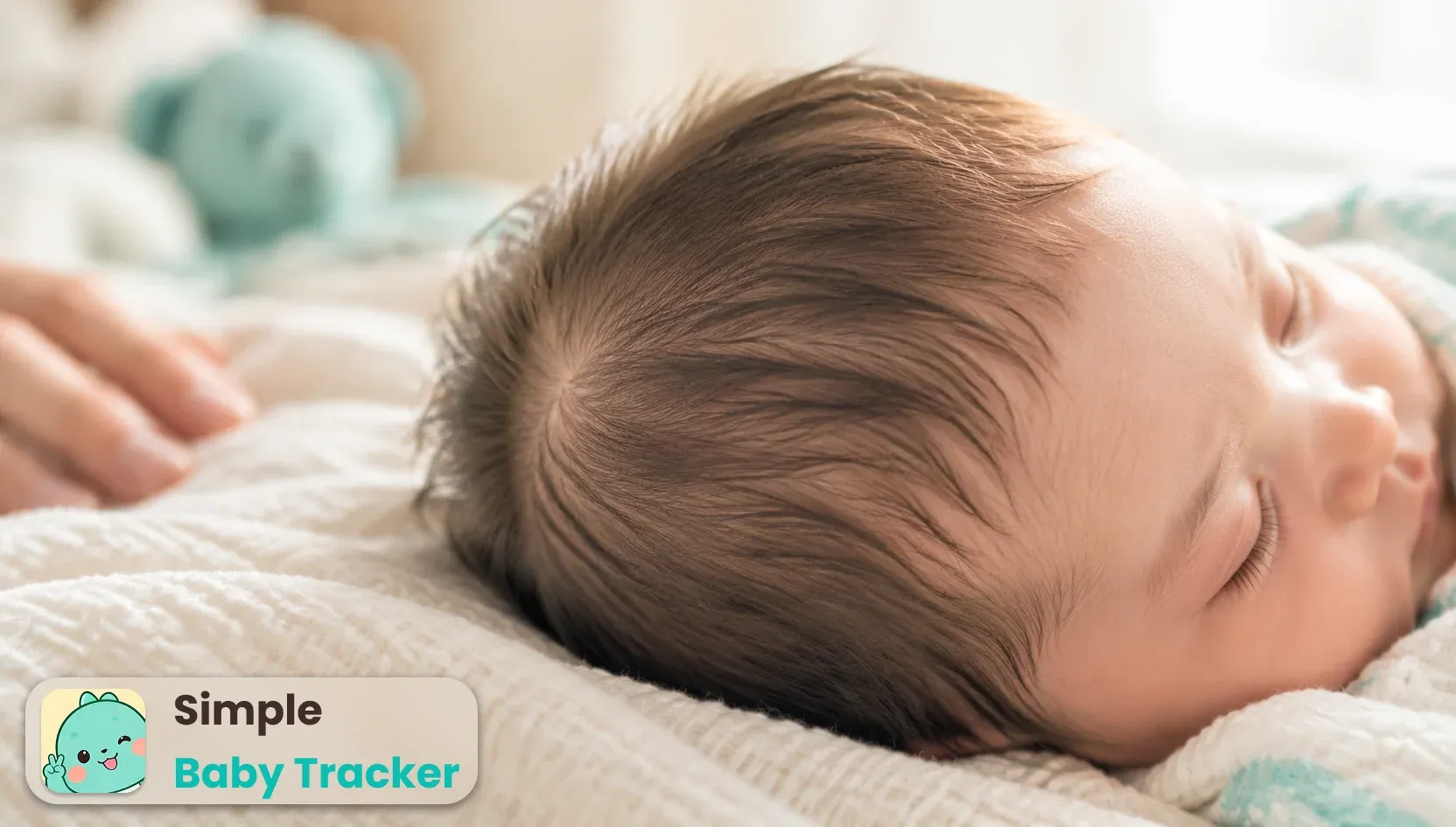
Hair at birth is also not one uniform crop. There are two growth waves. The frontal and parietal hair is already in the resting (telogen) phase when the baby is born and sheds first. The occipital (back-of-head) hair is still in the growing (anagen) phase and typically falls out between 8 and 12 weeks after birth 7 — the same event we break down in why babies lose their first hair. That is why the classic bald patch appears at the back of the head on a predictable timetable. As the European Academy of Dermatology’s paediatric task force notes, it is not caused by friction from sleeping on the back. They propose the term transient neonatal hair loss precisely because the timing is set by the fetal hair cycle, not by the mattress 8.
Variation at the starting line is enormous and normal. About 30% of neonates are born with very thin hair and may look bald; others arrive fully covered. Neither predicts adult hair — some sparse newborns grow thick adult hair and some very hairy newborns end up sparse 8. Follicle density and coil pattern also differ by ancestry: roughly 100,000–150,000 scalp follicles in babies of African and European descent and 90,000–120,000 in babies of Asian descent, with tightly coiled, straight, and variable presentations respectively 7. Babies with darker skin tend to transition to the resting phase more slowly, so they often have more visible hair at birth 7.
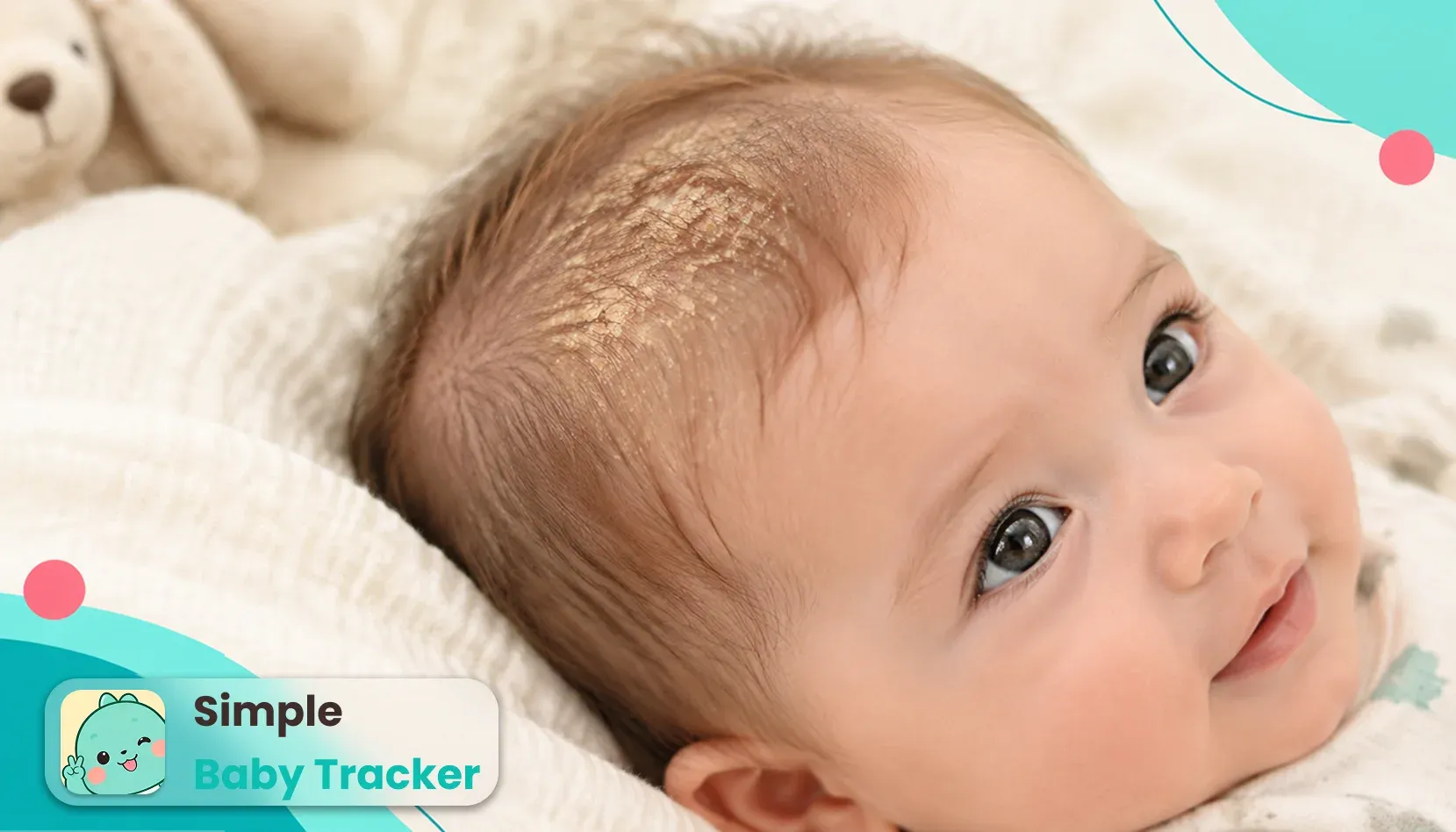
One more newborn-specific detail matters for how you wash: oil production on the scalp is high in the first week of life because maternal hormones cross the placenta, then falls sharply within days 11. A newborn scalp is oilier than it will be at 6 months — which is exactly why cradle cap appears in the first weeks and fades later.
How often should you wash a baby’s hair?
Two or three times a week is the answer for most babies in the first year, and it does not need to be more frequent than the bath itself. The American Academy of Pediatrics is direct: three baths per week during the first year may be enough, and bathing more often can dry out your baby’s skin 1. Its bathing guidance repeats the number specifically for hair — wash baby’s hair two or three times a week with a mild shampoo or body wash 1. Independent paediatric dermatology guidance lands in the same place, recommending bathing infants two to three times a week in lukewarm water for 5 to 10 minutes 11.
The one routine exception is cradle cap, where more frequent washing is the treatment. The American Academy of Dermatology recommends shampooing as often as every other day to soften the scale, and the AAP says the same 25. If your baby also has eczema, follow your dermatologist’s frequency instead 2.
| Age / hair type | Wash frequency | Notes |
|---|---|---|
| Newborn (0–4 weeks), sponge baths | 2–3× per week | Sponge baths only until the umbilical stump falls off, usually by 1–2 weeks 1 |
| Infant (1–12 months), straight or wavy hair | 2–3× per week | Match the bath; more is not cleaner 111 |
| Infant with cradle cap | Every other day | Until the scale clears, then return to routine 25 |
| Infant with tightly coiled hair | Weekly to every 10 days | Focus on the scalp; see the note below 6 |
| Infant with eczema or dry skin | Follow your clinician’s plan | Fragrance-free, pH-balanced products; emollient after bathing 11 |
The coiled-hair exception is worth understanding rather than memorizing. The Cochrane review of cradle cap treatments flags that frequent hair washing may be poorly acceptable for some cultural groups, because tightly coiled hair requires styling after washing. It also notes that low washing frequency has not been shown to be associated with seborrhoeic dermatitis in African-American girls 6. In other words, the “wash it more” advice for cradle cap is a treatment instruction, not a general hygiene standard.
Why over-washing is a real risk, not a myth. Infant skin is structurally different from adult skin, not just smaller. The outermost layer (the stratum corneum) is up to 30% thinner and the layer beneath it up to 20% thinner. The skin’s own moisturizers are lower, and water escapes through it faster — dermatologists call this transepidermal water loss 11. Surfactants and water alone raise skin surface pH: a soap bar can push skin pH above 8.0, and even plain water can move it from about 5.5 toward 7.5 12. At elevated pH, the enzymes that process barrier lipids work poorly — β-glucocerebrosidase and acid sphingomyelinase are acid-dependent — and the proteases that break down the bonds holding skin cells together become more active 11. The practical consequence is a scalp barrier that is easier to irritate and slower to recover.
There is also a water-quality variable most guides ignore. A population study of 1,303 three-month-olds found that high domestic water calcium carbonate (hard water) was associated with a higher risk of visible atopic dermatitis — about 1.9 times the odds compared with babies in the lowest-hardness homes 13. The authors call for an intervention trial before anyone changes plumbing. The reasonable takeaway is not to install a softener, but to keep baths short, avoid over-washing, and apply a fragrance-free emollient afterwards — especially if your baby has a family history of eczema 1311.
How to wash a baby’s hair, step by step
Set the temperature first. The AAP recommends the hottest water at the faucet be no more than 120°F (about 49°C) to prevent scalds. Check the water with your wrist or elbow before the baby goes in 1. Bath water itself should be lukewarm, and the bath should stay under 10 minutes 11.
Hold, don’t scrub. Support the head and neck with one forearm so the head is above the waterline, then use the other hand. A soft cloth is enough for the face and scalp — the AAP’s instruction is to avoid scrubbing or tugging the skin 1.
Wash the scalp like skin, not like a stain. Apply a small amount of mild shampoo, massage with fingertips or a soft-bristled brush, and rinse. The fontanelle — the soft spot — is skin over a gap in the skull, not an opening; washing over it gently is safe and expected 13.
Deflect the rinse. When you rinse, cup your hand across the forehead so the suds run toward the sides of the head rather than into the eyes 1. This is the single highest-yield technique in the whole routine.
Blot, don’t rub. Pat dry with a soft towel. Rubbing wet hair when the scalp is at its most permeable is how you create the irritation you were trying to avoid 11.
Do not rush the first bath. The World Health Organization recommends delaying a newborn’s first bath until 24 hours after birth, or at least 6 hours if a full day is not possible for cultural reasons. Early baths are associated with hypothermia and blood-sugar dips, and they interrupt skin-to-skin contact and early breastfeeding 1. Vernix — the waxy coating — is a natural moisturizer with possible antibacterial properties, and the AAP advises leaving it on for a while 1.
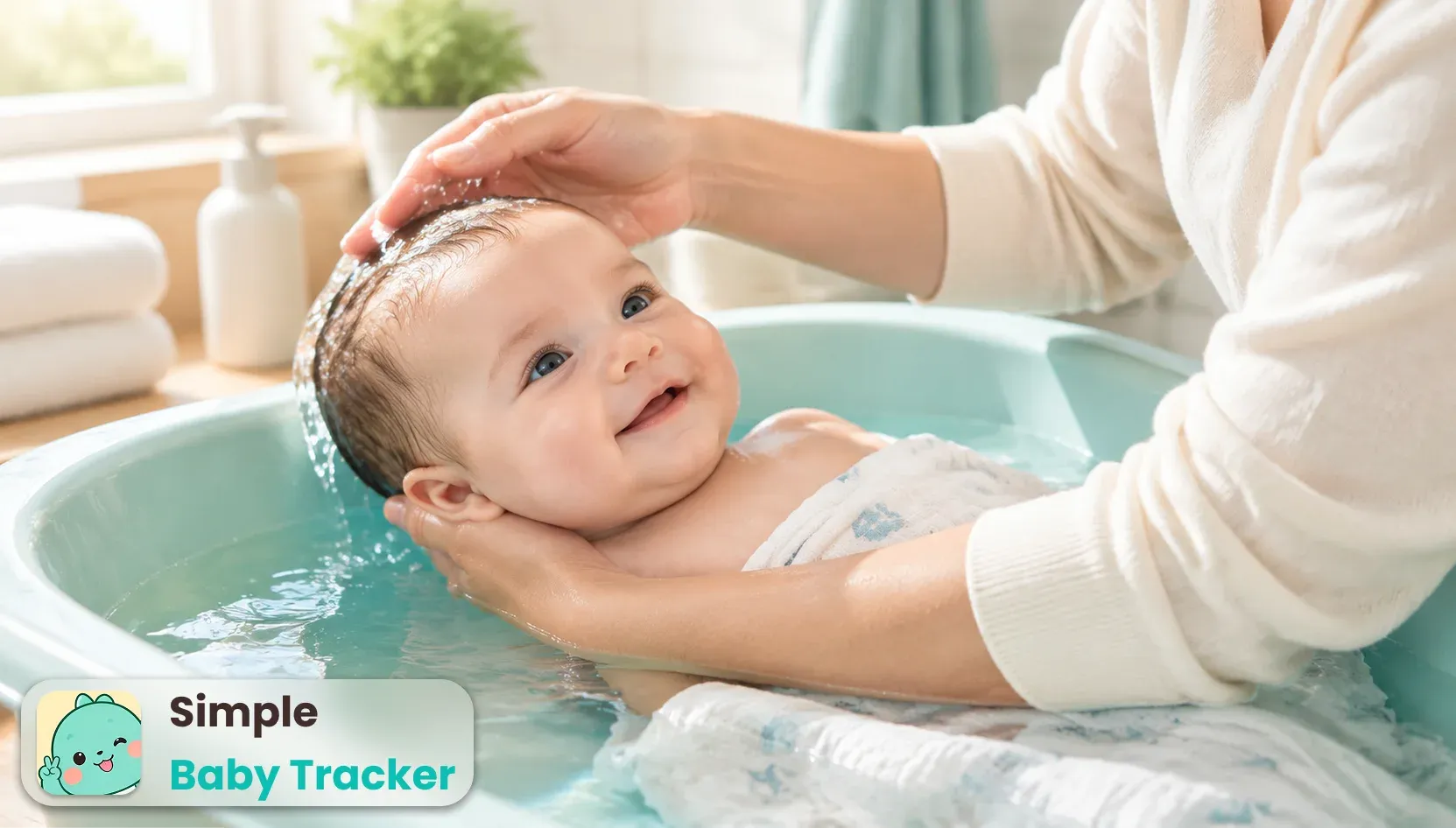
If bath time reliably sets off crying, the techniques in our guide to soothing a crying newborn apply here too — hair washing is often the part babies tolerate least.
Two things not to do. Do not use soap, adult shampoo, or fragranced products on an infant scalp — NHS guidance is explicit on all three 3. And do not leave shampoo residue; rinse until the water runs clear, because residue is itself an irritant 3.

How to choose a baby shampoo (and what “tear-free” really means)
“Tear-free” describes a formulation strategy, not a safety certification. Chinese regulation is the clearest about this: only products that test as non-irritating in the acute eye irritation test may be labelled “tear-free formula” 4. In other jurisdictions there is no equivalent bright line, which means the phrase on a US or EU bottle can be marketing rather than a test result 4.
What the formulation actually does is choose surfactants and pH. Shampoo surfactants come in four families, and their irritation profiles differ systematically 414:
| Surfactant class | Typical role | Eye/skin irritation |
|---|---|---|
| Anionic (e.g. sodium laureth sulfate, sodium lauryl sulfate) | Strong cleansing | Highest; polyether sulfates were the most irritating group tested 4 |
| Amphoteric (e.g. cocamidopropyl betaine) | Co-surfactant, mildness | Mixed; same ingredient from different suppliers scored differently 4 |
| Nonionic (e.g. decyl glucoside, coco-glucoside) | Mild cleansing | Lowest; 6 of 7 nonionic surfactants tested were non-irritating 4 |
| Cationic (e.g. polyquaternium-10) | Conditioning | Low at typical use levels 4 |
The mechanism behind “no tears” is partly micelle size. A newborn wash tested against water alone in a 307-infant randomized trial used a sodium-lauryl-sulfate-free blend of nonionic and amphoteric surfactants. Combined, these form large micelles that clean by dispersing fats without disrupting the skin barrier, at a pH around 5.5 12. Smaller, more reactive anionic molecules penetrate and irritate more readily; larger, milder surfactant structures stay at the surface 414.
The uncomfortable finding
A 2025 study put 39 commercial baby bath products through the standard laboratory eye-irritation test (the Draize test). Twelve were non-irritating (30.8%), 19 were slightly irritating (48.7%), and 8 were mildly irritating (20.5%) 4. More than a fifth of products sold for babies had a measurable eye-irritation signal. The most-used surfactant, cocamidopropyl betaine, appeared in 46% of formulations and carried the highest “risk attention index”; sodium laureth sulfate and sodium lauroamphoacetate were next 4.
Two details from that study are worth more than any brand recommendation. First, the same ingredient, listed under the same name, produced different irritation results depending on who made it — cocamidopropyl betaine and sodium lauroamphoacetate each landed in the non-irritating, slightly irritating, and mildly irritating categories depending on supplier 4. Impurities and manufacturing process matter, and an ingredient list alone cannot tell you the irritation profile. Second, fragrance is a coin flip: of four fragrance materials tested at real-use concentrations, one was mildly irritating, one slightly irritating, and two non-irritating 4. Fragrance is the most common avoidable irritant in the category, which is why every major guideline — AAP, AAD, NHS, and the paediatric skin-barrier literature — says fragrance-free 12311.
What to look for
| Check | Target |
|---|---|
| Fragrance | “Fragrance-free” or “unperfumed,” not “unscented” (which may mask with fragrance) 23 |
| Surfactants | Glucosides and other nonionic surfactants first; avoid sodium lauryl sulfate 412 |
| pH | Around 5.5 — the skin’s natural acidity 1112 |
| Medicated shampoo | Only on a clinician’s advice — it may irritate infant skin 5 |
| Residue | Rinse until clear; do not leave product on the scalp 3 |
If your baby has cradle cap, the AAD’s escalation is: fragrance-free baby shampoo first, and if that is not enough, a product formulated for cradle cap or a dermatologist’s recommendation 2.
Cradle cap: what the evidence actually says
Cradle cap is infantile seborrhoeic dermatitis of the scalp. It usually starts between 3 weeks and 2 months after birth, and it is not rare — the AAP states that 70% of 3-month-olds have it 5. Population data put the peak prevalence in the first three months at 71.7%, falling to 44.5% under one year, 7.5% between 12 and 23 months, and under 1% by age three 6.
It is a greasy, yellowish, scaly rash on a red base, found on hair-bearing and skin-fold areas. It is generally not itchy or painful, the baby is usually untroubled by it, and it is not contagious 536. On lighter skin the base looks pink or red; on brown and black skin the affected area may simply look lighter or darker than the surrounding skin, which is why it is sometimes missed 3.
Why cradle cap happens
The most consistent explanation combines three factors. First, the scalp’s oil glands, switched on by maternal hormones, produce extra oil in the first weeks. Second, Malassezia yeast feeds on that oil, consuming saturated fatty acids and leaving unsaturated ones behind. Third, the individual infant’s inflammatory response to the yeast does the rest 6.
The host-response part is the important nuance. Malassezia furfur was cultured from 73% of infants with seborrhoeic dermatitis — but also from 53% of controls. Presence of the yeast alone is not sufficient to cause the rash, which is why some infants with plenty of yeast never develop it 6. Neither poor hygiene nor allergy causes cradle cap 5.
The evidence gap
The Cochrane review of interventions for infantile seborrhoeic dermatitis identified only six randomized trials, covering 310 infants, and rated every comparison as very-low-certainty evidence. Critically, it found no trials at all of the treatments most parents are told to use: mineral oil, salicylic acid, or antifungals 6. In most of the included studies the condition improved regardless of which intervention was used — which is what you would expect from a self-limiting rash that clears by 4 to 6 months in most cases 6.
That does not mean treatment is useless. It means the treatments are unproven rather than disproven, and the decision should be driven by safety and by what actually helps the scale lift.
What the guidelines converge on
| Step | What to do | Source |
|---|---|---|
| 1. Wash more often | Shampoo every other day to soften scale | AAP, AAD 52 |
| 2. Use a mild shampoo | Fragrance-free baby shampoo | AAP, AAD 52 |
| 3. Soften stubborn scale | Mineral oil, coconut oil, or petroleum jelly; the AAP suggests leaving it on overnight | AAP 5 |
| 4. Lift the scale | Gentle massage, a soft brush, or a baby comb while shampooing | AAP, AAD, NHS 523 |
| 5. Never pick | Scratching or picking increases infection risk | AAP, AAD, NHS 523 |
What to avoid, and why
Several popular remedies have real downsides documented in the literature:
- Olive oil. NHS explicitly advises against it, and the Cochrane review explains why: olive oil can promote Malassezia furfur proliferation and may theoretically worsen the condition 36.
- Peanut oil. NHS rules it out because of allergy risk. More broadly, the Cochrane authors flag that applying food oils to infant skin carries a sensitisation risk, as was observed historically with peanut oil 36.
- Salicylic acid. Case reports document salicylate toxicity in infants after topical application, because infant skin absorbs far more of what is put on it 6.
- Selenium sulphide. Reported to cause scalp discolouration, with concerns about systemic absorption 6.
- Topical corticosteroids. Effective in adults, but infants have a much higher skin-to-body-surface ratio and therefore absorb proportionally more; use should be clinician-directed and time-limited 6.
- Antifungals like ketoconazole 2%. Topical ketoconazole is considered safe in infants with minimal systemic absorption, and antifungals are the mainstay in adult seborrhoeic dermatitis. The Cochrane review, however, found no infant RCTs of them at all 6.
Is it something else?
Most scaly infant rashes are cradle cap, but the differential matters because the treatments are different:
| Condition | Distinguishing features | Action |
|---|---|---|
| Cradle cap (seborrhoeic dermatitis) | Greasy yellow scale, scalp and folds, not itchy, baby well | Home care as above 56 |
| Atopic dermatitis (eczema) | Itchy, red, dry; flexural distribution; often with family history of atopy | Emollients and clinician-directed treatment 611 |
| Tinea capitis (ringworm) | Scaly patches with broken “black dot” hairs, significant erythema, posterior cervical lymph nodes | Needs oral antifungal; topical alone is insufficient in older children 15 |
| Psoriasis | Well-demarcated plaques, silvery scale, can be difficult to distinguish in very young infants | Dermatology assessment 6 |
| Scabies | Intensely itchy, similar distribution, household itching | Clinician assessment 3 |
The AAP’s escalation triggers are specific: see your paediatrician if the cradle cap becomes crusted, weepy, or develops pus bumps 5. NHS adds: if it does not improve after a few weeks of treatment, if it covers the body, or if crusts bleed or leak fluid or the area looks swollen 3. The AAD adds severe rash spreading beyond the hairline, pain, disruptive itch, hair loss, or an odour from the rash 2. And if severe generalised seborrhoeic dermatitis comes with failure to thrive and diarrhoea, that is a different and much more serious problem requiring prompt evaluation 6.
How long it lasts
Cradle cap usually resolves within weeks to months; the AAP says most cases have cleared by 1 year, though some toddlers keep a flaky build-up 5. The AAD gives a 6-to-12-month window for most infants 2. Don’t be alarmed if hair comes away with the scales — it grows back 53.
Brushing, combing, and detangling without causing damage
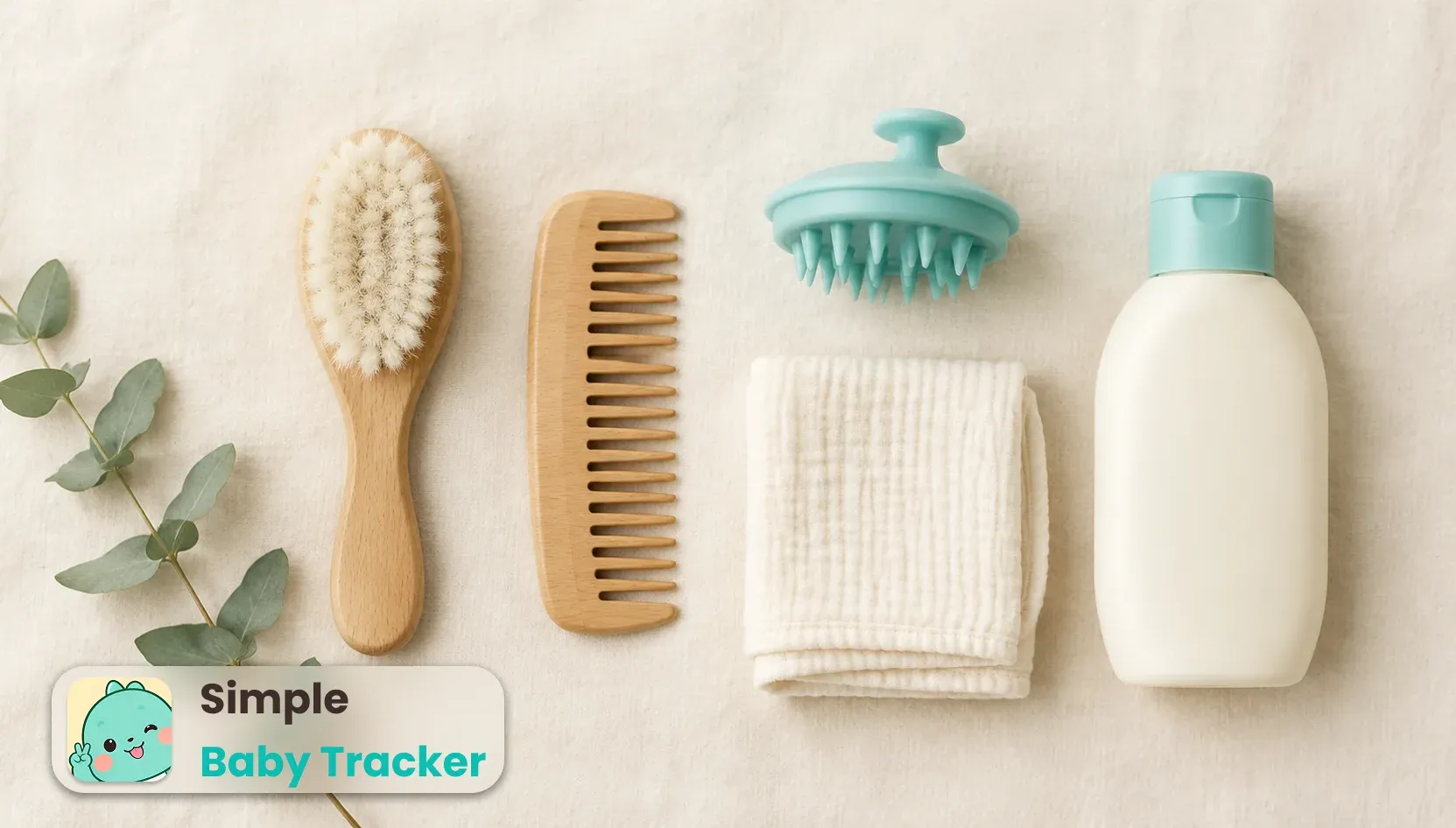
The tools matter less than the tension. A soft-bristle baby brush, a wide-tooth comb, and a silicone scalp brush cover almost everything; the brush is also the tool for lifting cradle cap scale during washing 25.
Traction alopecia is the injury to watch for, and it is entirely preventable. Constant tensile force on scalp hair produces early perifollicular redness, pustules, scaling, and broken hairs, and later follicular scarring with permanent loss 15. Two examination signs are diagnostic. The fringe sign is where a rim of hairs survives along the frontal or temporal hairline while the area behind it thins. Tenting is where the scalp visibly lifts when the hair is pulled tight 15. High-risk practices in children are tight buns, ponytails, braids, cornrows, dreadlocks, and applying weaves, braids, or extensions to already-relaxed hair — and any style that causes pain, crusting, tenting, or pimples 15. With early recognition and a change in grooming, regrowth usually occurs within months; chronic traction can be irreversible 15.
Chemical straighteners are the one intervention to rule out entirely in young children. A review of 33 studies found relaxers associated with scalp eczema, desquamation, pain, burns, inflammation, hair loss, and shaft damage. Long-term effects remain unknown 16. The numbers are stark. In African-American girls, where relaxer use prevalence was 42%, prior relaxer use roughly doubled the odds of traction alopecia. Relaxer use combined with cornrow braids made in the previous 12 months raised the odds more than fivefold 16. One cohort using an acid straightener reported hair breakage or loss in 95% of users and burning scalp pain in 25% 16.
Do not dismiss hair loss as cosmetic, either. Central centrifugal cicatricial alopecia was long considered an adult condition linked to chemical treatments. A paediatric case series found that most affected children had no history of chemical hair treatment but did have a family history. A child with vertex hair loss and scalp symptoms therefore deserves evaluation, not reassurance 15.
Sun and heat. A baby’s scalp is exposed skin. The AAD’s guidance for infants: keep them in the shade, especially under six months, and use a wide-brimmed hat with sun-protective clothing. Minimize sunscreen under six months. Where shade and clothing are unavailable, use a minimal amount of broad-spectrum SPF 30+ with titanium dioxide or zinc oxide, and reapply every two hours 17.
If your baby has curly or coily hair, this section is only half the picture. Curly hair is drier and more breakable than straight hair, so it needs a different wash routine, more conditioner, and a gentler way of detangling. Our guide to curly and coily baby hair covers that in full.
Baby hair growth: when it thickens, changes colour, or fills in
Hair changes in the first year follow the hair cycle, not your shampoo. The normal cycle runs roughly 90% of follicles in active growth (anagen), 1–3% in transition (catagen), and 5–10% resting (telogen); hair is shed after 2–3 months in telogen, and 50–150 hairs lost per day is normal 15. In newborns the cycles are synchronised across the scalp, which is why shedding arrives in visible waves instead of the steady trickle you see in adults 715.
| Age | What is happening | What you see |
|---|---|---|
| 0–3 months | Frontal/parietal hair already in telogen at birth sheds first; maternal hormones fade | Diffuse thinning, hair on the sheet 7 |
| 8–12 weeks | Occipital anagen hair enters telogen and sheds | The back-of-head bald patch 7 |
| 3–4 months | Lanugo is replaced by vellus hair | Softer, finer texture 11 |
| 4–6 months | Cradle cap typically clears | Scale resolves without scarring 6 |
| 6–9 months | Thin unpigmented hair converts to normal infantile hair | Thicker, darker, more even coverage 8 |
| 6–12 months | Terminal hair increasingly replaces vellus | The “fills in” phase 115 |
| 12–24 months | Density and texture settle; scalp has grown | Apparent density normalizes 7 |
Colour and texture change is expected. During the first six to nine months, a child’s hair changes from thin, unpigmented hair to normal infantile hair. Some infants are born with pale hair that pigments later, and both the amount and the distribution change over time 8. The EADV leaflet’s practical warning is the inverse: if that transition is not happening by six to nine months, that is a reason to see a dermatologist 8. Hair that is lighter than family members, or has a grey or silvery sheen, can be a sign of a pigment dilution disorder or a metabolic condition such as phenylketonuria, and warrants evaluation 7.
Does cutting or shaving make it thicker? No. Shaving cuts the shaft above the skin and does not touch the follicle. What changes is what you see: the thicker, darker base of the shaft is exposed while the finer, lighter tip is gone, and short hairs resist bending, so they feel coarser and stiffer 10. As they lengthen, the original texture returns. Genetics determines hair texture and thickness; a trim does not influence it 9. Scalp hair grows roughly 1 cm per month, which is the rate you can expect regrowth at 15.
The first haircut: timing, safety, and tradition
There is no medically correct age for a first haircut, because there is no medical reason for one. Hair quality is genetically determined, so the widely repeated instruction not to cut a baby’s hair before the first birthday “to improve hair health” has no physiological basis 9. Many babies need no haircut at all in the first year; others with fast-growing hair want one well before 12 months.
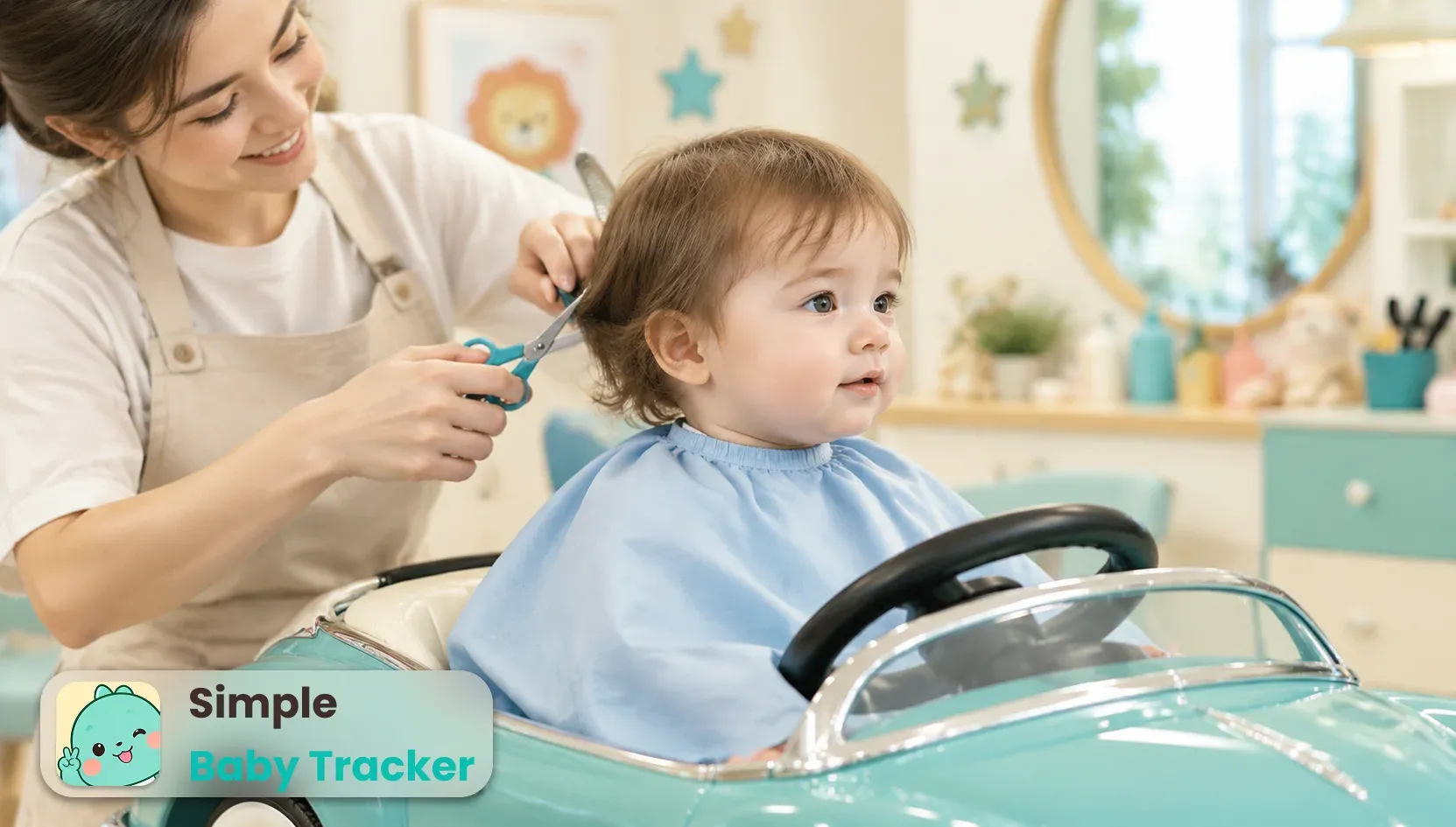
The safety considerations are mechanical, not developmental:
- Use rounded-tip scissors or guarded clippers; do not use a sharp razor near a moving head 9.
- Cut dry hair where possible — wet hair springs up and cuts shorter than intended.
- Never cut around a wiggling baby without a second adult; a lap or a high chair is safer than a salon chair they cannot sit in.
- Avoid pulling hair taut to “get an even line.” That is the tension pattern that causes traction alopecia 15.
- Skip chemical straightening entirely, for the reasons in the previous section 16.
Cultural and religious first-haircut practices are varied and old, and none of them is a medical recommendation. Muslim families typically perform the aqiqah within the first weeks of life, and Jewish families may hold an upsherin at age three. Hindu families observe mundan or chudakarana, while some Mongolian families wait until age two to five depending on the lunar year 9. The one thread connecting them is that the timing is cultural, not biological — which means you can choose your own without worrying that you have missed a developmental window 9.
When hair or scalp needs a doctor
Most of what happens to baby hair in the first year is scheduled, not pathological. These are the patterns that are not “wait and see”:
- Scaly or red patches with hair loss — the leading cause of patchy loss needing treatment is tinea capitis, which requires oral antifungal therapy; topical treatment alone is not sufficient in older children 156.
- Sharply defined, smooth bald patches, or “exclamation mark” hairs — the classic picture of alopecia areata, an autoimmune condition affecting about 2% of people over a lifetime, with 1–2% presenting before age two 15.
- A boggy, swollen, pus-filled plaque (kerion) — an inflammatory fungal reaction that can scar without prompt treatment 15.
- Crusted, weepy, or pus-filled cradle cap, or scale that spreads over the body, bleeds, or leaks fluid 53.
- No regrowth by 12 months, or hair that has not converted from thin unpigmented hair by six to nine months 8.
- Sudden patchy loss with broken hairs of different lengths — consider trichotillomania, which has a different management path 15.
- Hair loss with abnormal nails, teeth, or a family history of genetic skin disease — possible genotrichosis 87.
- Scalp pain, disruptive itch, or odour from a rash 2.
For the full breakdown of newborn shedding patterns and the friction-alopecia question, our guide to why babies lose their first hair covers the differential in detail.
Frequently asked questions
How often should I wash my newborn’s hair?
Two or three times a week with a mild, fragrance-free shampoo, matched to the bath 111. Newborns do not sweat or get dirty enough to need more, and over-washing strips the barrier 1. Until the umbilical stump falls off, sponge baths are the rule 1.
Is “tear-free” shampoo actually safe for eyes?
It is a formulation claim, not a guarantee. Only non-irritating products may carry the “tear-free formula” label in China. Elsewhere the phrase is not regulated to the same standard. In one 2025 study of 39 baby bath products, 20.5% were mildly irritating and 48.7% slightly irritating in an eye-irritation test 4. The best protection is technique — cup your hand across the forehead when rinsing 1.
My baby’s hair is falling out at 3 months. Is something wrong?
Almost certainly not. Frontal hair is already in the resting phase at birth and sheds first; occipital hair sheds between 8 and 12 weeks 7. The EADV renamed the phenomenon transient neonatal hair loss specifically because the timing is driven by the fetal hair cycle rather than by sleeping position 8. Call the doctor if there is scaling, redness, or no regrowth by 12 months 155.
Should I use olive oil for cradle cap?
NHS advises against it, and the Cochrane review notes olive oil may promote Malassezia furfur growth 36. The AAP’s suggested options are mineral oil, coconut oil, or petroleum jelly 5. Never use peanut oil on an infant’s skin because of allergy risk 3.
Does cutting my baby’s hair make it grow back thicker?
No. Shaving cuts the shaft, not the follicle. Regrowth feels coarser because the blunt-cut base is thicker and stiffer than the tapered tip, and that sensation fades as the hair lengthens 10. Genetics sets texture and thickness 9.
My baby’s hair is a different colour and texture than at birth. Normal?
Yes. Hair converts from thin, unpigmented hair to normal infantile hair during the first six to nine months, and pale hair often pigments later 8. Distribution and density change too. What matters is that the transition is happening 8.
Can I use adult shampoo once my baby has more hair?
Not in the first year. Adult shampoos are formulated for a thicker, more acidic adult barrier and often contain stronger anionic surfactants and fragrance 411. NHS guidance is explicit: no adult shampoos, soap, or fragranced products on a baby’s scalp 3.
Do I need a medicated shampoo for cradle cap?
Usually not, and the AAP says to check with your paediatrician before using one because it may irritate infant skin 5. Cradle cap is self-limiting and clears by 4 to 6 months in most cases 6. Medicated options are for cases that persist or spread, and should be clinician-directed 52.
The short version
Baby hair care in the first year is mostly about restraint. Wash two or three times a week with a mild, fragrance-free shampoo, keep the water lukewarm, rinse thoroughly, and deflect the suds away from the eyes. Treat cradle cap by washing more often and lifting scale gently — not by picking, not with olive oil, and not with a steroid unless a clinician prescribes one. Expect shedding around three months, a bald patch at the back of the head, and a colour and texture change between six and nine months. All of it is on the fetal hair cycle’s schedule, not yours. Skip chemical straightening entirely, keep styles loose enough that they never cause pain or tenting, and put a wide-brimmed hat on before you put anything else on the scalp.
A monthly photo in your baby log turns “is her hair filling in?” into a side-by-side answer, and gives a paediatrician a timeline if a red flag ever appears. Note the date any shedding started, where it is (all-over versus occipital versus defined patches), and any scalp symptoms alongside it. Shared through the family code, both parents and every caregiver see the same record — which matters most at handover, when a bath and hair-wash routine changes hands. If you are still deciding what is worth logging at all, our guide to tracking without data anxiety and the overview of what to track in your baby’s first year cover the rest. Bath time itself is also a sensory event — the micro-habits that keep a newborn calm apply directly to hair washing.
Disclaimer: This article is for informational purposes only and does not constitute medical advice. Always consult your paediatrician or a paediatric dermatologist about your baby’s hair, scalp, or skin.
Footnotes
-
American Academy of Pediatrics (HealthyChildren.org), “Bathing Your Baby,” by Dipesh Navsaria, MPH, MSLIS, MD, FAAP, updated Jul. 2025. Source ↩ ↩2 ↩3 ↩4 ↩5 ↩6 ↩7 ↩8 ↩9 ↩10 ↩11 ↩12 ↩13 ↩14 ↩15 ↩16
-
American Academy of Dermatology, “4 cradle cap tips from dermatologists,” Aug. 2022 (Elena Hawryluk, MD, PhD, FAAD). Source ↩ ↩2 ↩3 ↩4 ↩5 ↩6 ↩7 ↩8 ↩9 ↩10 ↩11 ↩12 ↩13 ↩14 ↩15 ↩16
-
NHS, “Cradle cap,” reviewed Oct. 2025. Source ↩ ↩2 ↩3 ↩4 ↩5 ↩6 ↩7 ↩8 ↩9 ↩10 ↩11 ↩12 ↩13 ↩14 ↩15 ↩16 ↩17 ↩18 ↩19 ↩20
-
He Q, Zhong Y, Li P, et al. “From Safety Evaluation to Influencing Factors Analysis: A Comprehensive Investigation on Ocular Irritation of Baby Bath Products,” Toxics, 2025;13(11):948. Source ↩ ↩2 ↩3 ↩4 ↩5 ↩6 ↩7 ↩8 ↩9 ↩10 ↩11 ↩12 ↩13 ↩14 ↩15 ↩16
-
American Academy of Pediatrics (HealthyChildren.org), “What is Cradle Cap?” by Sarah Stein, MD, FAAD, FAAP, updated Oct. 2023. Source ↩ ↩2 ↩3 ↩4 ↩5 ↩6 ↩7 ↩8 ↩9 ↩10 ↩11 ↩12 ↩13 ↩14 ↩15 ↩16 ↩17 ↩18 ↩19 ↩20 ↩21 ↩22 ↩23
-
Victoire A, Magin P, Coughlan J, van Driel ML. “Interventions for infantile seborrhoeic dermatitis (including cradle cap),” Cochrane Database of Systematic Reviews, 2019;2019(3):CD011380. Source ↩ ↩2 ↩3 ↩4 ↩5 ↩6 ↩7 ↩8 ↩9 ↩10 ↩11 ↩12 ↩13 ↩14 ↩15 ↩16 ↩17 ↩18 ↩19 ↩20 ↩21 ↩22 ↩23
-
Furdon SA, Clark DA. “Scalp Hair Characteristics in the Newborn Infant,” Advances in Neonatal Care, 2003;3(6). Source ↩ ↩2 ↩3 ↩4 ↩5 ↩6 ↩7 ↩8 ↩9 ↩10 ↩11 ↩12 ↩13 ↩14 ↩15
-
EADV Pediatric Dermatology Task Force, “Hair in the neonate,” Patient Information Leaflet, 2019. Source ↩ ↩2 ↩3 ↩4 ↩5 ↩6 ↩7 ↩8 ↩9 ↩10 ↩11
-
Hernandez A, “A baby’s first haircut,” Think Twice, University of Texas at Austin, Sep. 2019. Source ↩ ↩2 ↩3 ↩4 ↩5 ↩6 ↩7
-
Cleveland Clinic, “Will Shaving Make Your Hair Grow Back Thicker?” Jan. 2023. Source ↩ ↩2 ↩3
-
Choi EH. “Skin Barrier Function in Neonates and Infants,” Allergy, Asthma & Immunology Research, 2025;17(1):32–46. Source ↩ ↩2 ↩3 ↩4 ↩5 ↩6 ↩7 ↩8 ↩9 ↩10 ↩11 ↩12 ↩13 ↩14 ↩15 ↩16 ↩17 ↩18 ↩19
-
Lavender T, Bedwell C, Roberts SA, et al. “Randomized, Controlled Trial Evaluating a Baby Wash Product on Skin Barrier Function in Healthy, Term Neonates,” Journal of Obstetric, Gynecologic & Neonatal Nursing, 2013;42(2):203–214. Source ↩ ↩2 ↩3 ↩4
-
Perkin MR, Craven J, Logan K, et al. “Association between domestic water hardness, chlorine, and atopic dermatitis risk in early life: A population-based cross-sectional study,” Journal of Allergy and Clinical Immunology, 2016;138(2):509–516. (Adjusted odds ratio 1.87, 95% CI 1.25–2.80, high-calcium/low-chlorine vs low/low baseline.) Source ↩ ↩2
-
Cornwell PA. “A review of shampoo surfactant technology: consumer benefits, raw materials and recent developments,” International Journal of Cosmetic Science, 2018;40(1):16–30. Source ↩ ↩2
-
Xu L, Liu KX, Senna MM. “A Practical Approach to the Diagnosis and Management of Hair Loss in Children and Adolescents,” Frontiers in Medicine, 2017;4:112. Source ↩ ↩2 ↩3 ↩4 ↩5 ↩6 ↩7 ↩8 ↩9 ↩10 ↩11 ↩12 ↩13 ↩14 ↩15
-
Hatsbach de Paula JN, Basílio FMA, Mulinari-Brenner FA. “Effects of chemical straighteners on the hair shaft and scalp,” Anais Brasileiros de Dermatologia, 2022;97(2):193–203. (Risk estimates as reported in this review, from Rucker et al.’s cross-sectional study of 201 African-American girls: relaxer use OR 2.2, 95% CI 1.1–4.5; relaxer plus cornrow braids OR 5.27, 95% CI 1.5–18.3.) Source ↩ ↩2 ↩3 ↩4
-
American Academy of Dermatology, “Infant sun protection: How parents can keep their baby safe.” Source ↩