

Curly Baby Hair Care: A Simple Guide for Curly and Coily Hair
By Simple Baby Tracker Editorial TeamBaby Care
How to wash, moisturize, untangle, and style curly or coily baby hair. How often to wash, the three-step moisture routine, loose braids, and when to call the doctor.
Key Takeaways
- Curly hair is drier than straight hair. It also breaks more easily. This is normal 12.
- Wash curly hair about once a week. Never wait longer than 2 to 3 weeks.
- Always use conditioner. Add a leave-in between washes 3.
- Detangle wet hair only. Start at the ends and work up.
- Keep braids loose. If a style hurts, take it out 4.
Why does curly hair need different care?
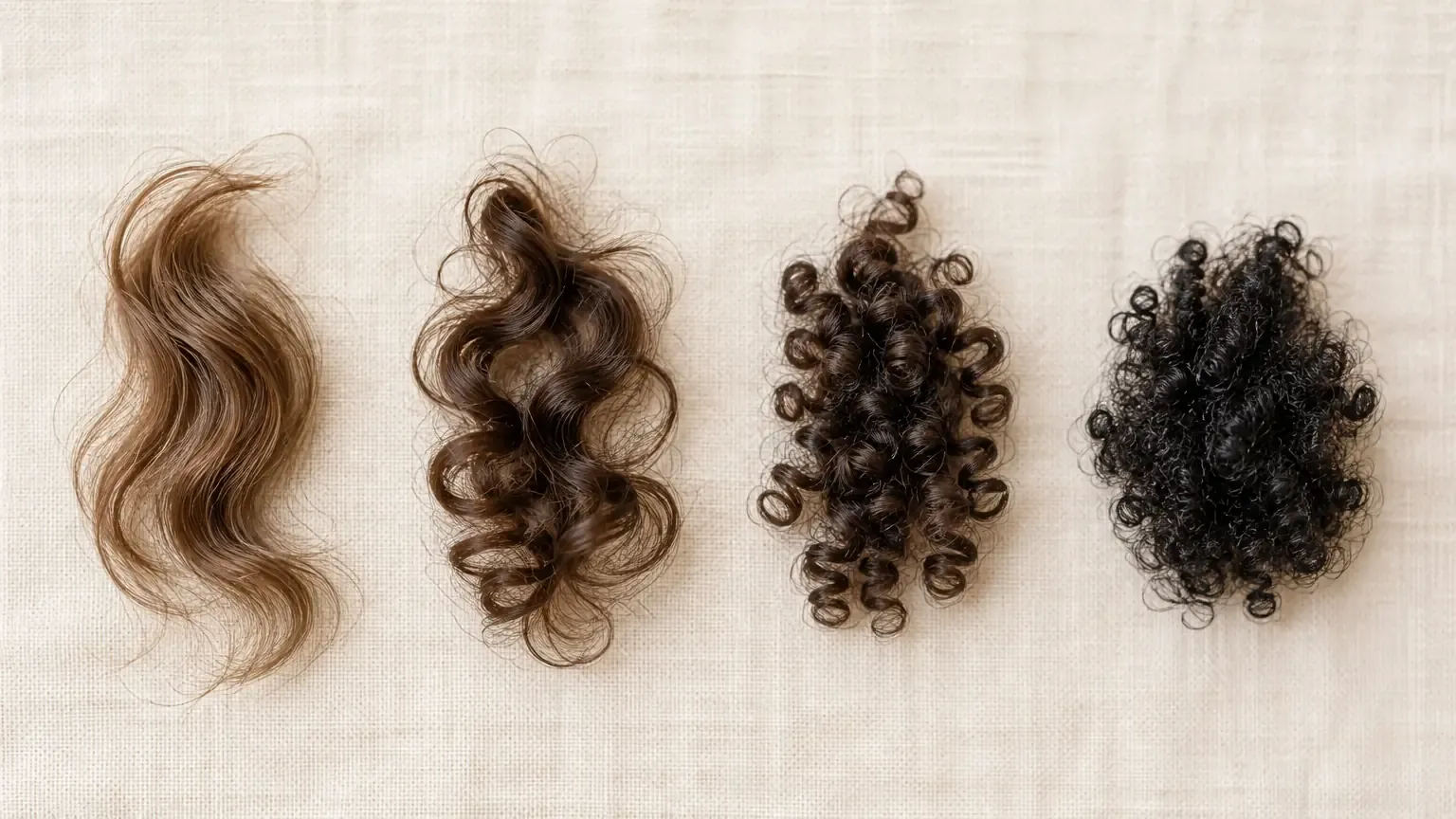
Each hair grows from a small pocket in the skin. In curly hair, that pocket is curved. So the hair grows out curved too 2. The curve causes two problems. First, scalp oil cannot slide down the strand. It gets stuck near the roots while the ends stay dry 12.
Second, curly hair is uneven in thickness. It runs thicker near the scalp and thinner toward the tip. Those thin spots break easily 12. So curly hair feels dry, snaps fast, and tangles more. None of this means you are doing something wrong. It is simply how the hair is built 1.
Will my baby’s hair stay curly?
Curl pattern comes from genes. It is set before birth. No shampoo, oil, or haircut can change it 25. First hair often falls out in the early months. The new hair can look different in both color and texture.
Both shifts are normal, and we cover that timeline in our guide to baby hair care. A baby born straight can curl later. A curly newborn can go straighter. There is no right curl pattern. There is only the hair your baby has.
How often should you wash curly baby hair?
Once a week is enough for most babies. Some families wash every 10 days. That is fine too. But do not wait too long. Going past 2 to 3 weeks can leave the scalp flaky and itchy 3.
This differs from straight hair, which needs washing more often. Curly hair holds little oil, so washing too much strips it fast 6. If flakes appear between washes, that is your cue to wash sooner. A clear calm scalp means your rhythm is right.
Pick a gentle shampoo
Choose a shampoo made for curly hair. Look for the word “moisturizing” on the label. Avoid strong cleaners. One harsh one to watch is sodium lauryl sulfate. It cleans well but dries hair out 7. Gels and creams leave residue over time, so use a “clarifying” shampoo about once a month. It clears the buildup before you follow with your mild shampoo 3.
What about washing with conditioner only?
Some parents skip shampoo and wash with conditioner instead. This adds moisture and cleans gently. But it has a catch. Conditioner cannot clear buildup well. Gel and oil collect on the scalp, and over time flakes and itch appear. If you wash this way, still use real shampoo once or twice a month. That resets the scalp 7.
How do you wash curly baby hair?
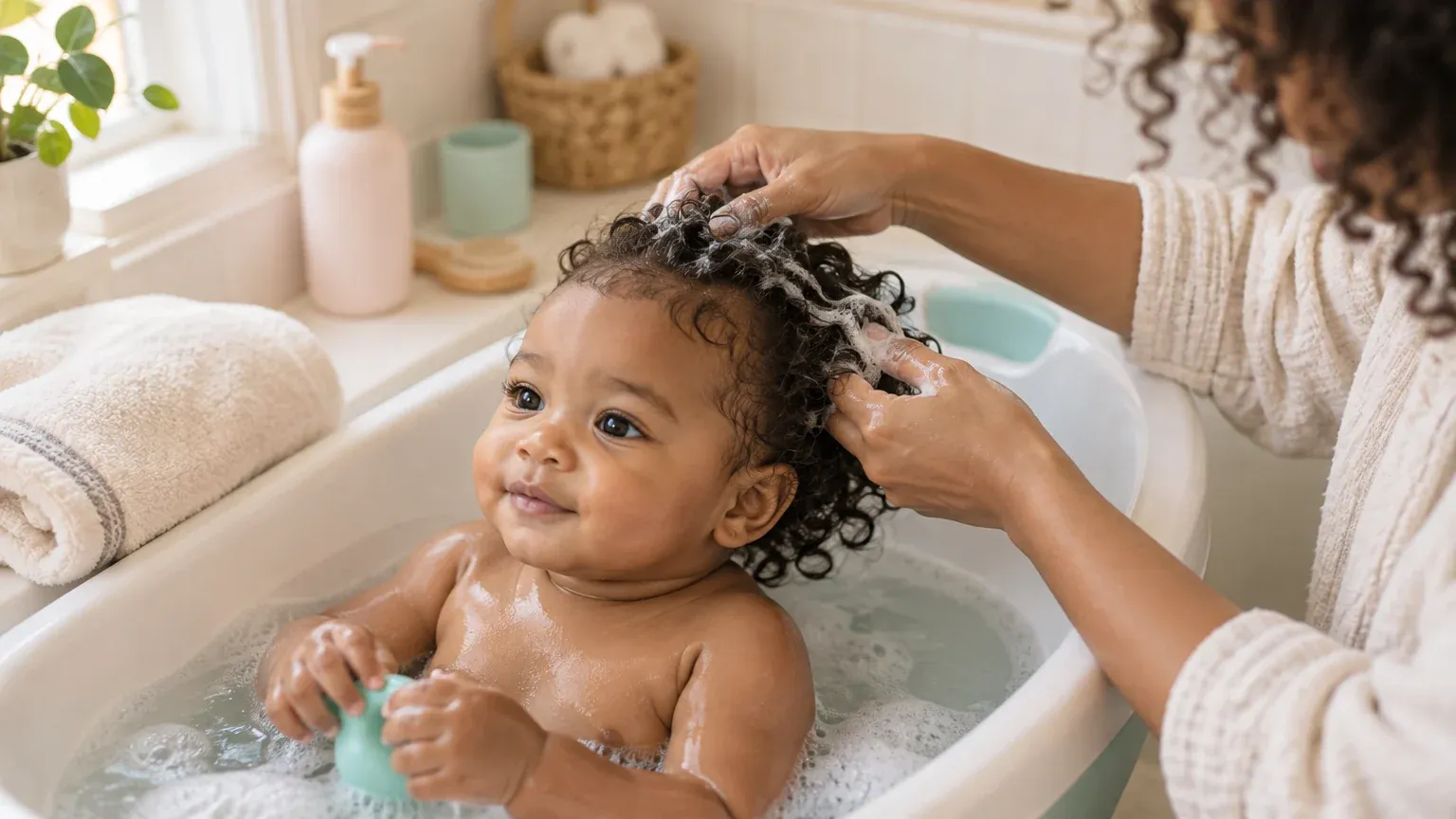
A calm wash day starts with setup. Put shampoo, conditioner, a wide-tooth comb, and a towel within reach. A wet baby will not wait. Wet the hair in sections with warm water, not hot. Thick curls need time to soak through.
Rub a small amount of shampoo into the scalp only. Let the rinse clean the rest. Do not scrub the ends. Then coat the hair from the middle down. Leave the conditioner for a minute or two before rinsing lightly 8.
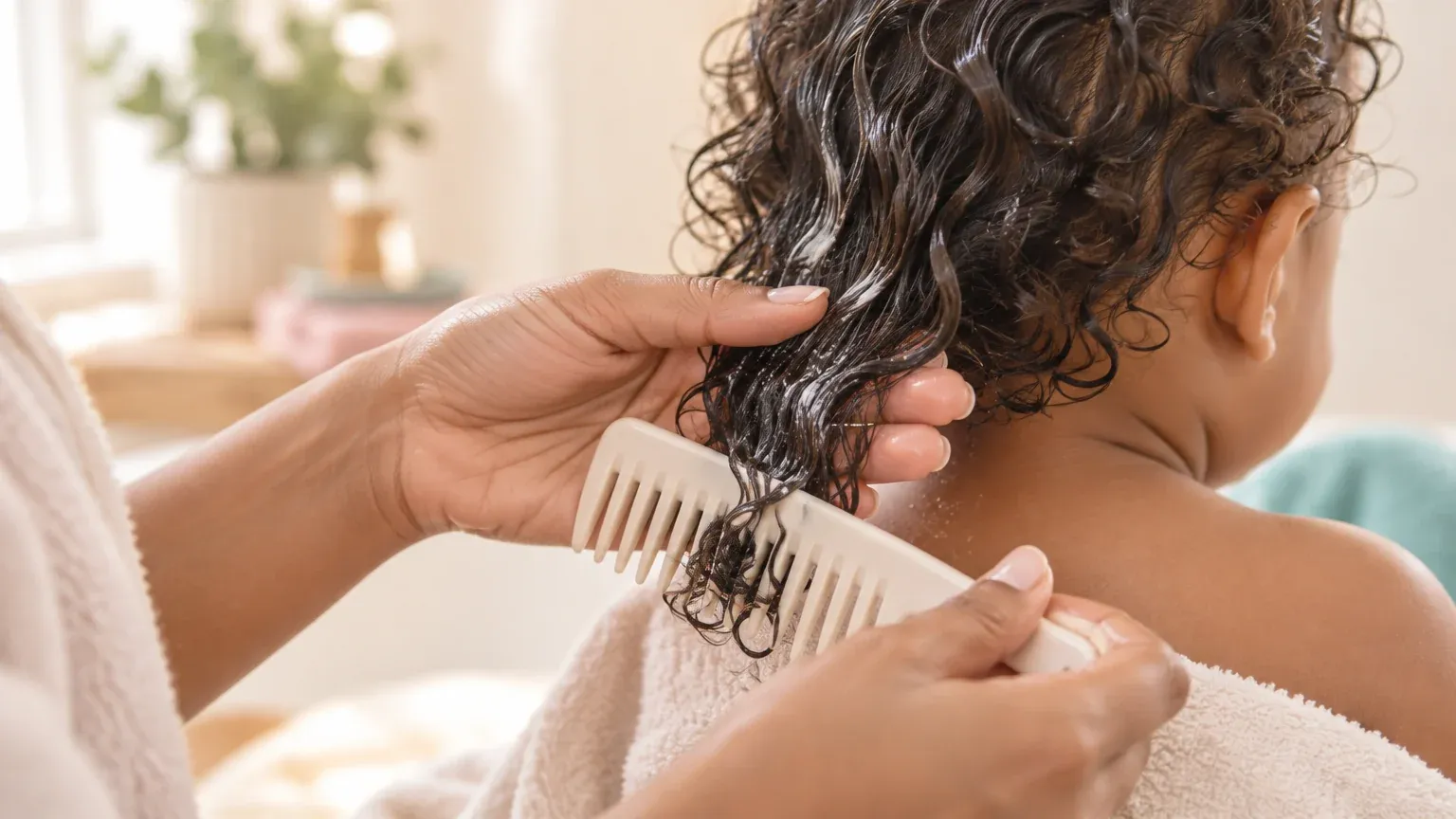
Comb while the conditioner is still in. This is the easiest time to remove knots. Use a wide-tooth comb and start at the ends.
After rinsing, squeeze water out with a soft towel. Do not rub hard. Add cream or leave-in while the hair is still damp. Products take best on damp hair.
How do you keep curly hair moist?
Dry hair breaks, so moisture is the main job. Use three steps in a fixed order. First comes water. Wet the hair or spray it, since only water truly adds moisture. Next comes oil. Smooth a little over damp hair to seal the water in. Coconut oil is a common choice.
Last comes cream. Use a leave-in or curl cream. It holds moisture and shapes curls 7. Oil on dry hair adds no water. It only seals water that is there. So each step belongs on damp hair 7.
Beyond wash day, use conditioner at every wash. Do not skip it, even for a quick rinse 18. Between washes, refresh curls with a leave-in. That avoids a full wash. But do not pile on product. Heavy buildup can clog the scalp 37.

What do label words mean?
You do not need to learn ingredient names. A few label words tell you enough. Glycerin, argan oil, or cetyl alcohol are good signs. They help hair hold water 3.
| On the label | What it means |
|---|---|
| Moisturizing | Good for curls. Adds moisture |
| Sulfate-free | Gentler wash. Less drying |
| Clarifying | Strong cleaner. Use monthly |
| Leave-in | Stays in hair. No rinse |
| Detangler | Helps knots slide out |
| Relaxer or perm | Chemical straightener. Never use on babies 9 |
How do you untangle curls without hurting?
Tangles are the hardest part of curly hair. Go slow and never rush this step. Always start with wet hair plus leave-in or detangler. Wet hair slides while dry hair snaps 3. Loosen small knots at the tips first. Then move up toward the scalp bit by bit.
Never drag from the roots down. That packs knots tighter and pulls hard. A wide-tooth comb beats a brush, though fingers work too 8. Work in small sections and hold the hair above the knot. This keeps the pull off the scalp 3.
If your baby fusses, stop and come back later. A little done calmly beats a full session done upset. Keep one rule absolute: never comb dry curly hair. Dry curls break and frizz.
How do you braid safely?
Tight styles worn over and over can pull hair out. Doctors call this traction alopecia. In plain words, it means hair loss from pulling 4. It builds up slowly as hair breaks near the root. If pulling stops early, hair often grows back. Years of pulling can turn the loss permanent 4.
Keep braids and ponytails loose. They should never tug at the scalp. Use covered bands, since plain rubber catches and tears hair 84. Take braids out within about 2 months. Skip heavy extensions, which pull hard on roots. Change styles often by moving the part. If a style hurts, take it out, since pain is the warning sign.
You can spot damage early by watching for two signs 410. One is a thin rim of fine hair along the edge. Thinner hair sits behind it. The other is the scalp lifting where hair pulls tight. If you see either one, change the style right away. Early action saves the hair.
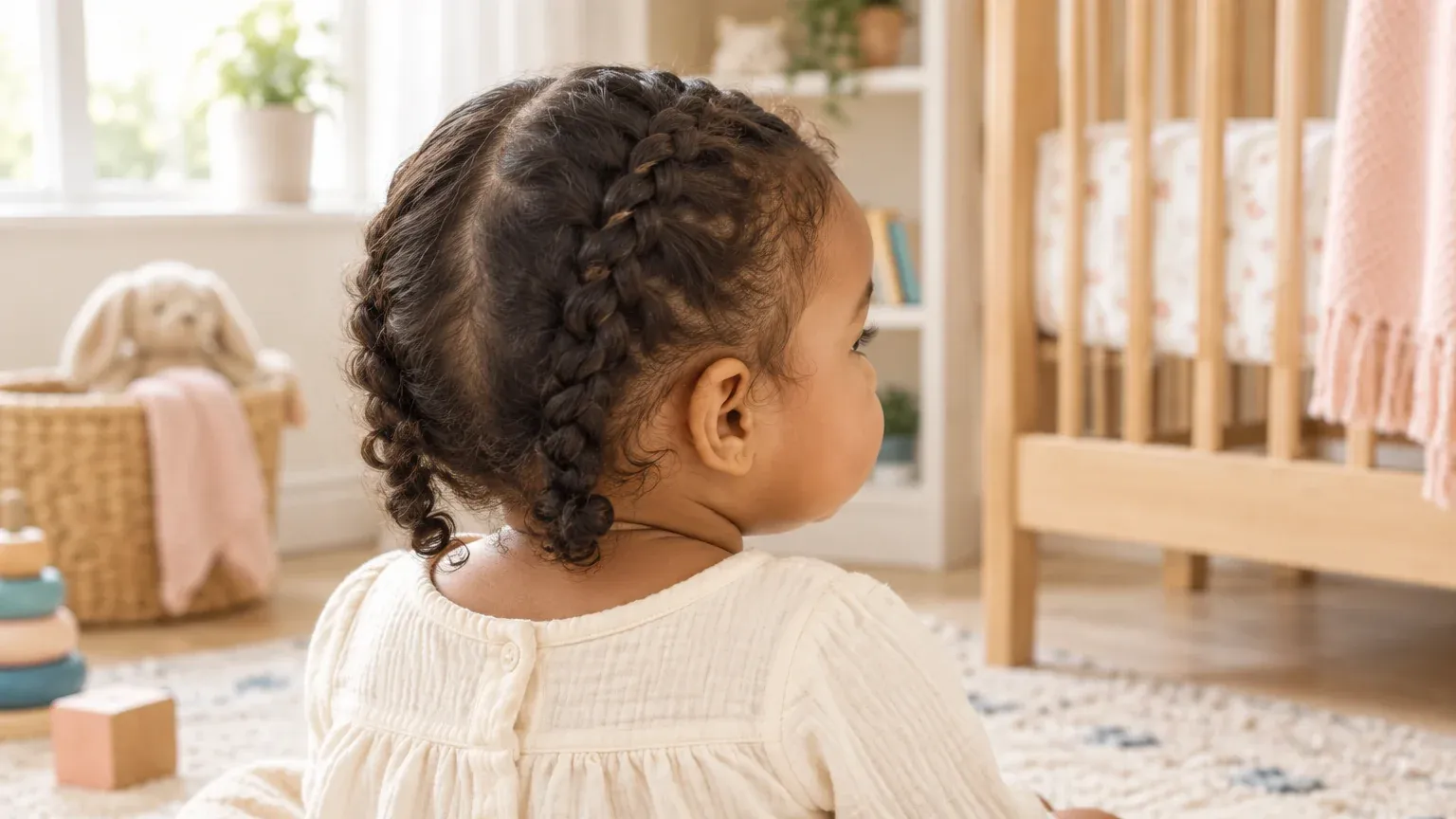
Why skip straightening and heat?
Never use chemical straighteners on a young child. They are also called relaxers or perms. They break bonds inside the hair to force it straight 7. The risks are real. A review of 33 studies linked relaxers to burns, pain, swelling, and hair loss 9.
One study tracked Black girls. Relaxer use roughly doubled the risk of hair loss from pulling. Tight braids plus relaxer raised it over five times 9. Heat is milder but still risky. Flat irons dry and weaken hair. For babies and toddlers, skip both 8.
What about mixed or biracial hair?
A child with parents of different backgrounds can have any curl type. No one can predict it. Waves, curls, or tight coils are all possible 5. One head can even hold more than one pattern. The front may curl one way while the back curls another.
So ignore the label and care for the hair you can feel. Dry hair gets moisture. Tangled hair gets gentle detangling. Coarse patches get more conditioner. These same rules fit every pattern.
When should you call the doctor?
Most first-year hair changes are normal. But some signs deserve a visit. Watch for these:
- Scaly or red patches with hair loss. This may be fungus. It needs medicine by mouth 1112.
- Smooth round bald patches. This may be alopecia areata 13.
- A soft swollen lump with pus. This needs care right away 10.
- No regrowth by 12 months 12.
- A scalp that stays red, crusted, or itchy 4. For the full list, see our guide to why babies lose their first hair. For general wash and cradle cap basics, see baby hair care.
Frequently asked questions
Should I cut hair to make it grow thicker?
No. Cutting does not change how hair grows. It only makes the ends blunt. Blunt ends feel coarser for a while, which fools many parents. The real thickness comes from genes, not scissors 14.
My baby’s hair is always dry. Am I doing it wrong?
Probably not. Curly hair is dry by nature. Keep using conditioner at every wash. Add the three-step moisture routine on top. If dryness persists for weeks, ask your paediatrician 8.
Can I use adult shampoo?
No. Adult shampoo is often too strong for babies. It strips the little oil curly hair has. Use a mild moisturizing baby product instead. Look for “sulfate-free” on the label 7.
When will hair fill in?
Most hair fills in between 6 and 12 months. Some children take longer. Density keeps shifting as the head grows. Bring photos to checkups if you feel unsure 512.
My baby’s texture changed. Is that normal?
Yes. Texture often shifts in the first year. Fine straight newborn hair can turn thicker and curlier. Color can shift too. Both settle down as growth steadies 15.
Keeping track of wash days
Hair changes slowly. Memory alone cannot track it. A monthly photo turns “is it getting better?” into a side-by-side answer. It also helps at the doctor’s office. Wash day details are easy to forget when care shifts hands. A partner or grandparent may wash differently.
So note the date and what you used each time. Log washes in your bath tracker. Share the record with family sync. That keeps routines steady at handover. Our guide to tracking without data anxiety keeps the habit to seconds.
Disclaimer: This article is for information only. It is not medical advice. Talk to your paediatrician or a paediatric dermatologist about your baby’s hair or scalp.
Footnotes
-
Society for Pediatric Dermatology, “Curly/coily hair care,” Patient Perspectives, Equity, Diversity & Inclusion Special Issue, 2021. Adapted from Haskin A, Aguh C. Source ↩ ↩2 ↩3 ↩4 ↩5
-
Cloete E, Khumalo NP, Ngoepe MN. “The what, why and how of curly hair: a review,” Proceedings of the Royal Society A, 2019;475(2231):20190516. Source ↩ ↩2 ↩3 ↩4 ↩5
-
American Academy of Dermatology, “6 curly hair care tips from dermatologists,” reviewed Jun. 2022. Source ↩ ↩2 ↩3 ↩4 ↩5 ↩6 ↩7
-
Afifi L, Maddali A, Alhariri J, et al. “Review of traction alopecia in the pediatric patient: Diagnosis, prevention, and management,” Pediatric Dermatology, 2021;38(S2). Source ↩ ↩2 ↩3 ↩4 ↩5 ↩6
-
Callender V, Burgess C, Harvey VM, Heath C, Mitchell H, Woolery-Lloyd H, et al. “Classification of High Curl Pattern Hair: A Systematic Review and Clinical Perspective,” Journal of Cosmetic Dermatology, 2026;25(4). Source ↩ ↩2 ↩3
-
Punyani S, Tosti A, Hordinsky M, Yeomans D, Schwartz J. “The Impact of Shampoo Wash Frequency on Scalp and Hair Conditions,” Skin Appendage Disorders, 2021;7(3):183–193. Source ↩
-
Society for Pediatric Dermatology, “Curly/Coily Hair Care Tips from Pediatric Dermatologists.” Source ↩ ↩2 ↩3 ↩4 ↩5 ↩6 ↩7
-
American Academy of Dermatology, “Teaching your child healthy hair care habits.” Source ↩ ↩2 ↩3 ↩4 ↩5 ↩6
-
Hatsbach de Paula JN, Basílio FMA, Mulinari-Brenner FA. “Effects of chemical straighteners on the hair shaft and scalp,” Anais Brasileiros de Dermatologia, 2022;97(2):193–203. Source ↩ ↩2 ↩3
-
Xu L, Liu KX, Senna MM. “A Practical Approach to the Diagnosis and Management of Hair Loss in Children and Adolescents,” Frontiers in Medicine, 2017;4:112. Source ↩ ↩2
-
Cleveland Clinic, “Tinea Capitis: Symptoms, Causes & Treatment.” Source ↩
-
Seattle Children’s Hospital, “Hair Loss” (Schmitt Pediatric Guidelines). Source ↩ ↩2 ↩3
-
American Academy of Pediatrics (HealthyChildren.org), “Hair Loss (Alopecia) in Children,” by Keri Wallace, MD, FAAP. Source ↩
-
Cleveland Clinic, “Will Shaving Make Your Hair Grow Back Thicker?” Jan. 2023. Source ↩
-
EADV Pediatric Dermatology Task Force, “Hair in the neonate,” Patient Information Leaflet, 2019. Source ↩