

How Much Crying Is Normal for a Baby? What the Numbers Say
By Simple Baby Tracker Editorial TeamBaby Care
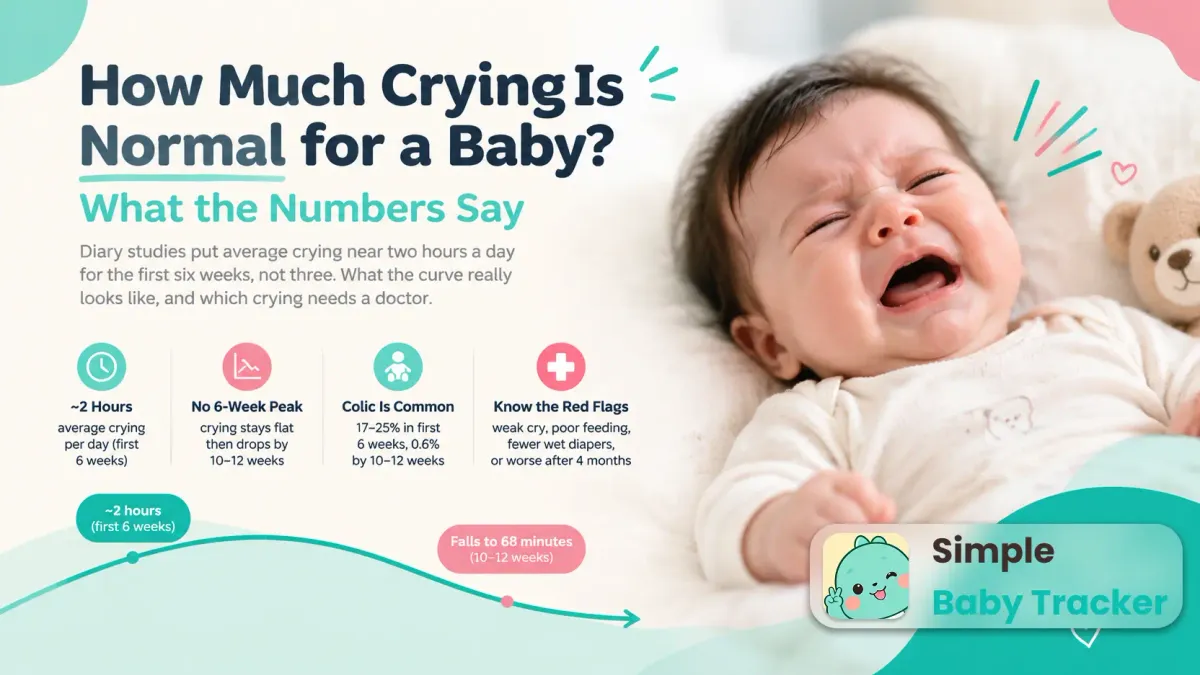
Diary studies put average crying near two hours a day for the first six weeks, not three. What the curve really looks like, and which crying needs a doctor.
Key Takeaways
- The “three hours a day” figure quoted as an average is a diagnostic threshold for colic, not a mean. In a meta-analysis of 8,690 infants, mean fussing and crying was 117 to 133 minutes a day across the first six weeks 123.
- There is no universal six-week peak in the diary data. Crying stayed flat for six weeks, then fell to 68 minutes a day by 10 to 12 weeks 1.
- Colic is common early and rare later: 17% to 25% in the first six weeks, 11% at 8 to 9 weeks, and 0.6% at 10 to 12 weeks 1.
- Crying is not what injures babies. Shaking is. Hospitalizations for abusive head trauma peak at 10 to 13 weeks, later than the crying curve rather than at its worst point 4.
- Normal crying is consolable some of the time, in a baby who feeds and has wet diapers. A weak or high-pitched cry, or a cry that does not sound like theirs, is an emergency 56.
The short answer
Most babies fuss or cry for about two hours a day in the first weeks, more in the late afternoon and evening, and less by three months. That is the shape of it. The number that circulates online, three hours a day at six weeks, is a different thing wearing the same clothes: it is the threshold clinicians use to define colic 23.
| Source | What it says about the peak | The number behind it |
|---|---|---|
| NHS | Crying rises from about 2 weeks and gradually reduces at about 3 months | No figure given 5 |
| AAP | Fussing peaks at about 3 hours a day at 6 weeks, then falls to 1 or 2 hours by 3 to 4 months | 3 hours at 6 weeks 2 |
| Diary meta-analysis, 8,690 infants | No statistical evidence of a universal 6-week peak | 117 to 133 minutes flat for 6 weeks, 68 minutes by 10 to 12 weeks 1 |
Those three statements are not as far apart as they look, and the gap between them is the most useful thing in this article.
Where “three hours” comes from
In 1954, a pediatrician named Wessel proposed a definition of colic that is still in use: crying for more than three hours a day, more than three days a week, for more than three weeks, in an otherwise healthy baby 3. It was a way to make a vague complaint measurable. It was never a description of the average baby.
That definition hardened into folklore. The three hours became “normal” and the six weeks became “the peak.” The two then merged into a sentence that appears on hundreds of parenting sites: babies cry up to three hours a day, peaking at six weeks.
The AAP page says something close, and the phrasing is careful: “The length of this regular fussing usually peaks at about 3 hours a day by 6 weeks old, and then declines to 1 or 2 hours a day by 3 to 4 months of age” 2. Note what that claims. It is a peak of about 3 hours in a fussy period, not an average across the day.
The NHS takes a different route and gives no number at all: crying “tends to increase when they’re around 2 weeks old and then gradually reduces at around 3 months old” 5. That is a curve with a rise and a fall, and no spike in the middle.
What the diary data shows
The best estimate comes from a 2017 systematic review and meta-analysis in the Journal of Pediatrics 1. The authors screened 5,687 papers and pooled 28 diary studies, covering 33 samples and 8,690 infants.
| Measure | First 6 weeks | 8 to 9 weeks | 10 to 12 weeks |
|---|---|---|---|
| Mean fussing and crying per day | 117 to 133 minutes | Not reported separately | 68 minutes |
| Colic, modified Wessel criteria | 17% to 25% | 11% | 0.6% |
| Diary samples pooled | 45 | 9 | 12 |
Two results matter.
The mean held steady, then dropped. Across the first six weeks, the average sat between 117 and 133 minutes a day, with a standard deviation of 66 to 70 minutes. By 10 to 12 weeks it was 68 minutes, with a standard deviation of 46.2. The authors put it plainly: they found “no statistical evidence for a universal crying peak at 6 weeks of age” 1.
Colic collapsed faster than crying did. By modified Wessel criteria, colic affected about one baby in five in the first six weeks. That fell to one in nine at 8 to 9 weeks, and six in a thousand at 10 to 12 weeks. The authors also noted that rates were lowest in Denmark and Japan, which is a reminder that some of what looks biological is cultural 1.
Why the discrepancy with the six-week peak? Three reasons, and all of them are real.
- A mean and a threshold are different numbers. A distribution with a mean of two hours and a standard deviation of about an hour will have a substantial minority above three hours. The tail is what gets described in clinic, and the threshold is what gets remembered.
- Diaries and recall measure different things. A diary captures fussing, which is quieter and more frequent. A parent at a six-week visit remembers the bad evenings.
- Studies disagree with each other. The pooled estimate hides real variation between countries and cohorts, which is exactly why the authors declined to declare a peak.
Why evening is worse
Almost every parent notices that the hardest hours are between late afternoon and bedtime. The AAP puts the fussy period between 6 p.m. and midnight, and notes the obvious: that is when you are also tired 2. The NHS says afternoon and evening are the most common times, and that this is often when you are least able to cope 5.
The explanation is not fully settled, and it is worth being honest about that. What is established is the pattern: crying clusters in the evening in the first months, across countries, in both breastfed and formula-fed babies. What is not established is a single cause.
What the pattern does mean practically is that the evening is not evidence of a problem. A baby who is peaceful in the morning and fractious from 6 to 9 p.m. is following the usual shape. A baby who is inconsolable around the clock, or whose cry has changed, is a different picture.
Colic, and what the label is good for
Colic is a description, not a diagnosis. The NHS defines it as crying more than three hours a day, three days a week, for at least a week, in a baby who is otherwise healthy. It usually stops by 3 or 4 months 6. Wessel’s original version used three weeks rather than one 3. The definitions differ because nobody knows the mechanism well enough to draw a sharp line.
Two things follow.
The label is useful for reassurance and useless for treatment. The NHS is unusually direct here. Anti-colic drops, herbal remedies and probiotic supplements are “not recommended and there’s no evidence they help colic” 6. It also advises against spinal manipulation and cranial osteopathy, because the evidence is thin and the manipulation may hurt 6. That removes most of what is sold for it.
The label can hide something else. Reflux, a feeding problem, cow’s milk protein allergy, constipation and infection can all produce a baby who cries a lot 6. Colic is the answer only after those have been considered, not before.
The gap that matters more than the peak
Here is the finding that changes how you read the curve.
Shaken baby syndrome, now usually called abusive head trauma, has an age curve of its own. One analysis looked at 273 hospitalizations in California between 1996 and 2000. Cases began at 2 to 3 weeks, peaked at 10 to 13 weeks, and returned to baseline by about 36 weeks 4. The authors’ conclusion was that the shape is consistent with early crying as the trigger. The injury peak arrives four to six weeks after the crying peak reported in the same literature.
Read that again. The crying curve goes flat and then down. The injury curve goes up. The risk is highest in the weeks when the crying is improving and the parent is most depleted.
That is why the advice that matters is not “how do I stop the crying.” It is what to do when you cannot.
The ICON program, used by UK health services, reduces it to four lines: infant crying is normal; comforting methods can help; it is OK to walk away; never, ever shake a baby 78. The third line is the one parents are least prepared for, and ICON pairs it with a sentence worth repeating: “Not being able to stop a baby crying does not mean you are doing anything wrong” 7. The instruction is specific. Check the baby is safe, leave the room for a few minutes, and go back when you feel calmer 7.
Said plainly: put the baby on their back in the crib, leave the room, shut the door, and take five minutes. A baby crying safely in a crib is not in danger. A baby being shaken is.
The evidence on whether telling parents this works is mixed, and the honest version is worth stating. In a randomized trial of 2,738 mothers, the PURPLE Crying materials raised knowledge about crying (69.5 against 63.3 points). They also raised knowledge about the dangers of shaking (84.8 against 83.5). Reported behavioral responses to crying, though, did not differ between groups 9. Education moves knowledge. It does not reliably move behavior at 3 a.m.
What is not normal crying
The features below are the ones that turn a crying baby into a medical question. They come from NHS guidance for parents 56.
| Call your doctor or an urgent line today | Call emergency services |
|---|---|
| Crying that is inconsolable and does not sound like their normal cry | A weak or high-pitched cry |
| Not feeding, or feeding much less than usual | A fit or seizure |
| Fewer wet diapers than usual, or none in 8 hours | Blue, gray, pale or blotchy skin, lips or tongue |
| Crying that is getting worse after 4 months | Unresponsive, floppy, or hard to wake |
| You are worried and cannot say why | Breathing fast, grunting, or ribs sucking in |
| Violent projectile vomiting | |
| A rash that does not fade when pressed |
Two of those deserve emphasis because they are easy to miss.
The cry itself is a symptom. A weak or high-pitched cry, or one that does not sound like the baby’s usual cry, is on the NHS list for immediate assessment 6. Parents are good at this and often talk themselves out of it.
The 8-hour diaper is a hard number. No wet diaper in 8 hours is an emergency threshold, not a “keep an eye on it” threshold 5.
Does the crying harm the baby?
No. The injury in abusive head trauma comes from the shaking, not from the sound. That distinction is the whole point of the safety literature, and it is worth holding on to when guilt arrives at 2 a.m.
The longer-term picture is more nuanced, and it should not be flattened into either “it’s fine” or “it damages them.”
A cohort of 342 children followed from infancy to age 28 found that babies with multiple or persistent regulatory problems, meaning crying plus sleep plus feeding problems that co-occurred or continued, had a higher risk of attention problems and an ADHD diagnosis later 10. The signal was in the combination and the persistence, not in the volume of crying on any given evening.
That is a reason to raise persistent difficulties with a clinician. It is not a reason to fear a normal evening.
What is worth recording
The useful record is not a stopwatch. It is four things, kept for about a week: when the crying happens, how long it lasts, whether anything consoles it, and what feeding and diapers did that day.
That pattern is what a clinician asks for, and it is impossible to reconstruct from memory. It also answers a question that a single bad night cannot: is this the ordinary evening cluster, or is it getting worse?
Our mood tracker logs fussy, crying and calm periods in a tap and keeps them beside feeding and sleep, which is the comparison that matters. If the logging itself starts to feel like surveillance, tracking without data anxiety is the counterweight.
Three related guides go deeper. The soothing techniques cover what to do in the moment. Wake windows covers the overtired state that makes evening crying worse. The spit-up guide covers the reflux question that colic gets confused with.
Frequently asked questions
How much crying is normal for a newborn?
About two hours a day on average across the first six weeks, with wide variation: the standard deviation in the pooled data was 66 to 70 minutes 1. Many babies are well above that, and a baby who cries for three hours on a bad evening is common.
Does crying peak at 6 weeks?
Not in the diary data. The pooled mean stayed between 117 and 133 minutes a day for the first six weeks, then fell to 68 minutes by 10 to 12 weeks. The authors found no statistical evidence of a universal peak 1. The six-week timing comes from clinical descriptions, and the three hours from the colic threshold. Neither is an average.
How do I know if it is colic?
The NHS definition is crying more than three hours a day, three days a week, for at least a week, in a baby who is otherwise healthy 6. The behavior matters too: clenched fists, a red face, knees pulled up or back arched, and difficulty soothing.
Do anti-colic drops work?
The NHS says they are not recommended and there is no evidence they help 6. The same applies to herbal and probiotic supplements sold for colic. Ask a clinician before giving anything, and do not use remedies marketed for adults.
Is it safe to let a baby cry for a few minutes?
Yes, if the baby is safe and you are at your limit. Put them on their back in the crib, leave the room, and come back when you have calmed down 7. That is a different act from leaving a baby to cry for long stretches as a sleep-training method. This article is not about that choice.
When should I worry about crying?
Three triggers: a cry that does not sound like theirs, crying with poor feeding or fewer wet diapers, and crying that is getting worse after four months. The first is an emergency; the others need same-day advice 56.
Disclaimer: This article is for informational purposes only and does not constitute medical advice. Crying patterns vary widely between babies, and the averages here describe populations rather than your child. Follow the guidance from your own health visitor or pediatrician. Seek immediate help for a weak or high-pitched cry, a baby who is hard to wake, breathing difficulty, or a rash that does not fade when pressed.
Footnotes
-
Wolke D, Bilgin A, Samara M, “Systematic Review and Meta-Analysis: Fussing and Crying Durations and Prevalence of Colic in Infants,” The Journal of Pediatrics, June 2017. Source ↩ ↩2 ↩3 ↩4 ↩5 ↩6 ↩7 ↩8 ↩9
-
HealthyChildren.org (AAP), “Colic Relief Tips for Parents,” accessed October 2026. Source ↩ ↩2 ↩3 ↩4 ↩5
-
Wessel MA, Cobb JC, Jackson EB, Harris GS, Detwiler AC, “Paroxysmal fussing in infancy, sometimes called colic,” Pediatrics, November 1954. Source ↩ ↩2 ↩3 ↩4
-
Barr RG, Trent RB, Cross J, “Age-related incidence curve of hospitalized Shaken Baby Syndrome cases: convergent evidence for crying as a trigger to shaking,” Child Abuse & Neglect, January 2006. Source ↩ ↩2
-
NHS, “Soothing a crying baby,” reviewed 22 April 2026. Source ↩ ↩2 ↩3 ↩4 ↩5 ↩6 ↩7
-
NHS, “Colic,” reviewed 26 April 2022. Source ↩ ↩2 ↩3 ↩4 ↩5 ↩6 ↩7 ↩8 ↩9 ↩10
-
ICON, “It’s OK to walk away,” updated 7 December 2025. Source ↩ ↩2 ↩3 ↩4
-
ICON, “Never, ever shake a baby,” updated 7 December 2025. Source ↩
-
Barr RG, Rivara FP, Barr M, et al., “Effectiveness of educational materials designed to change knowledge and behaviors regarding crying and shaken-baby syndrome in mothers of newborns: a randomized, controlled trial,” Pediatrics, March 2009. Source ↩
-
Bilgin A, Baumann N, Jaekel J, et al., “Early Crying, Sleeping, and Feeding Problems and Trajectories of Attention Problems From Childhood to Adulthood,” Child Development, January 2020. Source ↩