

Baby Acne vs Eczema: How to Tell Them Apart
By Simple Baby Tracker Editorial TeamBaby Care
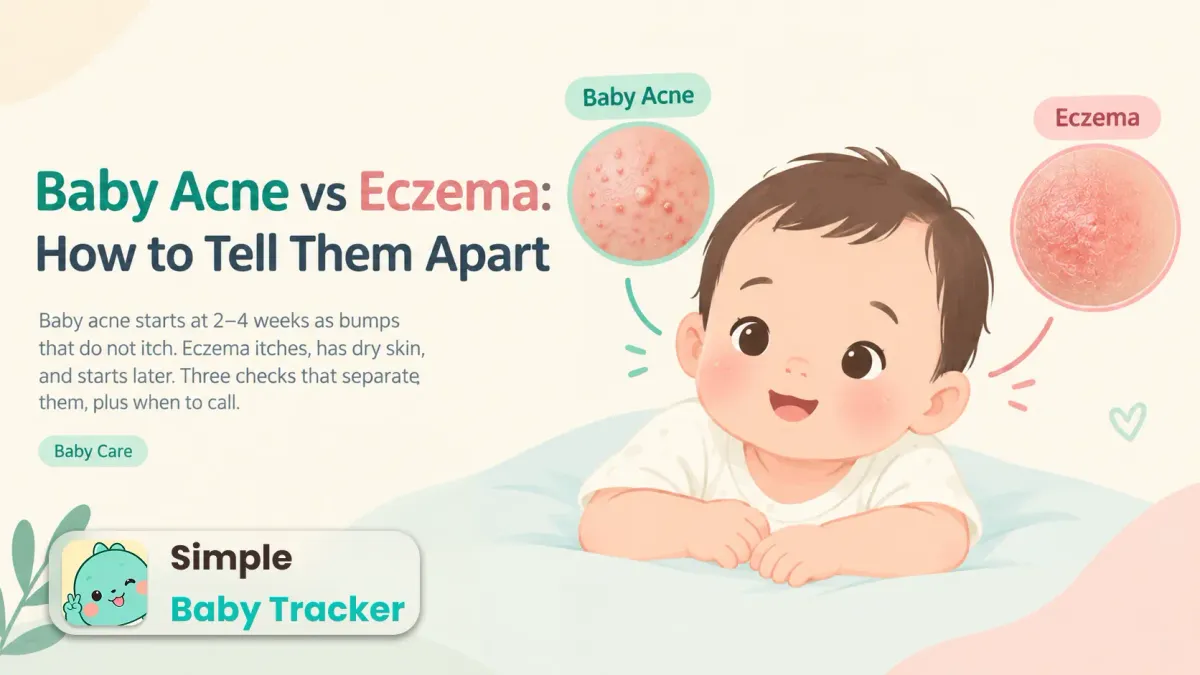
Baby acne starts at 2–4 weeks as bumps that do not itch. Eczema itches, has dry skin, and starts later. Three checks that separate them, plus when to call.
Key Takeaways
- Itch is the divider. Eczema is defined as an itchy skin condition; acne is not defined by itch 1.
- Comedones settle it. Blackheads and whiteheads mean acne. Eczema never produces them, and neither does heat rash 2.
- Timing narrows it fast: in the first 48 hours, erythema toxicum is the usual pustular rash and affected 21.3% of 2,831 newborns; 2 to 4 weeks points to neonatal acne (about 20% of babies); 6 weeks to 12 months is infantile acne 342.
- Neonatal acne clears on its own, with a mean duration of about 4 months in one case series. Infantile acne can scar and is worth a dermatology referral 52.
- Emollients treat eczema but do not prevent it. In a trial of 1,394 high-risk infants, eczema by age 5 was 31% with daily emollients and 28% without 6.
The short answer
Most rashes that get called “baby acne” turn out to be one of five things, and three questions separate them: does it itch, are there blackheads or whiteheads, and when did it start.
| What you see | Most likely | The deciding feature |
|---|---|---|
| Small red bumps and pustules on the cheeks, forehead, or chin at 2 to 4 weeks, no itch | Neonatal acne | Timing, and no itch 4 |
| Blackheads or whiteheads, with inflamed bumps, from 6 weeks to 12 months | Infantile acne | Comedones are the definition of acne 2 |
| Dry, red, scaly patches on the cheeks or scalp, itchy, often worse at night | Eczema | Itch plus dryness, relapsing course 1 |
| Tiny itchy spots in the neck folds, chest, or back during hot weather | Heat rash | Heat, occluded skin, clears in days 7 |
| Blotchy red patches with tiny pale pustules in the first days of life | Erythema toxicum | Appears in the first 48 hours and moves around 3 |
If the rash is dry and itchy, it is eczema until proved otherwise. If it is bumpy without itch and the baby is otherwise well, it is usually acne, and usually nothing needs to be done.
Check 1: does it itch?
This is the most useful question, and the hardest to answer in a baby who cannot scratch.
Eczema is not a rash that happens to itch. Itch is part of the diagnostic definition. NICE diagnoses atopic eczema when a child has an itchy skin condition plus at least three of five supporting features: visible dermatitis in the skin creases, or on the cheeks and extensor surfaces in a child aged 18 months or under; a history of the same; dry skin in the past 12 months; asthma or allergic rhinitis, or atopic disease in a first-degree relative of a child under 4; and onset before age 2, a criterion not applied under age 4 1.
Acne has no such requirement. It is defined by comedones, and it can be tender, but it is not a pruritic disease 2.
In practice, look for the behaviour rather than the complaint:
- Rubbing the face against a sheet, a shoulder, or the mattress
- Scratching with open fingers, or a baby who settles only when the cheek is cooled
- Waking at night with distress that is not hunger
- Scratch marks, broken skin, or small crusts on the cheeks
A baby with acne may be fussy for other reasons, but the rash itself does not drive that behaviour. A baby with eczema usually shows you.
One caution: itch and sleep are linked but not in the way most parents assume. In a birth cohort of 13,988 children, active eczema was associated with a 48% increase in the odds of poor sleep quality, yet total sleep duration differed by about two minutes a day 8. The problem is fragmentation, not a missing hour.
Check 2: are there comedones?
A comedone is a plugged pore: a blackhead (open) or a whitehead (closed). It is the lesion that defines acne, at any age 2.
Eczema does not produce comedones. Heat rash does not either. So if you can see distinct blackheads or whiteheads, the diagnosis has narrowed to acne before you consider anything else.
There is a catch, and it explains most of the confusion in the first month. What parents call “baby acne” at 2 to 4 weeks is often neonatal cephalic pustulosis: small pustules on the cheeks, chin, and scalp that appear at the same age and sit in the differential of acne rather than being identical to it 49. In a follow-up study of 104 newborns, 26 developed it, roughly one in four, and severity did not track with how much Malassezia yeast was on the skin 9.
That matters because it changes what you do with the information. A well baby with a few pustules at 3 weeks does not need an acne cream and does not need a workup. It needs time.
Check 3: when did it start?
Age at onset is the cheapest diagnostic test you own.
| Age window | What typically appears |
|---|---|
| First 48 hours | Erythema toxicum: blotchy redness with tiny pale pustules, often on the trunk, fading and reappearing elsewhere 3 |
| 2 to 4 weeks | Neonatal acne, or neonatal cephalic pustulosis: pustules and red bumps on the cheeks, forehead, chin, and eyelids 49 |
| 6 weeks to 12 months | Infantile acne: comedones plus inflammatory papules, sometimes nodules, on the face, and sometimes the chest and back 2 |
| Before age 2 in most cases | Eczema: dry, itchy, red patches on the cheeks and scalp first, flexures later 1 |
| Any age, in hot weather or heavy clothing | Heat rash: 2 to 4 mm raised spots, itchy or prickly, in folds and covered areas 7 |
Two of those overlap by design. Acne and eczema both peak in the first months, and a baby can have both. When they coexist, treat the eczema and leave the acne alone.
Where the rash sits
Distribution is supportive, not decisive, but it is a useful tiebreaker.
| Condition | Typical location in a baby |
|---|---|
| Neonatal acne | Forehead, cheeks, chin, eyelids; occasionally scalp, neck, and trunk 4 |
| Infantile acne | Face; chest and back in more extensive cases 2 |
| Eczema | Cheeks and scalp in infants; extensor surfaces; skin creases as the child gets older 1 |
| Heat rash | Neck, chest, back, armpits, groin, and anywhere clothing or a carrier traps heat 7 |
| Erythema toxicum | Trunk and limbs, sometimes the face; it migrates 3 |
NICE adds an important caveat that most parent-facing guides omit: in Asian, Black Caribbean, and Black African children, eczema can favour the extensor surfaces rather than the creases, and circular or hair-follicle-centred patterns are more common 1. A rash that does not match the textbook picture is not automatically not eczema.
The two acnes are not the same diagnosis
Neonatal acne appears between the second and fourth week of life in about 20% of babies, with a male-to-female ratio around 4.5 to 1. It clears without treatment. In a series of 22 cases, the mean age at onset was 3 weeks, the mean duration was 4 months, and the cheeks were involved in 81.8% 45.
Infantile acne starts later, between about 6 weeks and 12 months, and it behaves differently. Comedones are present, inflammatory lesions can be nodular or cystic, and scarring is possible. Most cases settle within 6 to 12 months of onset without treatment, but the ones that scar matter, and children who have had infantile acne are at higher risk of severe acne in adolescence 2.
The practical split:
- Weeks 2 to 4, pustules, no comedones, well baby: observe. Gentle washing is enough 4.
- Any time from 6 weeks, comedones, nodules, or scarring: ask for a pediatric dermatology opinion 2.
- Severe or persistent neonatal acne, especially with poor growth or unusual genital findings: this is the one scenario that needs a same-day clinician, because rare androgen excess such as congenital adrenal hyperplasia can present this way 4.
What eczema looks like between flares
Eczema is a chronic, relapsing condition, and the skin between flares is not normal. It is dry. That background dryness is part of the diagnostic criteria, and it is the reason emollients are used every day rather than only when the rash is visible 1.
The itch-scratch cycle explains the rest. Itch leads to scratching, scratching breaks the skin barrier, broken skin itches more, and the cycle continues at night when attention and distraction are lowest.
How common is it? In a Swedish birth cohort of 4,089 children, cumulative incidence by age 4 was 27.1% with no atopic parent, 37.9% with one, and 50.0% with two 10. A German birth cohort, slightly enriched for allergy risk, found cumulative incidence by age 5 of 43% without allergic parents and 57% with one or two 11.
The same German cohort offers the most reassuring number in this article: of 529 children whose eczema began in the first five years, 459, or 87%, reported no symptoms at ages 20 and 30 11. Early eczema is not a life sentence.
What actually helps
Acne
For neonatal acne, the treatment is a mild cleanser and water 4. No scrubbing, no exfoliation, no oils or heavy creams on the affected area. Adult acne products are not a home remedy here: benzoyl peroxide and salicylic acid irritate newborn skin, and topical retinoids and antibiotics belong to specialist care, not the changing table.
Infantile acne that is mild can also be watched. Nodules, cysts, or scarring change the plan and belong with a dermatologist, who may consider prescription treatment to prevent permanent marks 2.
Eczema
Two things do the work: an emollient in quantities most families underestimate, and a prescription steroid for flares.
Emollient, in quantity. NICE recommends 250 to 500 g a week of leave-on emollient for a child with eczema, applied to the whole body, smooth rather than rubbed in, and continued when the skin is clear 1. That is far more than most families use. A 500 g tub that lasts three months is being used at less than a fifth of the lowest recommended rate.
Topical corticosteroid for flares. Potency is matched to severity and site: mild for mild eczema, moderate for moderate, potent for severe. The face and neck get mild potency, with moderate potency only for 3 to 5 days during a severe flare. Potent steroids should not be used under 12 months without specialist supervision 1.
NICE is explicit that the benefits outweigh the harms when these are applied correctly 1. Under-treatment driven by steroid fear is a bigger problem in pediatric eczema than over-treatment, and untreated inflammation is what thickens and damages the skin.
Heat rash
Cool the baby down and wait. Loose cotton clothing, lighter bedding, a tepid bath, and a cool damp cloth for up to 20 minutes. NHS guidance says heat rash usually settles within a few days, and that hydrocortisone cream is not for children under 10 without a doctor’s advice 7.
It is common enough to be worth recognising: a survey of 5,387 Japanese newborns recorded miliaria in 8.5% 12.
What does not help
Emollients to prevent eczema. This is a common piece of advice given to pregnant parents, and the trials do not support it. In the BEEP trial, 1,394 infants with a family history of atopic disease were randomised to daily emollient or standard skin care. By age 5, eczema was reported in 31% of the emollient group and 28% of controls, an adjusted relative risk of 1.10 6. A Cochrane review of skin care interventions reached the same conclusion: emollients in the first year are probably not effective for prevention, may increase the risk of food allergy, and probably increase the risk of skin infection 13.
That does not make emollients useless. It makes them a treatment, not a vaccine.
Elimination diets. NICE puts it carefully: food allergy is sometimes associated with eczema, particularly in very young children, and should be considered when moderate or severe eczema has not responded to optimal treatment, especially with gut symptoms or poor growth 1. It also says most children with mild eczema do not need allergy tests, and that suspected food allergy belongs with specialist investigation rather than a home elimination trial 1.
Breast milk, coconut oil, and other kitchen remedies. None has trial evidence in infant acne or eczema. Coconut oil can clog pores, which is the opposite of what a blocked pore needs.
Waiting for a diagnosis before treating severe eczema. The skin does not pause. If the rash is itchy, widespread, and disturbing sleep, it needs assessment now, not at the next routine visit.
When to call
| What you see | Why it matters |
|---|---|
| A newborn with acne-like pustules plus poor feeding, lethargy, or unusual genital appearance | Rare androgen excess; same-day assessment 4 |
| Infantile acne with nodules, cysts, or scarring | Scarring is preventable with treatment; see a dermatologist 2 |
| Eczema that is blistered, crusty, weeping, or has pus-filled spots | Possible bacterial infection or eczema herpeticum; urgent 14 |
| Eczema that is painful, swollen, warm, or comes with fever | Possible infection; urgent, because herpeticum can progress quickly 14 |
| Eczema not controlled after 7 to 14 days of appropriate topical treatment | The diagnosis or the treatment needs review 1 |
| A rash with fever in a baby under 3 months | Emergency, whatever the rash looks like |
| Purple or black spots that do not fade when pressed | Emergency; this is not acne or eczema |
The last two are not skin-disease questions. They are the reasons a rash deserves a second look rather than a cream.
Photograph it, do not describe it
Rashes are hard to describe and easy to photograph. The single most useful thing you can bring to an appointment is a set of images taken in daylight, at the same distance, on consecutive days, with the date visible.
Note what changed alongside each photo: a new food, a hotter room, a new soap, a fever, a missed emollient. That timeline is what separates a contact reaction, eczema, and an infection, and it is impossible to reconstruct from memory at 8 a.m. in a clinic room.
Our health tracker keeps those notes next to feeding and sleep, and the doctor visit tracker holds the questions and photos you want to raise. For the wider differential, the diaper rash guide uses the same logic in a different area of the body, and the teething vs ear infection vs cold guide applies it to a different set of symptoms. If photographing every patch is starting to feel like a job, tracking without data anxiety is the counterweight.
Frequently asked questions
Is baby acne caused by breastfeeding or formula?
No. Neonatal acne is driven by sebaceous glands responding to maternal and neonatal androgens, not by diet 4. Changing formula or stopping breastfeeding will not clear it.
Does baby acne need to be treated?
Usually not. Neonatal acne clears on its own, and a mild cleanser with water is sufficient 4. The exception is infantile acne with nodules or scarring, which should be assessed 2.
Can baby acne turn into eczema?
No. They are different conditions with different mechanisms, and one does not become the other. They can, however, appear at the same time, and eczema is the one that needs treatment.
Is eczema contagious?
No. It is an inflammatory skin condition, not an infection, so it cannot be passed to siblings or caregivers.
Does eczema mean my baby has a food allergy?
Not usually. NICE advises considering food allergy when moderate or severe eczema has not responded to optimal treatment, especially with gut symptoms or poor growth, but most eczema is not caused by a food. Do not start an elimination diet without guidance 1.
Will my baby grow out of it?
Most do. Neonatal acne clears within months, and infantile acne usually settles within 6 to 12 months 52. For eczema, 87% of children with onset in the first five years were symptom-free by their twenties in one cohort, though relapses before then are common 11.
Disclaimer: This article is for informational purposes only and does not constitute medical advice. Skin conditions in newborns can look alike, and some need urgent care. Always consult your pediatrician or a pediatric dermatologist about a rash, especially if your baby is unwell, feeding poorly, or has a fever.
Footnotes
-
NICE, “Atopic eczema in under 12s: diagnosis and management,” Clinical guideline CG57, 2007, updated 2025. Source ↩ ↩2 ↩3 ↩4 ↩5 ↩6 ↩7 ↩8 ↩9 ↩10 ↩11 ↩12 ↩13 ↩14
-
Poole CN, McNair V, “Infantile Acne,” StatPearls, updated July 2023. Source ↩ ↩2 ↩3 ↩4 ↩5 ↩6 ↩7 ↩8 ↩9 ↩10 ↩11 ↩12 ↩13 ↩14
-
Reginatto FP, Muller FM, Peruzzo J, Cestari TF, “Epidemiology and Predisposing Factors for Erythema Toxicum Neonatorum and Transient Neonatal Pustular Melanosis: A Multicenter Study,” Pediatric Dermatology, July 2017. Source ↩ ↩2 ↩3 ↩4
-
Godínez-Chaparro JA, Cruz HV, “Acne in the newborn,” Boletín Médico del Hospital Infantil de México, September–October 2021. Source ↩ ↩2 ↩3 ↩4 ↩5 ↩6 ↩7 ↩8 ↩9 ↩10 ↩11 ↩12
-
Katsambas AD, Katoulis AC, Stavropoulos P, “Acne neonatorum: a study of 22 cases,” International Journal of Dermatology, February 1999. Source ↩ ↩2 ↩3
-
Bradshaw LE, Wyatt LA, Brown SJ, et al., “Emollients for prevention of atopic dermatitis: 5-year findings from the BEEP randomized trial,” Allergy, April 2023. Source ↩ ↩2
-
NHS, “Heat rash (prickly heat),” reviewed May 2024. Source ↩ ↩2 ↩3 ↩4
-
Ramirez FD, Chen S, Langan SM, et al., “Association of Atopic Dermatitis With Sleep Quality in Children,” JAMA Pediatrics, May 2019. Source ↩
-
Ayhan M, Sancak B, Karaduman A, Arikan S, Sahin S, “Colonization of neonate skin by Malassezia species: relationship with neonatal cephalic pustulosis,” Journal of the American Academy of Dermatology, December 2007. Source ↩ ↩2 ↩3
-
Böhme M, Wickman M, Lennart Nordvall S, Svartengren M, Wahlgren CF, “Family history and risk of atopic dermatitis in children up to 4 years,” Clinical & Experimental Allergy, September 2003. Source ↩
-
Hung CW, Roll S, Icke K, et al., “Incidence and Remission of Atopic Dermatitis in a German Birth Cohort,” JAMA Network Open, December 2025. Source ↩ ↩2 ↩3
-
Hidano A, Purwoko R, Jitsukawa K, “Statistical survey of skin changes in Japanese neonates,” Pediatric Dermatology, February 1986. Source ↩
-
Kelleher MM, Phillips R, Brown SJ, et al., “Skin care interventions in infants for preventing eczema and food allergy,” Cochrane Database of Systematic Reviews, November 2022. Source ↩