

How to Choose a Baby Stroller: Safety Checklist
By Simple Baby Tracker Editorial TeamBaby Care
A stroller's real safety is set by the standard it meets, not its price. What half a million injury records and independent lab tests say to check, and what to skip.
Key Takeaways
- Price tells you almost nothing about safety. In one Australian lab, a $2,599 pram scored lowest of 49 models tested, while a $330 pram passed every test. In a 2026 German test, a €1,060 stroller and a €450 stroller both earned a “good” rating 12.
- The most common way a stroller injures a child is a fall out of it. In US emergency-department data covering 1990 to 2010, 76% of stroller injuries were falls, and the median age of an injured child was 11 months 3.
- An unrestrained child is the load-bearing hazard. One 14-month-old died after climbing on the outside of a double stroller and getting his neck caught between the canopy tube and the armrest. His father was nearby and could not see him 4.
- A stroller is not a place for sleep unless its seat lies genuinely flat. US regulators found 1,108 incidents and 73 infant deaths in inclined sleep products 5.
- Before you buy, ask for the standard number on the label rather than judging the price tag. A compliant stroller carries it. A non-compliant one often cannot 67.
The short answer is simple enough to memorise. Buy a stroller that meets the current safety standard for the country you live in, that your child fits with room to grow, and that you can fold, lift and push without help.
That is the whole decision. Everything else — the brand, the fabric, the number of configurations in the brochure — is a preference. The evidence base for this claim is unusually good, because strollers are one of the most heavily studied pieces of children’s equipment in existence.
The problem is where that evidence lives. It sits in federal injury databases, mandatory-standard rulemaking, and independent laboratory testing that most parents never see. This guide pulls it into one place, in the order the decisions actually matter.
Safety is a standard, not a price
Start here, because almost every mistake in this product category starts with the assumption that a more expensive stroller is a safer one.
It is not. In its most recent review, the Australian consumer organisation CHOICE tested 49 prams and strollers and found serious safety failures in 15 of them. The lowest-scoring model in the whole test was the iCandy Peach 7, at A$2,599. Testers found its shoulder and waist straps did not separate automatically when the buckle was pressed, creating a loop that could strangle a child, and that a fully reclined seat created a head-entrapment and fall risk. The pram failed CHOICE’s safety tests and, in the lab’s assessment, the mandatory standard as well 1.
Meanwhile, in a 2026 test by Stiftung Warentest with the Austrian consumer organisation VKI, the €450 Hauck Move N Care matched the “good” rating of a stroller costing €1,060. The testers’ own conclusion was blunt: a high price is no guarantee of high quality 2.
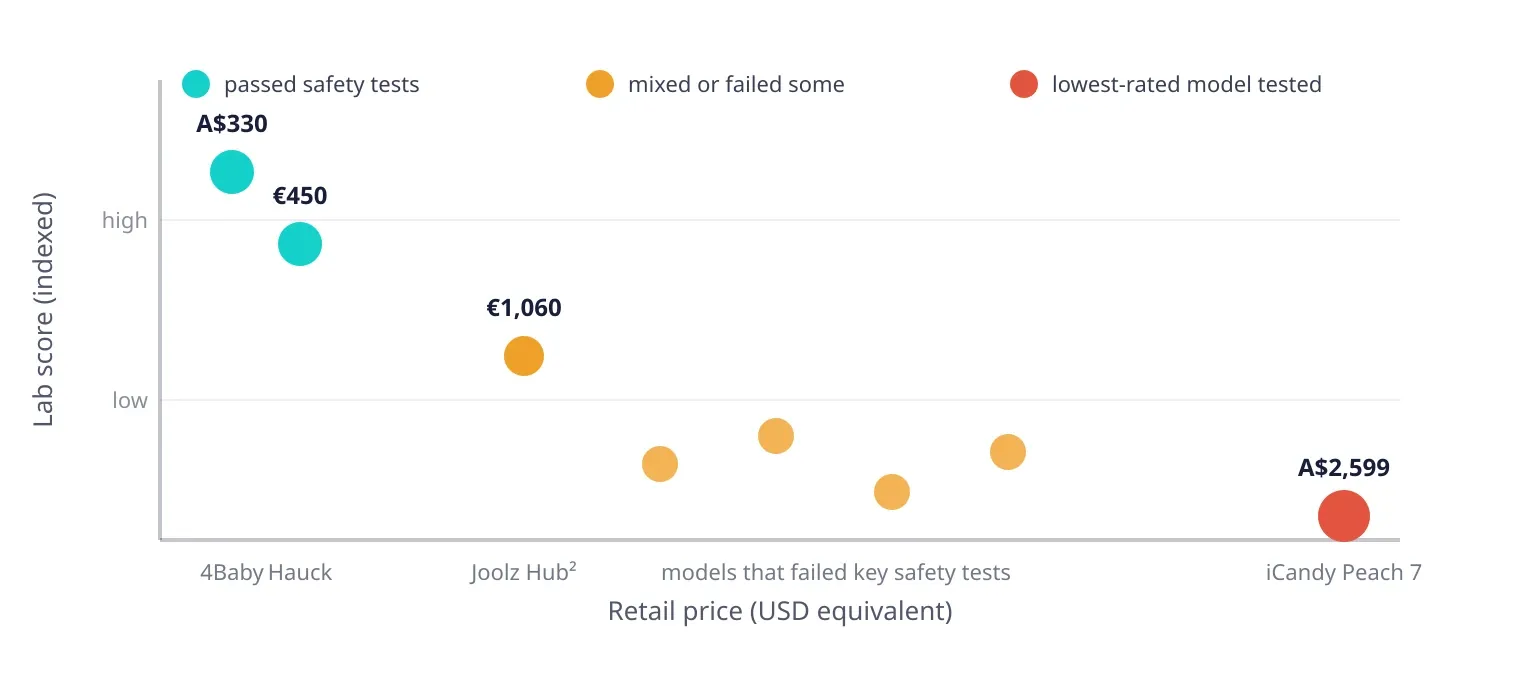
Independent 2026 test rounds in Australia and Germany, plotted by price. The most expensive pram tested scored lowest of 49 models; a €450 stroller matched the top rating of a €1,060 one. Prices shown in the currency of each test.
Both labs buy the products themselves and neither accepts manufacturer samples, which is what makes the comparison meaningful 18.
The three markets you can actually buy in
There is a second reason price does not track safety: compliance with US federal law is mandatory but self-certified. Manufacturers and importers must issue a Children’s Product Certificate stating the stroller meets the standard, and that certificate is based on third-party testing — but nobody approves the stroller before it is sold 6.
The consequence shows up in enforcement. In August 2024, the US Consumer Product Safety Commission warned consumers to stop using and dispose of COLOR TREE strollers because a child’s head could be trapped between the seat and grab bar. The notice stated the products violated the federal stroller regulation; the two importers were unresponsive to a recall. The strollers had sold on Amazon, Walmart, eBay and a direct site for $90 to $120 7.
In May 2025, CPSC issued the same kind of warning for Magic ZC model V9 travel systems, again for an opening between the seat and grab bar that could entrap a baby. The strollers had been sold as 2-in-1 and 3-in-1 travel systems 9.
The practical rule that falls out of this is narrower than “buy expensive”:
- Buy from a brand that will still exist to run a recall, and that has a real customer-service channel.
- Buy from a seller who can tell you which standard the stroller was tested to.
- Treat the very cheapest unbranded imports on open marketplaces as the highest-risk category, because that is exactly where non-compliance has been found.
What the label must say
The standard is not a marketing claim. It is a numbered document, and compliant products carry its number.
| Market | Standard to look for | What it covers |
|---|---|---|
| United States | ASTM F833, under 16 CFR Part 1227 10 | Stability, brakes, restraint, folding latches, frame integrity, cords, wheel detachment, entrapment |
| EU and UK | EN 1888, or BS EN 1888 in the UK 1112 | Pushchairs and prams to 15 kg, plus a part covering 15–22 kg |
| Australia and NZ | AS/NZS 2088 13 | Design, construction, performance, testing, warnings, labelling |
In the US, the currently incorporated edition of the standard is ASTM F833-21, which the commission approved on 15 June 2021 and which became effective on 15 February 2022. If a stroller’s paperwork cites a 2015 or 2019 edition, that is not evidence of failure — it is evidence that the paperwork is stale, and worth asking about 14.
The injury data, and what it changes
If you look at how strollers actually hurt children, the picture is consistent across twenty years, three countries and two continents.
The largest study of the question analysed US emergency department records for children aged 5 and under from 1990 to 2010: an estimated 360,937 injuries, an average of 17,187 a year. Stroller patients were most often male (52.4%) and younger than one year (42.0%). The head (43.0%) and face (31.0%) were the most commonly injured parts. The most frequent diagnoses were soft-tissue injuries (39.4%) and traumatic brain injuries or concussions (24.6%) 3.
An earlier study covering 1994 to 1998 found the same shape and added the number that matters most: 76% of injuries resulted from a fall from the stroller 15.
US federal reporting for 2023 tells you the scale today. Strollers and carriages were associated with an estimated 7,000 emergency-department-treated injuries in children under five, out of 60,400 across all nursery products — the third-largest product category, up from 6,600 in 2021 16.
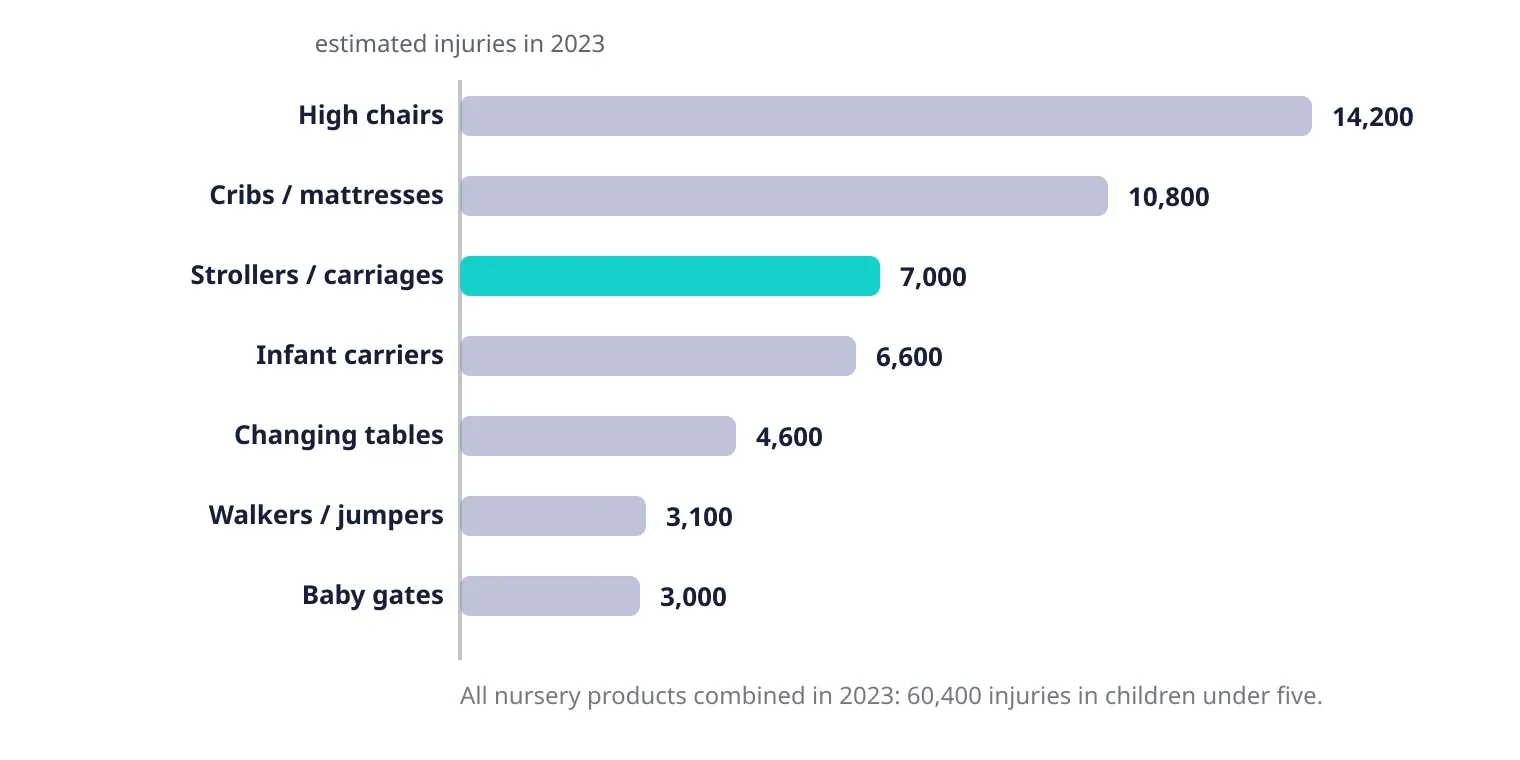
Strollers and carriages are the third-largest nursery product injury category in US emergency departments, and the estimate has risen slightly each year from 2021 to 2023 without reaching statistical significance.
Deaths are far rarer. Between 2019 and 2021, CPSC staff received reports of five stroller- or carriage-associated deaths across three years — an average of two a year. That is roughly 1% of the reported deaths associated with nursery products in the same period 16.
Two things follow from those numbers.
First, the harness is the component that matters most. The US standard treats it as mandatory, and the alert shows why. A child’s body can pass through the opening between the handrest bar or stroller tray and the seat bottom, while the head and neck become trapped at the top. The alert warns this is a particular risk for children under 12 months, notes that babies only weeks old can move around while asleep, and says never to leave a child unattended — especially with the backrest reclined 17.
Second, the most dangerous moment is not the one on the road. It is the stroller parked at home, or a toddler climbing on a stroller that is not moving.
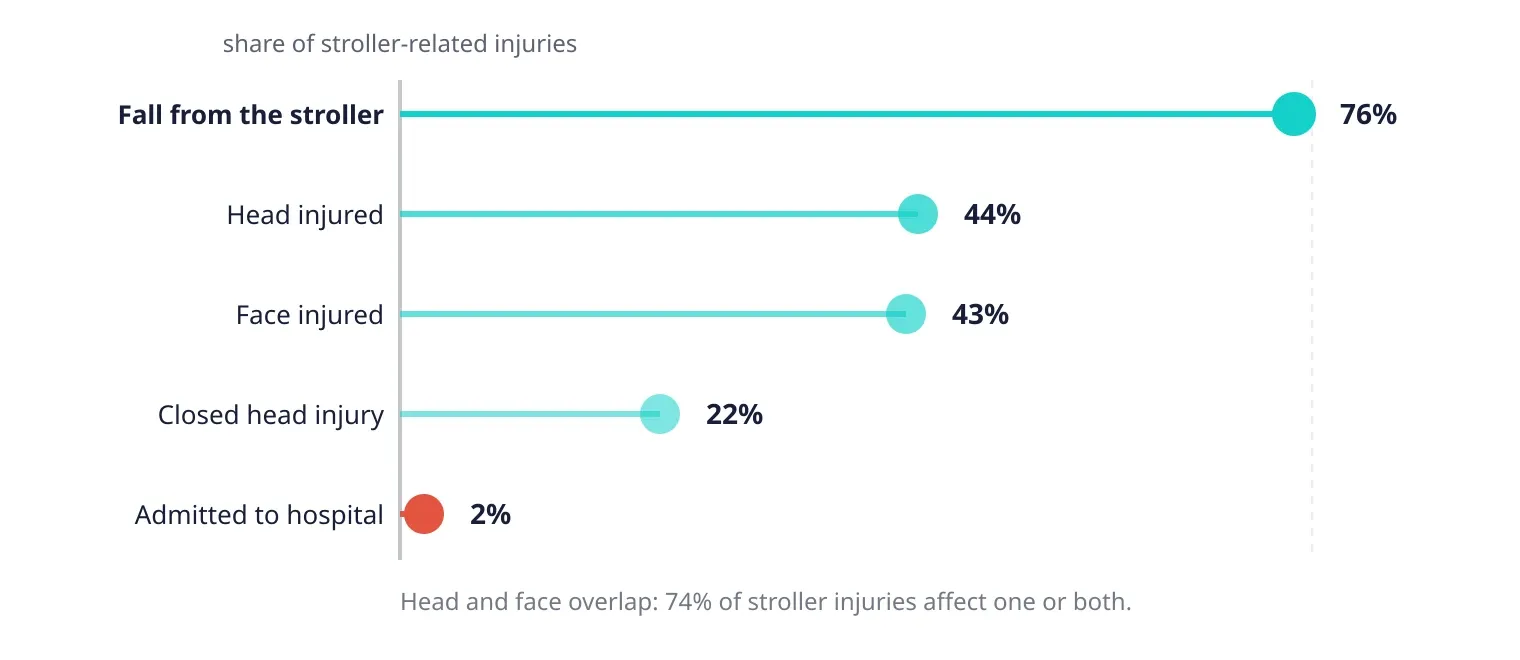
US emergency department data for children aged 3 and under, 1994–1998. Falls dominate every other mechanism, which is why a correctly fitted five-point harness is the single highest-value feature on a stroller.
The hazard that only appears when the stroller is parked
This is the part of stroller safety that no showroom test reveals, and it kills children who were never in the seat.
In February 2023, CPSC and Baby Trend warned about a head and neck entrapment risk between the pivoting front canopy and the armrest or seat back of Sit N’ Stand Double and Ultra strollers. The manufacturer had received a report of neck entrapment between the front of the canopy tube and the armrest of a double stroller. The child was a 14-month-old who was not an occupant — he had climbed on the outside of the stroller while his father was nearby but unable to see him. He died of asphyxiation. A second report described neck bruises in a 17-month-old who was only partially secured 4.
The mitigating steps the warning gives are free, and they apply to almost any stroller: remove and separately store the canopy when it is not in use, do not let children play on or climb on strollers, and always secure a child with all five points of the harness 4.
A second parked-stroller hazard is the tip-over. The physics are unforgiving: a stroller is a light vehicle with a narrow track and a high centre of mass, and hanging a loaded bag on the handlebar moves that centre of mass backwards and upwards. In one lab, Consumer Reports found a compact stroller that tipped at less than 12 degrees of incline with a 45-pound weight in the fully reclined seat, and rated it “Don’t Buy.” Its testers described an ordinary scenario: a parent pushing uphill, briefly taking their hands off the handle, with the seat reclined 18.
Three habits remove most of that risk:
- Never hang bags on the handlebar; use the basket under the seat, within its stated weight limit.
- Put the seat upright before you let go, and keep a hand on the stroller on any slope.
- Choose a model with a parking brake you can apply and confirm without looking.
The brake point is not cosmetic. It is the reason the current US standard added a proper test for it. ASTM F833-21 replaced the old wording — a brake that “cannot be disengaged by the child” — with three defined test methods. The brake must sit outside a defined access zone above and around the seat, or require a force above 10 lbf (45 N), or use a double-action release that needs two deliberate movements. CPSC’s assessment was that the old wording left the judgement to individual lab staff and produced inconsistent results 14.
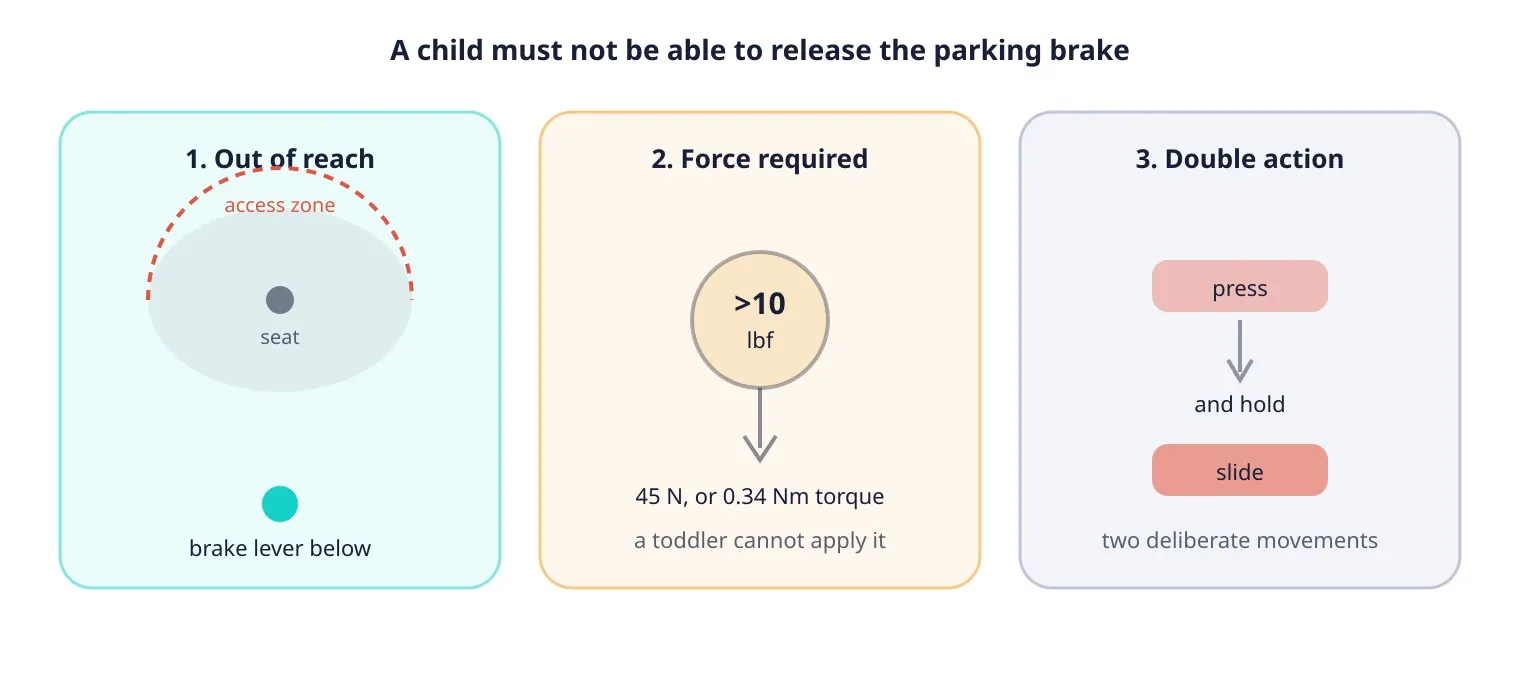
The three routes to compliance added to the US standard in 2021. Before that, the rule only said a brake “cannot be disengaged by the child”, which regulators found left the judgement to individual lab staff and produced inconsistent results.
Weight limits, and the number that matters more
Every stroller carries a maximum child weight, usually shown on a pictogram on the frame. Those limits are not marketing — they are the load the standard’s tests used.
The European standard splits the category. EN 1888-1 covers pushchairs and prams designed for one or more children up to 15 kg each, plus 20 kg for any integrated platform a child can stand on. EN 1888-2 covers the heavier group, above 15 kg up to 22 kg 11. In the US, the ASTM standard’s tests are written around specified test masses rather than a single headline number.
The number parents underestimate is the stroller’s own weight, not the child’s. In the 2026 Stiftung Warentest round, single strollers with a carrycot or seat weighed between under 10 kg and around 14 kg. The heaviest double strollers came in at just under 23 kg 2.
That matters because you will lift this thing — into a car boot, up a flight of stairs, onto a bus — hundreds of times, often holding a baby. A stroller that is 4 kg heavier than the alternative is not 4 kg heavier at the end of the day; it is 4 kg heavier every time.
Fold, boot and one hand
Fold quality is the most over-promised and most testable attribute in the category.
Which? has been testing pushchairs for more than 50 years and bought the strollers it tests. Its lab folds and unfolds each model and then places the folded result into the boot of a Ford Focus to measure the space it actually occupies. Its finding is that many “one-hand fold” claims require you to remove the seat, fold the hood, or complete some other two-handed step first 8.
You can test this yourself in the shop, and you should, because it takes ninety seconds:
- Fold it one-handed, with a bag in your other hand. If you need both hands at any point, the claim is marketing.
- Pick the folded package up by its stated carry point and hold it for ten seconds.
- Measure the folded dimensions with a tape and compare them to your car boot, not to the brochure.
- Unfold it while holding a phone in one hand. If you cannot, imagine doing it in rain, in a car park, with a crying baby.
- Put the seat upright and fully recline it, and check the harness adjustment without re-threading straps through the backrest.
That last point is worth dwelling on, because it affects you every day rather than once. Which? scores a harness that adjusts from the front of the seat above one that requires you to re-thread the shoulder straps through the backrest 8. A harness you find annoying is a harness you will not tighten properly — and the harness is the component that prevents the single largest category of stroller injury.
Wheels, brakes and the ground you actually walk on
Stroller marketing has invented a vocabulary of terrain — city, all-terrain, travel — that maps only loosely to what the wheels do. The useful physical facts are smaller and more honest.
Brakes are independently tested, and they fail. In CHOICE’s 49-model review, some prams’ wheels could move even when the parking brake was engaged. That was one of the failure types contributing to 15 of 49 models failing the lab’s key safety tests, alongside fall risk, tip-over, removable harnesses, strangulation and head entrapment 1. A stroller whose brake cannot hold on a slope is not a stroller you can park.
The stability requirement is about your hill, not a flat shop floor. EN 1888 defines a maximum angle of inclination for a pram body when tested with a test mass and a 50 N downward force applied at the middle of the handle 12. The point of the test is that the stroller must not tip when you take your hand off it on a slope. When you try a stroller, apply the brake on the steepest surface you can find outside the shop and let go — briefly, with a hand ready.
Structural durability is tested in cycles, and the tests are brutal. The EN 1888 irregular-surface test runs a loaded stroller over a bumpy course 72,000 times at 5 km/h. The handle durability test raises and lowers the handle 10,000 times. Attachment devices between the seat and chassis are operated 200 times and then loaded to check nothing dislodges 12. Which?’s version of the same idea wheels each pushchair more than 200 km on a bumpy treadmill — roughly London to Birmingham — with a baby’s weight in the seat and a full basket 8.
That is the standard your stroller should survive. It is also why the frame flexes you feel in the shop, the rattle in the handle, and the wobble in a wheel matter more than the fabric pattern.
Sleep, flatness and the car-seat question
This is the section where getting it wrong has the highest cost, and where the marketing is most aggressive.
The core finding is from US federal safety work. CPSC cited 1,108 incidents and 73 infant deaths related to infant inclined sleep products between January 2005 and June 2019. The agency’s commissioned biomechanics testing concluded that none of the inclined sleep products tested was safe for infant sleep, and that products with inclines of 10 degrees or less, with flat and rigid surfaces, were likely safe 5. CPSC’s advice is direct: do not use car seats, bouncers and other inclined products for sleep, and put babies to sleep on their backs on a firm, flat surface 5.
Now apply that to the most popular stroller configuration sold today: the travel system, where an infant car seat clicks onto a frame.
A car seat on a stroller is a reclined, semi-upright seat, and the child in it is often asleep. That is exactly the configuration regulators warn about. A UK autopsy series covering 16 years identified 14 infant deaths that occurred while the infant was seated in a car seat. Ten of those 14 — 70% — happened while the car seat was being used outside the car, including as a replacement for a cot or high chair. Every death among infants using the seat appropriately in a car had an underlying medical cause; there were no cases of previously healthy infants dying in car seats used correctly for transport 19.
A US study of car seat injuries outside the car found the same pattern of misuse. It counted 43,562 emergency-department injuries to infants from 2003 to 2007. The most common mechanisms were infants falling from car seats, car seats falling from elevated surfaces, and car seats overturning on soft surfaces. The average age was 4.07 months, 62.4% of the injuries were in infants under four months, and 84.3% of the injured infants had a head injury 20.
Two rules follow, and they are simple enough to memorise:
- A car seat on a stroller is a transport device, not a bed. If the baby falls asleep, finish the journey and move them to a flat surface. Do not leave a sleeping baby in a car seat on a stroller frame, and never place a car seat on a bed, sofa or table.
- If you want the stroller to be sleep-capable, buy a genuine lie-flat seat or a carrycot. Which? checks whether seats recline far enough to be a safe sleep surface for a newborn 8. CHOICE’s testers took the opposite case seriously: on a stroller reclined fully, a head could be trapped between the head barrier and the end of the seat, which was one of the failures behind its 15-of-49 result 1.
The Australian labelling rules capture the same distinction usefully. A stroller whose backrest does not recline past 130 degrees must carry a permanent label reading “NOT RECOMMENDED FOR A CHILD UNDER 6 MONTHS OLD.” A stroller that reclines past 150 degrees must have a head barrier that does not create an entrapment hazard 13. If you are choosing one stroller for a newborn, that is the axis to shop on.
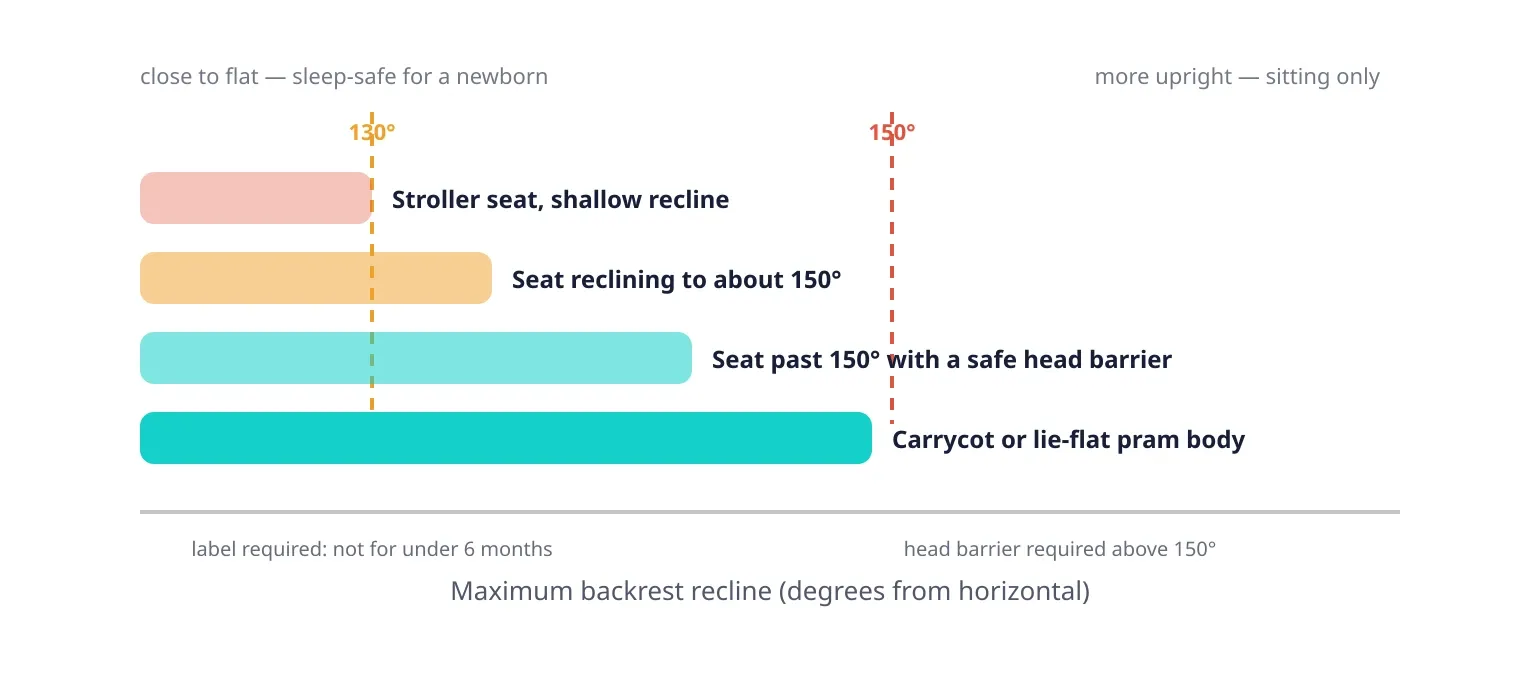
Australian labelling rules mark the two thresholds that matter for a newborn: below 130° recline a stroller must carry a “not recommended for a child under 6 months old” label, and above 150° it must have a head barrier that does not create an entrapment hazard.
Chemicals in the fabric, and what the tests found
This is the newest area where independent testing has changed the picture, and it does not map to price either.
In July 2026, Stiftung Warentest and VKI tested twelve strollers — nine combination strollers and three double or sibling models. Only four were rated good overall; three were average, one was less satisfactory and four were unsatisfactory. In two strollers, the plasticiser DEHP was found at levels above the legal limit, in a seat bar and in a supplied weather cover. Testers also found PFAS — per- and polyfluoroalkyl substances, used to make textiles water- and stain-repellent — in several models. No model was found to have serious safety defects, and all were described as extremely robust 2.
Three clarifications keep this in proportion.
DEHP is not a grey area. US federal law prohibits children’s toys and child care articles containing more than 0.1% (1,000 ppm) of DEHP in an accessible plasticised component, alongside seven other phthalates, and a stroller sold for a child’s use falls within that regime’s scope for its accessible parts 21.
The direct health risk from contact is low. VKI’s own assessment was that PFAS bound into the material pose no immediate health danger to children through contact. The concern is environmental: those substances escape during manufacture, use and disposal 2.
The older finding points the same way. A much earlier German test round, reported in 2005, found that two out of three buggies tested carried harmful substances in handles, seat surfaces and textiles 22.
What this means for a buying decision is modest but real. You cannot test fabric yourself. You can prefer brands that publish their chemical testing, you can air a new stroller’s fabrics before heavy use, and you can treat a weather cover or rain shield that smells strongly of plastic with suspicion. Beyond that, this is a reason to buy from a manufacturer with a reputation to protect, not a reason to buy the most expensive option.
The ergonomics test nobody does in the shop
The 2026 German test included a finding that is easy to dismiss and expensive to ignore: on some strollers the handlebar could only be adjusted within a narrow range, and a few had a fixed handlebar height. For a very short or very tall parent, that is not a comfort issue — it is a daily posture problem, and it changes how well you can steer a loaded stroller 2.
VKI’s recommendation is the most practical sentence in the whole test report: push the stroller in the shop, and also try folding it, carrying it and fitting it into your car 2.
Which? scores exactly this, and weights it heavily. Its overall score is 75% daily use — of which 40% is manoeuvrability alone — 15% ergonomics and 10% storage. To become a Best Buy, a single pushchair must score at least 77%, and a double at least 70% 8.
Their course is worth copying. It includes tight corners and dead ends, kerbs up and down, and surfaces designed to replicate gravelly car parks, sand and bumpy grass. Testers mark down a stroller that has a wobbly frame, an uncomfortable handlebar, or a basket that catches kerbs when full. They check whether the brake is easy to see and whether it has colour indicators showing it is engaged 8.
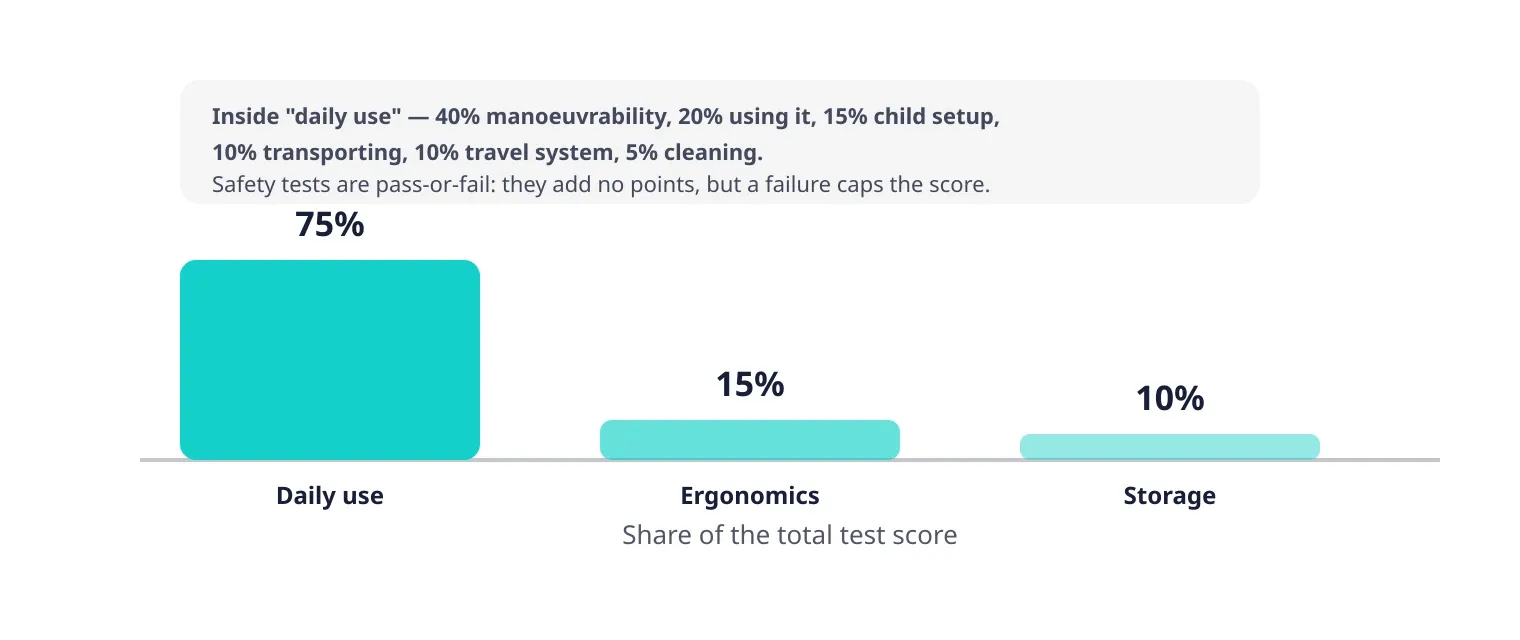
Which? builds its pushchair score less than 15% from safety-test results, because every stroller claiming EN 1888 compliance is expected to pass them. A failure still reduces the score — but the ranking is dominated by how the stroller behaves in daily life.
The five-minute shop test
Do this with the model you are about to buy, not a similar one:
- Set the handlebar to your height and walk a lap pushing with one hand.
- Kick the rear axle deliberately. If your stride hits it, you will hit it ten thousand times.
- Load the basket with something heavy and check it does not drag on the ground.
- Fold, lift, carry, unfold — with a bag in one hand.
- Crouch and look at the seat at the reclined position, and check the harness buckle releases with one press and separates cleanly.
- Check the label for the standard number and the maximum child weight.
If the shop will not let you do this, that is information too.
A buying checklist you can act on
Non-negotiable
- Meets the current standard for your country: ASTM F833 via 16 CFR 1227 in the US, EN 1888 or BS EN 1888 in Europe and the UK, AS/NZS 2088 in Australia and New Zealand 10111213.
- Five-point harness with waist and crotch straps, permanently attached, adjustable without re-threading the backrest 138.
- Parking brake you can apply, see and confirm — and that holds on a slope 141.
- A frame and handle that survive the cycles the standard specifies, tested by someone other than the brand 128.
- A brand reachable for a recall, and a seller who can name the standard 67.
Depends on your baby’s age
- Under 6 months: a genuine lie-flat seat or a carrycot, not a reclined seat and not a car seat on a frame 13519.
- Any age: no sleep in a car seat outside the car 51920.
- Past 15 kg: a model rated to 22 kg under EN 1888-2 if you want it to last 11.
Depends on your life
- Car boot size, measured, not estimated 8.
- Folded weight you can lift while holding a baby 2.
- One-handed fold, tested in the shop, not in the brochure 8.
- Handle height range that fits the adults who will push it 2.
What to check on a second-hand stroller
A used stroller is a reasonable buy and carries specific, checkable risks, because a damaged or modified stroller may no longer meet the standard it was built to. UK trading-standards guidance lists the checks worth doing, and they transfer to any market 23:
- Sharp edges or points anywhere on the frame.
- The folding chassis must have two locking devices. Do they both engage?
- Harness condition — straps not frayed, buckle releasing cleanly, all five points present.
- Wheel security and wear at the wheel edges.
- The parking brake engages and holds, forwards and backwards.
- General stability in all directions.
- Bent tubes or linkages, which usually mean a heavy impact with a kerb or stairs.
- Finger entrapment points on exposed tubes.
Also apply the recall check that most people skip: search the model against your national recall database before you pay. The failures that trigger recalls — seat-to-grab-bar openings, canopy entrapment, brake failure — are exactly the ones you cannot see.
How long a stroller is actually for
The usage window shapes how much you should spend. Stroller injuries cluster hard in the first year: 42.0% of stroller-related injuries in the 1990–2010 data were in children under one, and the median age at injury was 11 months 315. Car-seat injuries outside the car were even more concentrated — 62.4% of them in infants under four months 20.
Meanwhile the equipment that carries an older child is a different product from the one that carries a newborn. Which? notes that seats are marketed from birth to 15 months or up to 22 kg, and checks whether the seat actually supports a child across that whole range 8.
That gap is the most common expensive mistake in this category: buying one stroller to do everything, then buying a second one anyway. If your budget is limited, the case for spending on a newborn-capable lie-flat setup and a separate cheap compact stroller later is stronger than the case for a single heavy convertible that folds badly.
Frequently asked questions
Is an expensive stroller safer?
No. In CHOICE’s 49-model test, the most expensive pram tested received the lowest overall rating and failed the lab’s key safety tests, while cheaper models passed. In the 2026 Stiftung Warentest round, a €450 stroller matched the top rating of a €1,060 one 12. Price buys materials, features and finish. Safety comes from the standard and from correct use.
Do I need a travel system, or is a car seat on a stroller fine?
A travel system is convenient for moving a sleeping baby short distances. It is not a sleep environment. CPSC advises against using car seats and other inclined products for infant sleep on the grounds that inclines above 10 degrees are not a safe sleep surface, and UK autopsy data found that 70% of car-seat-associated infant deaths occurred when the seat was used outside the car, including as a cot substitute 519. Use it to travel; move the baby to a flat surface to sleep.
How do I know the harness is good enough?
Look for a permanently attached five-point harness with waist and crotch straps, and check that it adjusts from the front rather than by re-threading shoulder straps through the backrest. Which? scores front-adjusting harnesses higher precisely because they get used correctly 8. Australian rules require waist and crotch straps of at least 20 mm width, with the crotch strap linked to the front waist strap and positioned no more than 200 mm from the backrest 13. Also check that the buckle releases with one press and that the straps separate — a loop that does not separate is a strangulation risk, and it was one of the failures in CHOICE’s most recent test 1.
Should I worry about chemicals in the fabric?
Not at the level of avoiding a category, but not nothing. A 2026 German test found DEHP above the legal limit in two of twelve strollers and PFAS in several, while concluding that direct contact posed no immediate health risk 2. The legal limit for DEHP in accessible plasticised parts of children’s products is 0.1% 21. Prefer brands that publish chemical testing, and air new fabrics before use.
What should I check on a used stroller?
Fold it and confirm both chassis locking devices engage. Check the harness for fraying and full five-point function. Test the brake forwards and backwards. Look for bent tubes, sharp edges and finger traps. Then search the model against your national recall database — the hazards that trigger recalls, such as seat-to-grab-bar openings and canopy entrapment, are not visible in a quick inspection 2379.
How much difference does the brake really make?
More than any other small feature, because it is the one you use on every stop. CPSC strengthened the parking-brake requirement in the current standard precisely because the old wording produced inconsistent test results, and independent testing has since found models whose wheels still moved with the brake engaged 141. Buy a brake you can apply and see without looking down.
The short version
A stroller’s safety comes from three things, and none of them is the price tag: the standard it was built and tested to, the harness and brake you use every time, and the way you handle it when it is standing still.
Buy one that meets the current standard for your country and that you can prove complies — ask for the number. Make sure the seat lies genuinely flat if a newborn will use it, and treat the car seat on a frame as transport rather than a bed. Test the fold, the lift and the brake in the shop with your own hands, because those are the three things you will do most often.
Then check the model against your national recall database, whether it is new or second-hand, and keep the receipt.
The useful habit underneath all of it is the same one that helps at the paediatrician: notice what you actually use. When your baby last fed, which stroller you took, how long the trip was before the harness came off and the seat reclined — those details turn “it happened at some point today” into a timeline someone can act on. Logging a pushchair nap alongside feeds and nappies is exactly what a sleep record is for, and a shared record through the family code means the other parent or a carer sees the same picture at handover rather than reconstructing it from memory.
Disclaimer: This article is for informational purposes only and does not constitute safety, medical or legal advice. Standards and recall status change; always confirm the current standard and any recall notice for a specific model in your own country, and consult your paediatrician about your baby’s sleep and positioning.
Footnotes
-
CHOICE (Australia), “Prams to avoid buying,” by Alice Richard, updated 13 Aug. 2026. (15 of 49 models failed key safety tests; iCandy Peach 7 at A$2,599 rated lowest; harnesses that do not separate on release posing a strangulation risk; head entrapment and fall risk when fully reclined; wheels moving with the parking brake engaged.) Source ↩ ↩2 ↩3 ↩4 ↩5 ↩6 ↩7 ↩8 ↩9
-
Stiftung Warentest with Verein für Konsumenteninformation (VKI), Kinderwagen test, reported 28 Jul. 2026. (Twelve strollers tested — nine combination models and three for two children; four rated good, three average, one less satisfactory, four unsatisfactory; DEHP above the legal limit in two models, in a seat bar and a weather cover; PFAS found in several models; single strollers under 10 kg to about 14 kg, heaviest doubles just under 23 kg; some handlebars with very narrow adjustment ranges or fixed height.) ORF report · Zeit report ↩ ↩2 ↩3 ↩4 ↩5 ↩6 ↩7 ↩8 ↩9 ↩10 ↩11
-
Fowler E, Kobe C, Roberts KJ, Collins CL, McKenzie LB. “Injuries Associated With Strollers and Carriers Among Children in the United States, 1990 to 2010,” Academic Pediatrics, 2016;16(8):726–733. (360,937 injuries, 95% CI 294,279–427,594; average 17,187 per year; stroller patients 52.4% male, 42.0% under one year; head 43.0%, face 31.0%; soft tissue 39.4%, TBI/concussion 24.6%.) Source ↩ ↩2 ↩3
-
U.S. Consumer Product Safety Commission and Baby Trend, “CPSC and Baby Trend Warn Consumers About Entrapment Hazard with the Detachable Canopy on Baby Trend Sit N’ Stand Strollers; One Death Reported,” Release 23-119, 9 Feb. 2023. Source ↩ ↩2 ↩3
-
U.S. Consumer Product Safety Commission, “CPSC Cautions Consumers Not to Use Inclined Infant Sleep Products,” Release 20-016, 31 Oct. 2019. (1,108 incidents including 73 infant deaths, January 2005–June 2019; inclines of 10 degrees or less with flat, rigid surfaces likely safe.) Source ↩ ↩2 ↩3 ↩4 ↩5 ↩6
-
U.S. Consumer Product Safety Commission, “Children’s Product Certificate” business guidance. (Manufacturers and importers of children’s products subject to a CPSC rule must certify compliance based on third-party testing.) Source ↩ ↩2 ↩3
-
U.S. Consumer Product Safety Commission, “CPSC Warns Consumers to Immediately Stop Using COLOR TREE Strollers Due to Entrapment and Strangulation Hazards,” Warning 24-343, 15 Aug. 2024. (Head entrapment between seat and grab bar; two importers unresponsive to recall; sold for $90–$120 from November 2021 through November 2023 on Amazon, Walmart, eBay and Karmasfar.us.) Source ↩ ↩2 ↩3 ↩4
-
Which?, “How we test pushchairs,” updated 24 Sep. 2026. (More than 50 years of testing; over 30 safety and durability tests against BS EN 1888-1:2018+A1:2022 and BS EN 1888-2:2018+A1:2022; rolling-road test exceeding 200 km with a baby’s weight and a full basket; handle cycled 10,000 times; folded stroller fitted into a Ford Focus boot; score weighting 75% daily use, 15% ergonomics, 10% storage; Best Buy thresholds of 77% for single and 70% for double pushchairs; front-adjusting harnesses scored above re-threaded ones; claims of one-handed folding tested.) Source ↩ ↩2 ↩3 ↩4 ↩5 ↩6 ↩7 ↩8 ↩9 ↩10 ↩11 ↩12 ↩13
-
U.S. Consumer Product Safety Commission, “CPSC Warns Consumers Immediately to Stop Using Magic ZC Infant Strollers Due to Risk of Serious Injury or Death from Entrapment Hazard,” Warning 25-243, 1 May 2025. (Opening between seat and grab bar; Notice of Violation issued; firms did not agree to an acceptable recall.) Source ↩ ↩2
-
U.S. Consumer Product Safety Commission, “Carriages and Strollers,” CPSC regulations page (16 CFR Part 1227 incorporates ASTM F833 by reference). Source ↩ ↩2
-
European Committee for Standardization (CEN), EN 1888-1:2018+A1:2022, Child care articles — Wheeled child conveyances — Part 1: Pushchairs and prams, and EN 1888-2:2018+A1:2022, Part 2: Pushchairs for children above 15 kg up to 22 kg. Scope of Part 1: one or more children up to 15 kg each, and up to 20 kg for an integrated platform. Part 1 scope · Part 2 title ↩ ↩2 ↩3 ↩4
-
BSI, BS EN 1888-1:2018, Child care articles — Wheeled child conveyances — Part 1: Pushchairs and prams. Test excerpts: stability with a 50 N downward force at the handle and a 10° maximum pram-body inclination; irregular-surface test of 72,000 cycles at 5 km/h; handle durability of 10,000 cycles; attachment devices operated 200 times; wheel strength tested at 200 N; required warning labels. Source ↩ ↩2 ↩3 ↩4 ↩5
-
ACCC Product Safety, “Prams and strollers mandatory standard,” based on AS/NZS 2088:2000 and Consumer Protection Notice No. 8 of 2007, updated 18 Sep. 2024. Parking device with inaccessible release and red actuator; tether strap with loops under 360 mm perimeter; permanently attached harness with waist and crotch straps at least 20 mm wide and a crotch strap not more than 200 mm from the backrest; head barrier required above 150° recline; “NOT RECOMMENDED FOR A CHILD UNDER 6 MONTHS OLD” label for backrests not reclining past 130°. Source ↩ ↩2 ↩3 ↩4 ↩5 ↩6
-
U.S. Consumer Product Safety Commission, “Safety Standard for Carriages and Strollers,” Direct final rule, 86 FR 64345, 18 Nov. 2021. Effective 15 Feb. 2022. ASTM F833-21 approved 15 June 2021. Includes the parking-brake test methods and access-zone definition. Source ↩ ↩2 ↩3 ↩4
-
Powell EC, Jovtis E, Tanz RR. “Incidence and description of stroller-related injuries to children,” Pediatrics, 2002;110(5):e62. (64,373 stroller-related injuries to children aged 3 and under, 1994–1998; 76% from a fall from the stroller; median age 11 months; head 44% and face 43%; annual injury rate 184.4 per 100,000 among children under one year.) Source ↩ ↩2
-
U.S. Consumer Product Safety Commission, “Nursery Products Annual Report,” 2024 edition, data for 2023 injuries and 2019–2021 fatalities. (60,400 ED-treated injuries under age five in 2023; strollers/carriages 7,000 in 2023, 6,800 in 2022, 6,600 in 2021; five stroller/carriage deaths reported 2019–2021, an average of 2 per year.) Source ↩ ↩2
-
U.S. Consumer Product Safety Commission, “Infants in Strollers Must Be Properly Secured at All Times — Serious Risk of Entrapment and Strangulation,” Safety Alert, Publication 5096, Oct. 2010. Source ↩
-
Consumer Reports stroller testing, reported by KCRA, 23 Mar. 2026. (Any stroller that tips before a 12-degree incline fails CR’s stability test; the Zoe Traveler tipped at less than 12 degrees with a 45-pound weight in the fully reclined position and was rated “Don’t Buy.”) Source ↩
-
Bamber AR, Pryce J, Ashworth MT, Sebire NJ. “Sudden unexpected infant deaths associated with car seats,” Forensic Science, Medicine, and Pathology, 2014;10(2):187–192. (14 car-seat-associated deaths from 1,465 coronial infant autopsies over 16 years; 10 of 14 — 70% — occurred with the car seat used outside the car, including as an alternative to a cot or high chair; no cases of previously healthy infants dying in a correctly used car seat during transport.) Source ↩ ↩2 ↩3 ↩4
-
Parikh SN, Wilson L. “Hazardous use of car seats outside the car in the United States, 2003–2007,” Pediatrics, 2010;126(2):352–357. (43,562 car-seat-related ED injuries excluding motor vehicle crashes; average age 4.07 months; 62.4% under four months; 84.3% head injuries; most common mechanisms were infants falling from car seats, seats falling from elevated surfaces, and seats overturning on soft surfaces.) Source ↩ ↩2 ↩3
-
U.S. Consumer Product Safety Commission, “Phthalates Business Guidance,” 16 CFR Part 1307 and 15 U.S.C. § 2057c. (Prohibition above 0.1% / 1,000 ppm of DEHP and seven other phthalates in accessible plasticised components of children’s toys and child care articles.) Source ↩ ↩2
-
Der Spiegel, “Kinderwagen-Test: Schadstoffe in zwei von drei Buggys,” reporting a Stiftung Warentest round. (Harmful substances found in handles, seat surfaces and textiles of two of three buggies tested.) Source ↩
-
London Borough of Bromley Trading Standards, “New and second-hand prams and pushchairs,” guidance for England, Scotland and Wales, reviewed June 2024. (Used-stroller checks: sharp edges, both chassis locking devices, harness condition and five-point function, wheel security, parking brake forwards and backwards, stability in all directions, bent tubes, finger entrapment points; BS EN 1888 labelling.) Source ↩ ↩2