

How Much Should I Pump? Normal Output by Day, Session, and Baby's Age
By Simple Baby Tracker Editorial TeamFeeding
Pumping 2 ounces on day 3 is not a supply problem. Normal pump output by postpartum day and by session, why the two breasts differ, and what actually raises output.
Key Takeaways
- The first 24 hours of milk weigh about 15 g in total — half an ounce, spread across roughly 10 feeds, about 1.5 g at a time 1.
- A single pump session is not a supply test. In exclusively breastfed 3-month-olds, 24-hour intake averaged 818 mL, with a 16% spread between babies 2.
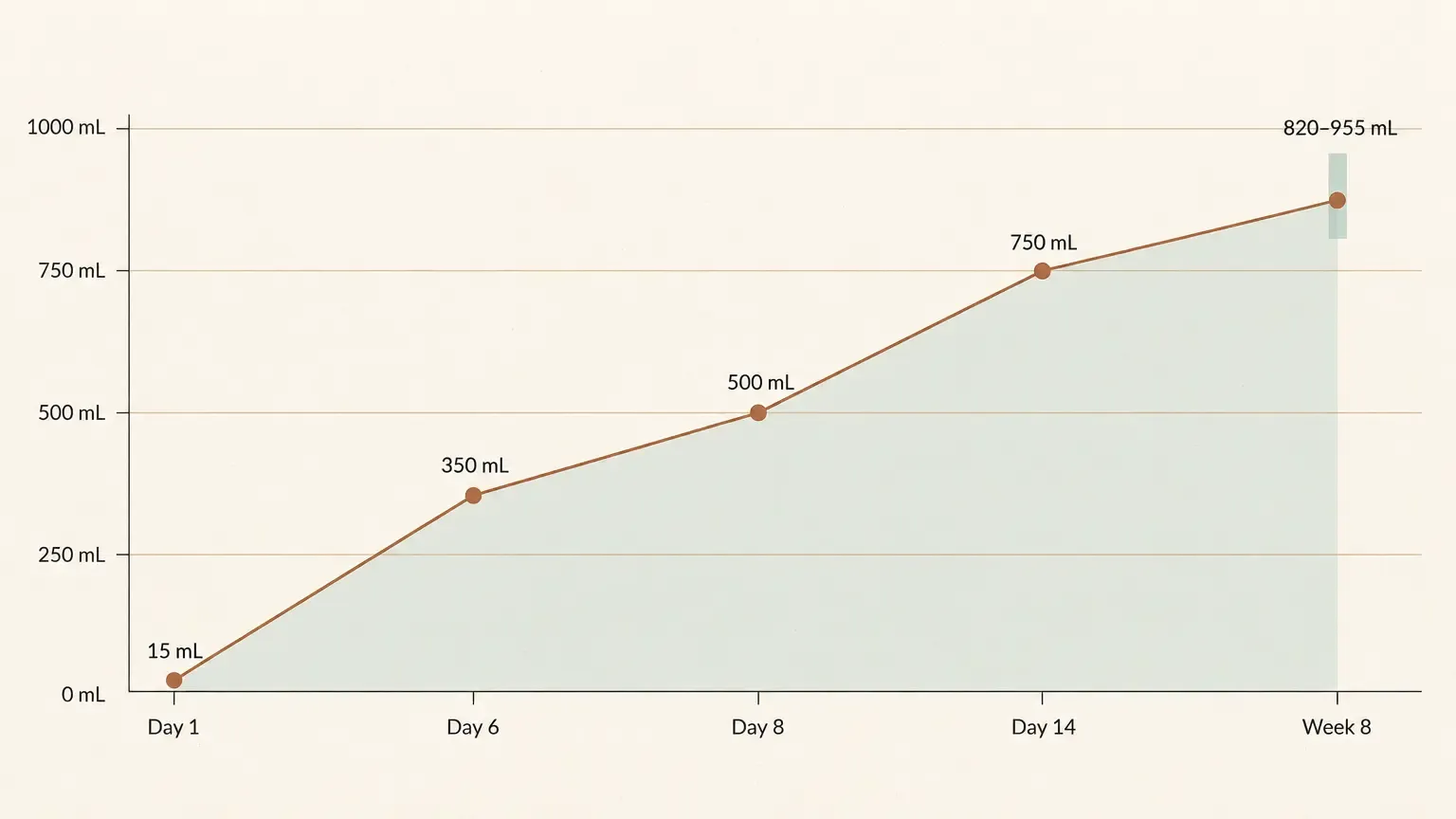
- Mothers of preterm infants pumping exclusively reached about 350 mL a day by day 6, 500 mL by day 8, and 750 mL by day 14 3.
- Frequency is the lever that moves: in a trial of late-preterm mothers, 7.1 sessions a day produced 1,791 mL in week one, against 894 mL at 5.3 sessions 4.
- Flange fit is measurable: an individually fitted smaller flange produced 15 mL more per session and felt better than a standard fit 5.
The short answer
There is no standard “right” amount per pump. There is a normal 24-hour range, and a normal trajectory over the first two weeks. Judge the day, not the bottle.
| Stage | 24-hour output | Per session at 7–8 sessions | What it means |
|---|---|---|---|
| First 24 hours | about 15 mL (0.5 oz) 1 | 2 mL | Colostrum. Volume is not the job yet. |
| Day 6 | about 350 mL 3 | 45–50 mL | Milk is in. Frequency now sets the ceiling. |
| Day 8 | about 500 mL 3 | 60–70 mL | Supply is coming to volume. |
| Day 14 | about 750 mL 3 | 95–105 mL | Close to the range it will hold. |
| Week 8 | 820–955 mL 6 | 105–135 mL | Established; wide variation is normal. |
| 1–6 months, baby at the breast | 800–840 mL 27 | about 76 mL per feed (range 0–240) | Intake plateaus; it does not climb with weight. |
The per-session column is arithmetic, not a separate measurement: the 24-hour total divided by seven or eight sessions. It is there to calibrate your eye, not to grade a single pump.
Two caveats change everything. If you are pumping after nursing, expect much less than the table, because the breast has already been drained. If you are pumping for a baby who is not feeding at the breast at all, the table is your trajectory, and it is the one most of the research describes.
Most of the hard numbers in this guide come from mothers pumping for preterm babies, because that is the group researchers study. Those figures describe exclusive pumping; a term mother pumping after feeds will see less. The shape of the curve — small, then steep, then flat — is the same.
Why one bottle is not a verdict
The pump gives you a number, and the number feels like a measurement of you. It is a measurement of one session.
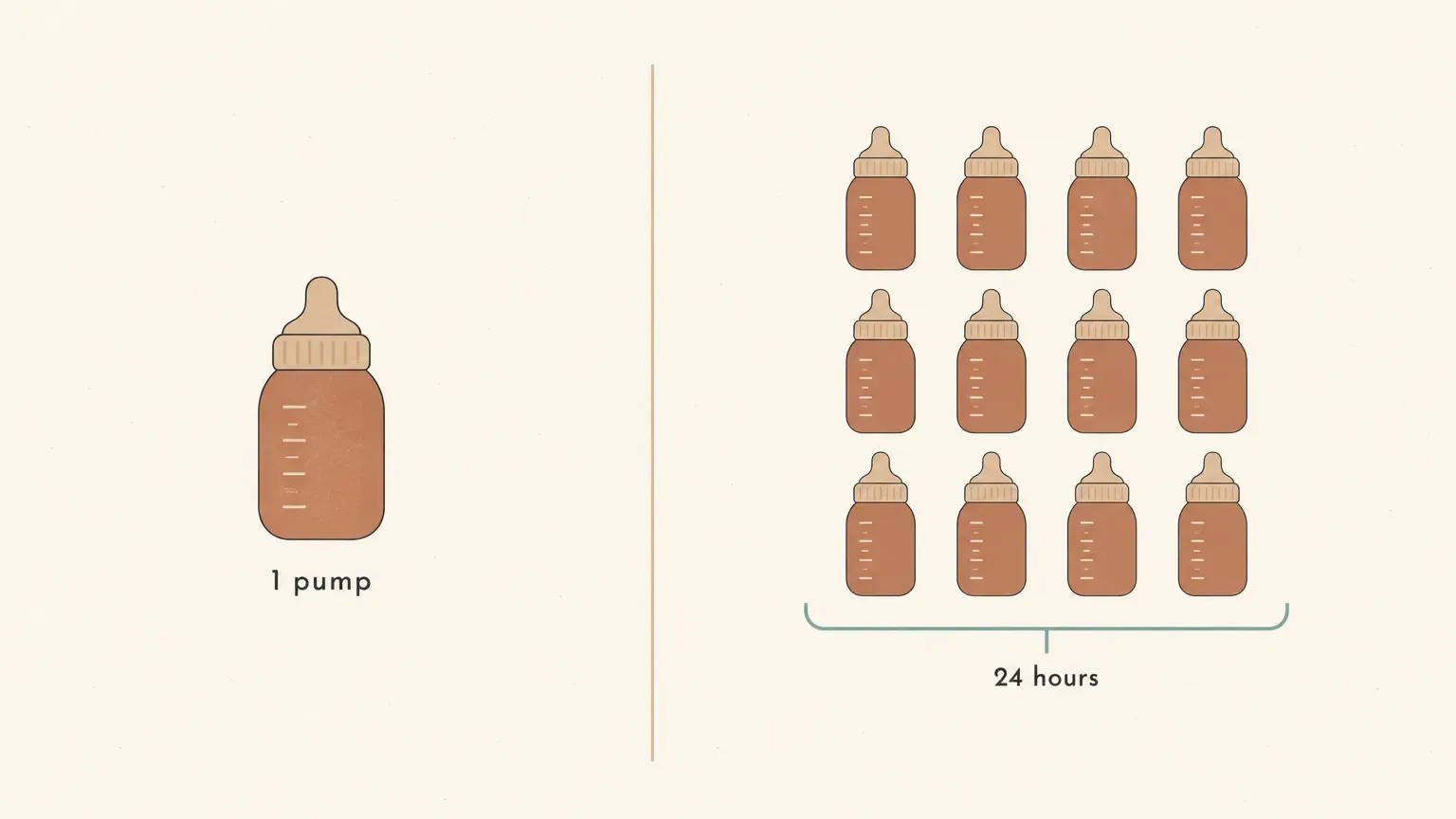
In a study of 71 mothers who weighed their babies before and after every feed for 24 hours, a single breastfeed averaged 76 g, with a range from 0 to 240 g. The babies fed 11 times a day on average, but anywhere from 6 to 18. Left and right breasts rarely produced the same volume, and the amount taken depended on which breast was offered, the time of day, and whether the feed happened at night 7.
That is the spread in a baby, who is better at removing milk than any pump. A pump adds its own variables: flange size, suction pattern, how long since the last removal, whether you are relaxed, and whether you are watching the bottle.
The between-baby spread is just as wide. In the DARLING study, 24-hour intake at 3 months averaged 818 mL, and the coefficient of variation between babies was 16.3% — larger than the day-to-day variation within the same baby 2. A baby taking 690 mL and a baby taking 950 mL can both be thriving.
So the useful question is not “is 2 ounces enough?” It is “what does my 24-hour total look like, and is my baby gaining?”
The first two weeks, number by number
Day one is smaller than almost anyone expects. In a study of 90 healthy exclusively breastfed newborns, the entire intake over the first 24 hours was 15 ± 11 g. Per feeding, it was 1.5 ± 1.1 g 1. That is not a failure of supply; it is what a newborn stomach is built for, and it is why “I only got drops” on day one is a description, not a diagnosis.
Then milk production switches on. In mothers of preterm infants pumping from birth, the median time to that switch — lactogenesis II — was 75.4 hours, a little over three days 3. From there the curve is steep:
- Day 6: about 350 mL a day
- Day 8: about 500 mL a day
- Day 14: about 750 mL a day 3
A separate cohort pumping for preterm infants averaged 820 mL a day by week 8 6. The mothers in that study who hand-expressed more than five times a day in the first three days averaged 955 mL a day by week 8 — a difference that showed up weeks later 6.
That early window is the part with the strongest evidence behind it. In a prospective study of 88 pump-dependent mothers, 51% never reached a full volume, and unscheduled pumping plus a lower pumping frequency in the first week were independent risk factors for falling short 8. In another cohort, the number of expressions in the first week correlated with milk volume on day 21, and the volume on day 7 predicted volumes at days 14, 21, and 28 9.
None of that means a slow start is permanent. It means the first two weeks are when frequency buys the most.
What moves a single session
Five things, in rough order of how much they matter:
- Time since the last removal. A pump five hours after the last feed will beat a pump ninety minutes after it. This alone explains most of the “my supply crashed” panic in the evening.
- Time of day. Milk volume varies across the day, and night feeds make an important contribution to the total 7. A smaller evening pump is a schedule artefact, not a verdict on the day.
- Which breast. Left and right rarely match 7. If one side consistently gives half, that is common and not a sign of a problem on its own.
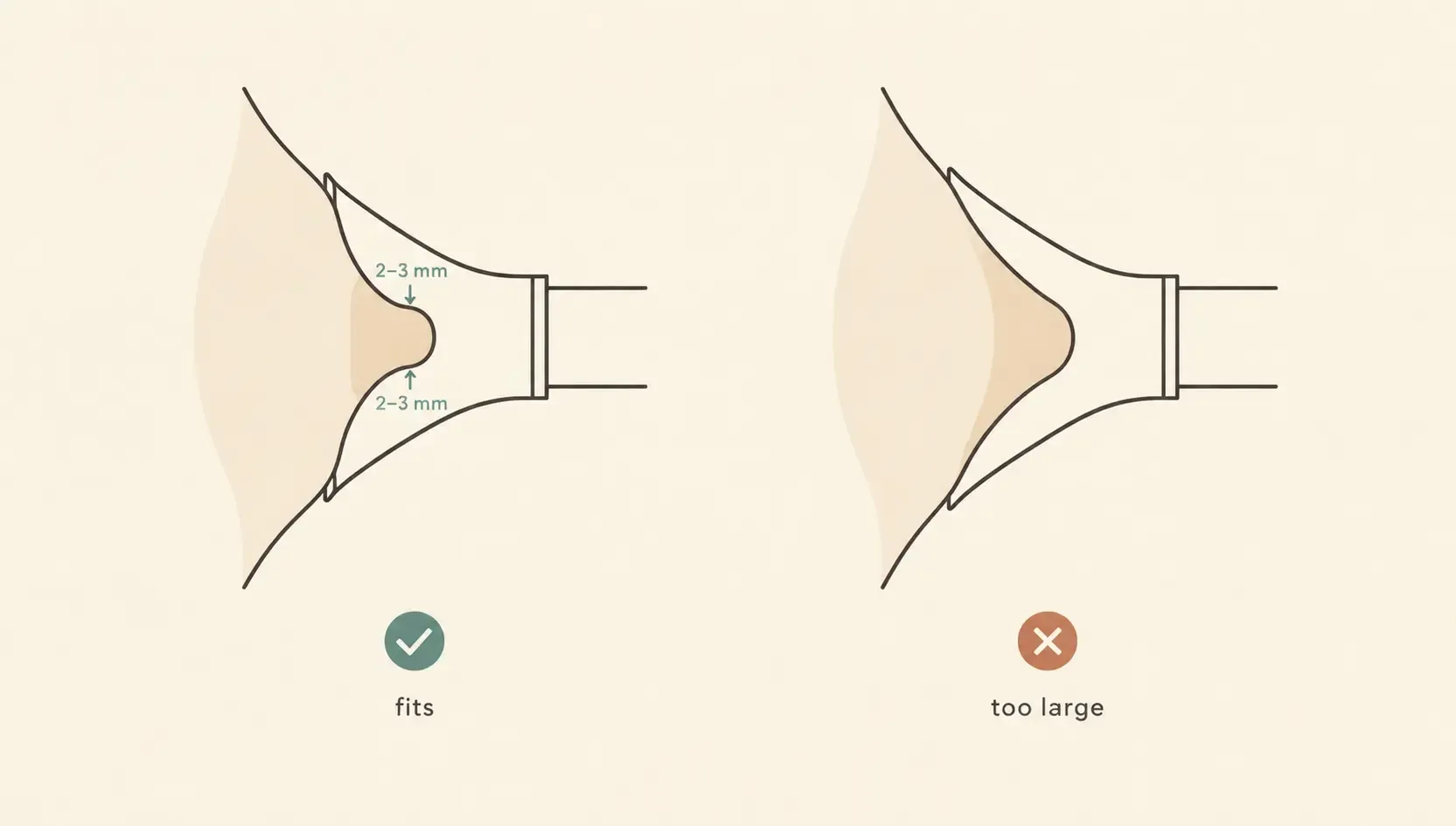
- Flange fit. In a within-subject trial, parents using a standard-fit flange produced 15 mL less per session and reported less comfort than with an individually fitted smaller flange 5. Fifteen milliliters is half an ounce — enough to change how a session feels, not enough to change whether a baby is fed.
- Hands and technique. Adding hand expression and breast massage to electric pumping increased daily volume by 48% in mothers of preterm infants, even though they pumped less often 6.
Stress and pain belong on that list too, but they are harder to measure and easier to fix: pain during pumping is not normal, and it is usually a flange or suction problem.
How much to leave in a bottle
The CDC’s storage guidance doubles as portion guidance: freeze milk in 2 to 4 ounce portions, or the amount offered at one feeding 10. That range matches what breastfed babies take per feed — 76 g on average in the 24-hour study, with a spread from 0 to 240 mL 7.
For a caregiver, the practical rule is to start small and offer more. A 60 mL bottle that gets finished and refilled tells you more than a 150 mL bottle that gets abandoned.
How the bottle is offered matters as much as what is in it. Paced bottle-feeding — holding the bottle more horizontal, letting the baby set the pace, pausing — is designed to mimic the breast. In a survey of 197 mothers, those who used paced feeding were far less likely to encourage their baby to finish the bottle 11. That is the behavior you want in a caregiver: responsive, not goal-oriented.

The schedule that builds supply
Milk production follows removal. The CDC’s newborn guidance is 8 to 12 feeds in 24 hours 12, and an exclusively pumping schedule that mirrors it — 8 removals, including one overnight — is the standard starting point.
The trial evidence is blunt about frequency. In a randomized trial of mothers of late preterm infants, a target-guided expression protocol produced 7.1 sessions a day against 5.3 in usual care, and 1,791 mL cumulative milk in the first week against 894 mL 4. The intervention group was also expressing more often after discharge. The population was preterm and separated from their babies, so the absolute volumes do not transfer to a term mother pumping after feeds. The direction does.
Practical shape of a day:
- Double pump when you can. Both breasts at once saves time and raises output per sitting.
- Do not drop the night session first. It is one of the 8 to 12, and long overnight gaps are the fastest way to tell your body to make less.
- Pump to empty, then two minutes more. Session length is not settled by trials — the Cochrane review found too little comparable data to pool 13 — but stopping while milk is still flowing leaves volume behind.
- Protect the first week. Frequency in days 1 to 7 is the variable most consistently tied to volume at weeks 2 to 4 98.
Power pumping, hands-on pumping, and flange fit
Power pumping — clustering short pumps into an hour to imitate cluster feeding — has no trial evidence behind it. The Cochrane review of expression methods found 34 trials and could not pool most outcomes; the one frequency comparison it included (more than four sessions a day versus fewer than three) is a single small study 13. The rationale is reasonable, because frequency is the lever the observational data support. Treat it as a three-to-five-day experiment with a before-and-after 24-hour total, not a permanent schedule.
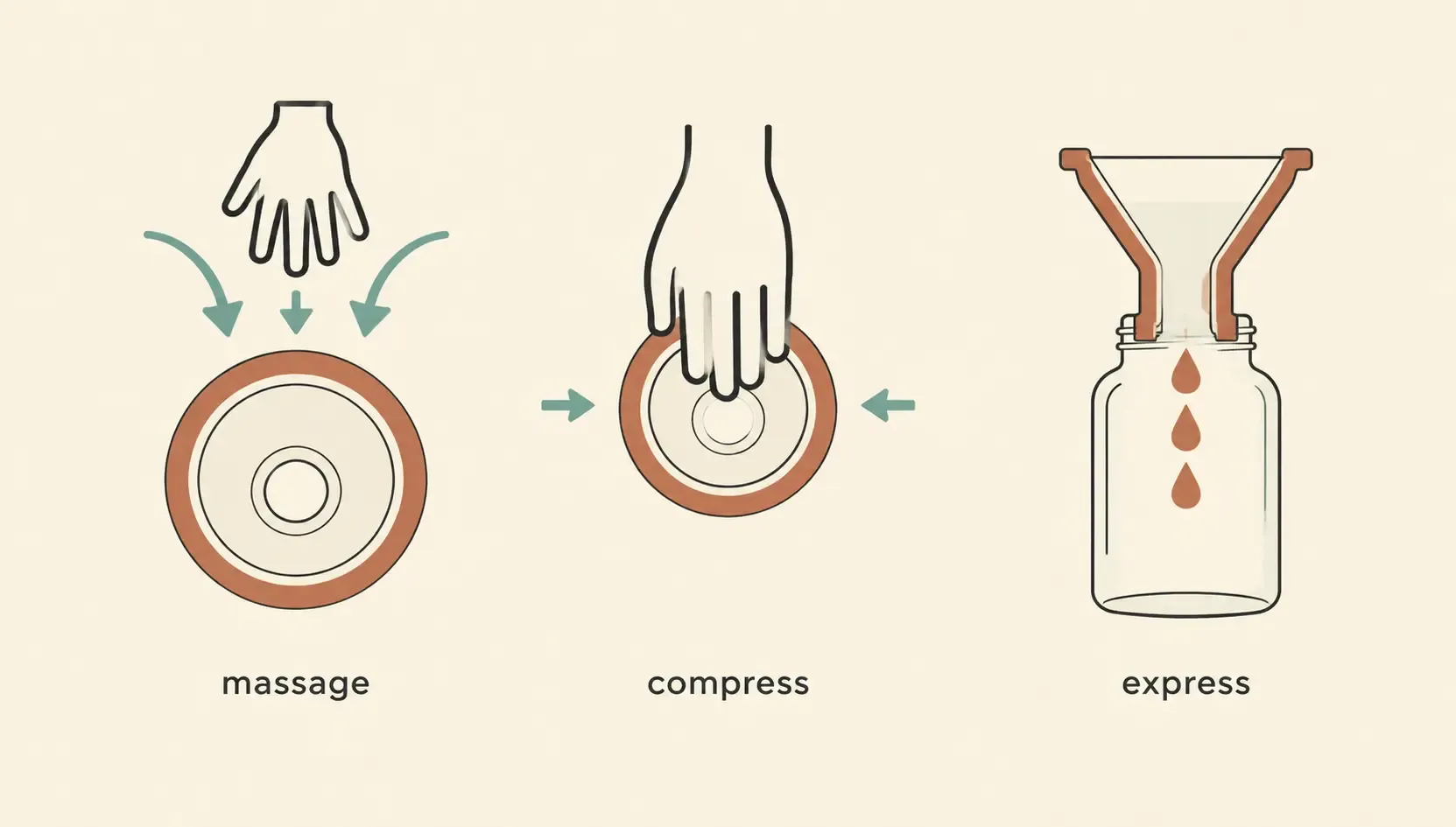
Hands-on pumping has better support, at least in preterm mothers: hand expression plus massage plus electric pumping raised daily volume 48% compared with pumping alone 6. The technique is unglamorous — massage toward the nipple, compress, express, repeat — and it costs nothing.
Flange fit is the most under-checked variable. Nipple size is not cup size, and the flange that came in the box is frequently too large. Measure the nipple base, try one size down, and judge by two things: comfort and output over a full session. The trial that compared methods found a 15 mL per-session difference and a clear comfort difference 5. Pumping should not hurt.
When output is a real problem
A number alone is rarely the red flag. The baby is.
- Weight. Birth weight should be back by day 10 to 14 12. Weight loss is nearly universal in the first days, and larger losses carry more risk — which is why pediatricians plot it on a nomogram rather than eyeball it 14.
- Diapers. From day 4 onward, at least 6 wet diapers and 3 poops a day 12. A drop below that, especially with a sleepy baby, needs a call.
- Milk not in. If there is no change in the breasts and no meaningful volume by around day 3 to 4, ask for a lactation assessment. The median in the preterm cohort was 75.4 hours 3; a term mother whose milk has not come in by then deserves help, not reassurance.
- Pain and fever. A red, painful wedge of breast with fever or flu-like symptoms is mastitis and needs medical care.
- A baby who will not wake to feed, has a dry mouth, or stops producing tears is a dehydration picture, not a supply question.
A low pump output with a gaining, content baby is a pump problem until proven otherwise. A normal pump output with a baby who is losing weight is a feeding problem. The scale and the diaper count decide which conversation you are having.
Track 24 hours, not 3 a.m.
The single most useful habit is to stop reading each bottle as a score and start reading the week.
Log the time, the side, and the volume — nothing more. At the end of a day, add it up. At the end of a week, compare the total. That is the number that tracks supply, and it is the number a lactation consultant or pediatrician will ask for.
Our pump tracker logs a session in one tap and keeps the daily total beside your feeding and diaper logs, so a low evening pump sits next to a normal morning one instead of replacing it in memory. If you are expressing across a separation, the caregiver handoff workflow and the newborn feeding guide cover the other half of the picture. And if the numbers are starting to cost you more sleep than they save, tracking without data anxiety is the counterweight.
Frequently asked questions
Is 2 ounces per pump enough?
It depends on when you pumped. Two ounces ninety minutes after a feed can be a full session; two ounces eight hours after a feed is worth a look. Judge the 24-hour total and the baby’s weight, not one bottle.
How long should I pump?
There is no trial-established number. A common working rule is to pump until flow slows, then two to five minutes more, which usually lands around 15 to 20 minutes. The Cochrane review could not pool session-length data, so comfort and output are better guides than the clock 13.
Can I pump after breastfeeding?
Yes, and expect a small volume. The baby has already removed about two-thirds of what was available in that breast 7. A small pump after a feed is consistent with that, not evidence that the breast is empty of supply.
Why is my evening pump smaller?
Because volume varies by time of day, and because the gap since the last feed is usually shorter in the evening 7. Morning sessions after a longer stretch are routinely the biggest of the day. Use the same time each day if you want a comparable trend.
How fast can I increase output?
Frequency first, then fit and technique. Adding sessions and ensuring each one empties the breast is the lever with the best supporting data 98; hands-on pumping added 48% in preterm mothers over weeks, not hours 6. Supplements and lactation foods do not substitute for removal.
Disclaimer: This article is for informational purposes only and does not constitute medical advice. Every baby and every pumping setup is different. Always consult your pediatrician or a lactation consultant about your baby’s feeding, weight, or health.
Footnotes
-
Santoro W Jr, Martinez FE, Ricco RG, Jorge SM, “Colostrum ingested during the first day of life by exclusively breastfed healthy newborn infants,” Journal of Pediatrics, January 2010. Source ↩ ↩2 ↩3
-
Dewey KG, Heinig MJ, Nommsen LA, Lönnerdal B, “Maternal versus infant factors related to breast milk intake and residual milk volume: the DARLING study,” Pediatrics, June 1991. Source ↩ ↩2 ↩3
-
Ru X, Huang X, Feng Q, “Successful Full Lactation Achieved by Mothers of Preterm Infants Using Exclusive Pumping,” Frontiers in Pediatrics, April 2020. Source ↩ ↩2 ↩3 ↩4 ↩5 ↩6 ↩7
-
Matrakul S, Prasitwattanasaree P, Xuto P, “Target-Guided Milk Expression to Improve Early Milk Volume in Mothers of Late Preterm Infants During Separation: A Randomized Controlled Trial,” Breastfeeding Medicine, Epub 14 July 2026. Source ↩ ↩2
-
Anders LA, Mesite Frem J, McCoy TP, “Flange Size Matters: A Comparative Pilot Study of the Flange FITS Guide Versus Traditional Sizing Methods,” Journal of Human Lactation, February 2025. Source ↩ ↩2 ↩3
-
Morton J, Hall JY, Wong RJ, Thairu L, Benitz WE, Rhine WD, “Combining hand techniques with electric pumping increases milk production in mothers of preterm infants,” Journal of Perinatology, November 2009. Source ↩ ↩2 ↩3 ↩4 ↩5 ↩6
-
Kent JC, Mitoulas LR, Cregan MD, Ramsay DT, Doherty DA, Hartmann PE, “Volume and frequency of breastfeedings and fat content of breast milk throughout the day,” Pediatrics, March 2006. Source ↩ ↩2 ↩3 ↩4 ↩5 ↩6 ↩7
-
Peng Y, Liang Y, Jiang X, Sun L, Yang K, Chen J, Yin C, “Why Emphasize Early Postpartum Pumping? The Critical Window for Coming to Volume in Pump-Dependent Mothers,” Breastfeeding Medicine, December 2025. Source ↩ ↩2 ↩3
-
Gomez-Juge C, Scarpelli V, Yellayi D, Cerise J, Weinberger B, Brewer M, Maffei D, “Breast Milk Production Variability Among Mothers of Preterm Infants,” Breastfeeding Medicine, August 2023. Source ↩ ↩2 ↩3
-
CDC, “Breast Milk Storage and Preparation,” Breastfeeding, accessed October 2026. Source ↩
-
Ventura AK, Drewelow VM, “Knowledge and Use of Paced Bottle-Feeding Among Mothers of Young Infants,” Journal of Nutrition Education and Behavior, November 2023. Source ↩
-
CDC, “Newborn Breastfeeding Basics,” Infant and Toddler Nutrition, accessed October 2026. Source ↩ ↩2 ↩3
-
Becker GE, Smith HA, Cooney F, “Methods of milk expression for lactating women,” Cochrane Database of Systematic Reviews, February 2015. Source ↩ ↩2 ↩3
-
Flaherman VJ, Schaefer EW, Kuzniewicz MW, Li SX, Walsh EM, Paul IM, “Early weight loss nomograms for exclusively breastfed newborns,” Pediatrics, January 2015. Source ↩