

When Do Babies Need Shoes? First Shoes Explained (2026 Guide)
By Simple Baby Tracker Editorial TeamBaby Care
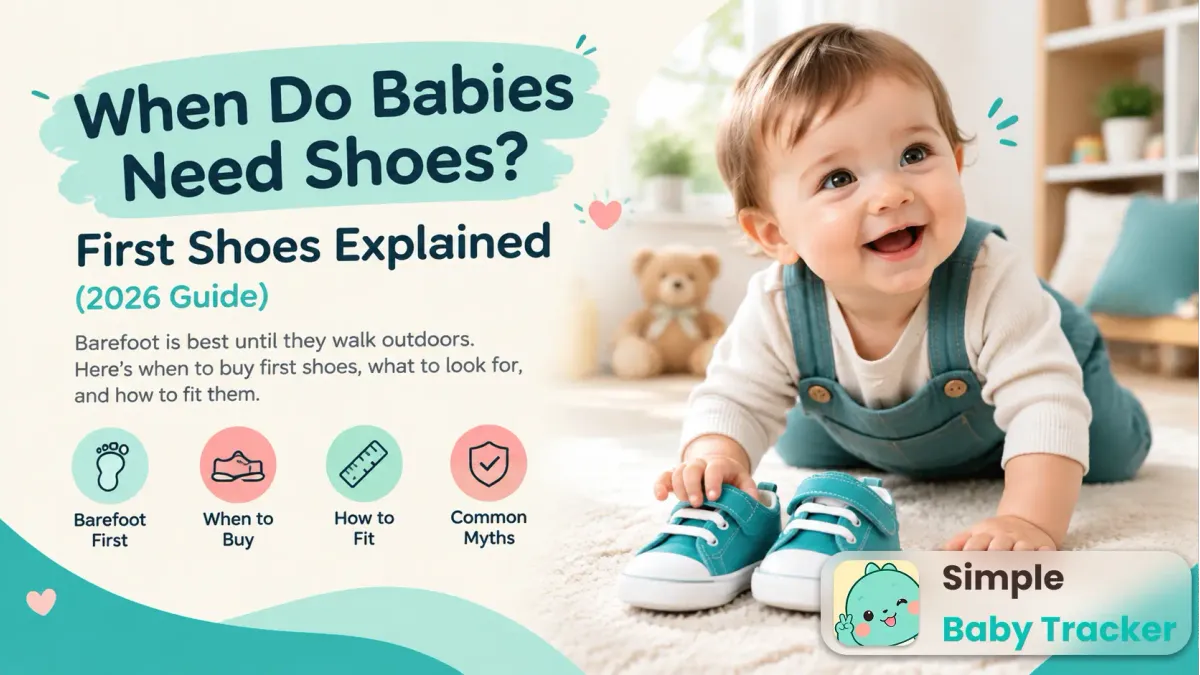
Babies don't need shoes until they walk outdoors — barefoot is best for foot development. Here's when to buy first shoes, what to look for, and how to fit them.
Key Takeaways
- Barefoot is best until your baby walks outdoors; prewalkers need no shoes — socks or soft booties suffice 12.
- Early shoes change how toddlers walk, so keep them light, flexible, and close to barefoot; stiff soles restrict natural foot movement 3.
- Fit rule: about 10–15 mm of toe room in front of the longest toe, measured standing, with the child present to try them on 24.
- Flat feet in toddlers are normal (97% under 18 months), and “corrective” baby shoes are a misnomer — they don’t fix flat feet, knock knees, or bow legs 2.
Short answer: not until they walk outside
Hold off on that first pair of tiny shoes until your baby is walking — shoes are mainly for protecting feet, especially outdoors, and putting them on sooner won’t help a baby learn to walk any faster 1. Indoors and on safe surfaces, barefoot remains the best thing for developing feet; when outdoor walking starts, buy shoes for protection: lightweight, flexible, well-fitting, with non-skid soles.
Why barefoot wins early
Walking barefoot develops toe gripping and muscular strength, and there is growing evidence that wearing shoes in early childhood may work against normal arch development. The Canadian Paediatric Society’s position is blunt: the old belief that babies must wear shoes soon after birth is no longer accepted — keeping a baby out of shoes in warm, dry conditions is a good idea 2.
The biomechanics back this up with a caveat. A 2019 systematic review found that shoes do change young children’s gait (longer steps, slower cadence) much as in older children — but also concluded there is no evidence supporting one shoe type over another, and no evidence on muscle activation changes 3. In plain terms: science confirms shoes alter the walk, can’t yet crown a “best” shoe, and keeps repeating the one consistent message — soft, non-restrictive, as close to barefoot as possible.
Practical rule: indoors barefoot; socks or soft booties with non-skid soles for chilly floors; shoes only for outdoors, rough surfaces, or cold weather 1.
When to buy the first pair
Buy first shoes when your baby walks outdoors — not when they pull to stand, cruise furniture, or take first indoor steps. Until toddlers have been walking for at least a few months, footwear’s only jobs are protection and grip on smooth surfaces 2.
For prewalkers, shoes are simply not necessary; soft-sole footwear for warmth and protection is appropriate. First steps are a milestone worth logging — date, place, and a photo — which is exactly what our tracking without data anxiety guide is built around: seconds per entry, payoff at every checkup.
What good first shoes look like
Three non-negotiables, courtesy of pediatric guidance:
- Lightweight and flexible. The sole should bend easily in your hands. Hard, stiff soles restrict natural foot movement and can make learning to walk harder 1.
- Well-fitting. Snug at the heel, room at the toes — about 10–15 mm of toe room in front of the longest toe, with a toe box at least as wide as the widest part of the foot; narrow, tapered shoes are not recommended. Measure standing, with the child present to try them on 4.
- Non-skid soles with secure closure. Grip on smooth floors matters more than ankle height; laces or Velcro prevent clawing, gripping, and instability. Breathable mesh or leather handles toddler sweat better than non-breathable synthetics 4.
Ankle boots don’t give more support than low-cut shoes — they’re just harder for toddlers to pull off, which is a feature, not orthopedics. For early walkers, proper shoes beat sneakers on fit, stability, and safety; skip hand-me-downs that have lost their shape 2.
Myths that sell baby shoes
“They’ll correct flat feet.” 97% of children under 18 months have flat feet, mostly from a fat pad under the foot; by age 10, only 4% still do. Mild or moderate flat feet need no treatment and no restriction from activities. Corrective shoes for physically normal children are a misnomer — attempting to “correct” physiological flat feet, knock knees, or bow legs with prescribed shoes may harm the child and costs the family money 2.
“High-tops support weak ankles.” Ankle boots give no more support than low-cuts; new walkers’ wobble is neurology, not footwear deficiency.
“Expensive brands shape feet better.” The review literature finds no evidence base for one shoe type over another in young children — fit and flexibility beat logos 3.
How often to re-check fit
Toddler feet grow fast, so re-check fit often rather than buying ahead 5. Australia’s podiatry association gives a concrete cadence: a size check every 1–3 months up to age 3, every 4 months up to age 5, and every 6 months from age 5 6; the APMA advises every 4–6 months given growth and brand variability, always fitting to the larger foot when sizes differ 4. Signs the shoes are done: red marks or blisters, toes pressing the front when standing, sudden shoe refusal, or tripping more than usual 7.
Frequently asked questions
Can my baby wear shoes to “get used to them” before walking?
No need. Early wearing doesn’t speed up walking, and stiff shoes can hinder it — barefoot practice builds the strength walking requires 1.
Are soft-sole “pre-walker” shoes okay?
For warmth and protection, yes. They aren’t necessary for development, but a soft flexible covering on cold or rough floors is fine.
What socks go with first shoes?
Plain, well-fitting socks — no chunky seams pressing on toes. Non-skid soles on socks are a bonus for indoor cruising.
My 14-month-old still walks only indoors. Shoes yet?
Not yet. Keep them barefoot indoors and buy the first pair when outdoor walking begins.
When do I call the doctor about feet, not shoes?
Persistent intoeing causing tripping and functional problems, severe flat feet with leg or knee pain, a forefoot that won’t stretch to neutral, or any foot concern paired with developmental delay — those earn a pediatric or pediatric-orthopedic opinion, not a different shoe 2.
Disclaimer: This article is for informational purposes only and does not constitute medical advice. Always consult your pediatrician about your baby’s foot development.
Footnotes
-
KidsHealth / Lurie Children’s Hospital of Chicago, “Is My Baby Ready for Shoes?” (reviewed Oct. 2019). Source ↩ ↩2 ↩3 ↩4 ↩5
-
Canadian Paediatric Society, Community Paediatrics Committee, “Footwear for children,” Paediatrics & Child Health, 1998. Source ↩ ↩2 ↩3 ↩4 ↩5 ↩6 ↩7 ↩8
-
Cranage S et al., “The impact of shoe flexibility on gait, pressure and muscle activity of young children. A systematic review,” Journal of Foot and Ankle Research, 2019. Source ↩ ↩2 ↩3
-
American Podiatric Medical Association, “Buying Children’s Footwear.” Source ↩ ↩2 ↩3 ↩4
-
Gould N et al., “Foot Growth Rate in Children Age One to Six Years,” Foot & Ankle, 1983. Source ↩
-
Australian Podiatry Association, “Children’s Feet.” Source ↩
-
Israel Ministry of Health, “First Shoes: Everything You Need to Know,” Mar. 2026. Source ↩