

Huckleberry vs Baby Tracker: Which Baby Tracker App Is Right for You? (2026)
App Comparison
Huckleberry's AI sleep predictions and subscription vs Baby Tracker's simple, one-time-cost design. We compare features, pricing, and ease of use.
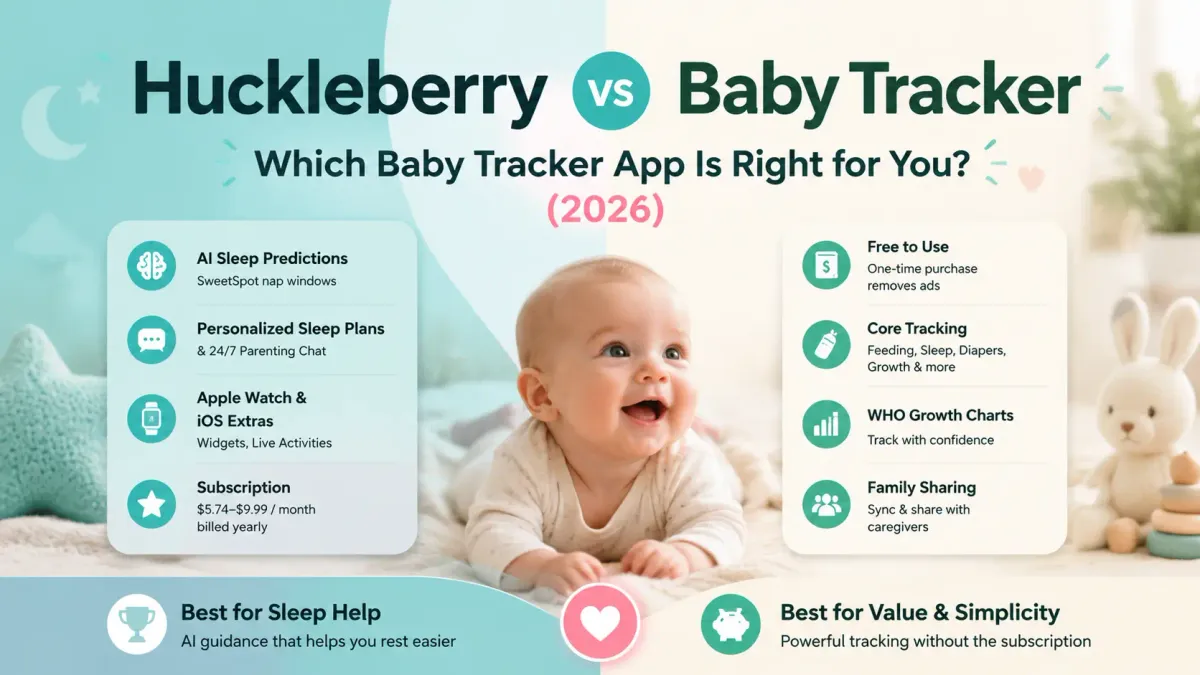
TL;DR: Huckleberry wins if you want sleep coaching — its AI nap predictions (SweetSpot), personalized sleep plans, and 24/7 parenting chat are unmatched. Baby Tracker (by Nighp Software) wins on cost and simplicity — the core app is free, a one-time purchase removes ads, and there’s no subscription to manage. Choose Huckleberry if sleep help is worth a subscription. Choose Baby Tracker if you want a free, dependable daily log that stays cheap over time.
Why this comparison matters now
Baby tracking has moved from paper logs to a crowded app market, and two names keep coming up in parent forums: Huckleberry and Baby Tracker. Huckleberry calls itself the No. 1 baby tracker app and says it’s trusted by over 5 million families 1. Baby Tracker, a long-running app by Nighp Software, has 70,900+ reviews and over 1 million downloads on Google Play alone 2. Both track the same core data — feeding, sleep, diapers, growth — but they take opposite approaches to money and features.
The core tension is simple: Huckleberry charges a subscription for AI-powered sleep guidance; Baby Tracker stays close to free with a one-time option to remove ads. If you’re deciding between them, the question isn’t “which tracks better” — both track well. It’s “what are you willing to pay for.”
This comparison covers pricing, sleep features, core tracking, ease of use, platform support, and family sharing. It’s based on each company’s published product pages and store listings, not hands-on testing, so treat feature details as what each app advertises rather than an independent benchmark.
Quick comparison table
| Category | Huckleberry | Baby Tracker (Nighp) |
|---|---|---|
| Best For | AI sleep coaching & guidance | Free, simple daily logging |
| Pricing | Free + subscription ($5.74–$9.99/mo billed yearly) | Free w/ ads; one-time IAP to remove ads |
| Sleep features | SweetSpot predictions, sleep plans, 24/7 AI chat | Sleep & nap logs, no prediction |
| Growth charts | Weight/length tracking | WHO-standard growth charts |
| Platforms | iOS + Android (Apple Watch on iOS) | iOS + Android |
| Family sync | Multi-device sync (free tier) | Sync across devices, share with caregivers |
| Ads | None on any tier | Yes on free tier |
| Rating | 4.9/5 (App Store) | 4.9★ (70.9K reviews, Google Play) |
| Our verdict | Sleep help | Value & simplicity |
Sleep tracking & AI guidance
Huckleberry wins on sleep — it’s the entire point of the app.
Huckleberry’s signature feature is SweetSpot, which predicts your baby’s next nap window based on logged sleep and wake times 1. On the paid tiers this extends to personalized sleep plans and data-driven insights, and Premium adds 24/7 parenting guidance through its AI chat assistant, Berry. For parents struggling with naps or night wakings, this turns a passive log into active advice.
Baby Tracker offers a capable sleep and nap logger with day/week/month views, but it does not predict sleep windows or offer coaching 2. What you log is what you get: a clear record of sleep patterns you can interpret yourself or share with your pediatrician.
Verdict: Huckleberry, by a wide margin — but only if you actually want AI guidance. If you just need to record sleep, Baby Tracker covers that for free.
Core tracking features
Here the two are closer. Both log feeding (breast, bottle, pump), sleep, diapers, growth, health, and milestones.
- Feeding: Huckleberry and Baby Tracker both support breastfeeding timers, bottle and pump logging, and left/right tracking 12.
- Growth: Baby Tracker plots weight, height, and head circumference against WHO-standard growth charts 2; Huckleberry tracks growth with its own charts 1.
- Health & milestones: Both record temperature, medications, vaccines, and milestone moments 12.
Verdict: Essentially a tie for core logging. Neither is missing anything a new parent commonly needs.
Ease of use & logging speed
Both apps are built for one-tap logging in the middle of the night, and both get strong reviews for it. Baby Tracker reviewers repeatedly describe it as “intuitive” and “well laid out,” and one long-time user notes they’ve relied on it across multiple children for years 2. Huckleberry’s free tier promises logging “in seconds,” and paid tiers add AI logging that can auto-fill entries (available on iOS) 1.
One differentiator: Huckleberry’s free tier includes Schedule Creator to plan your day, while Baby Tracker keeps things lean without planning tools 1.
Verdict: Tie on speed; Huckleberry offers more optional planning polish.
Platform & device support
Both apps run on iOS and Android. Huckleberry adds Apple Watch support and iOS-only conveniences like live lock-screen updates and widgets on paid tiers 1. Baby Tracker is available on both major stores without platform-specific extras 2.
Verdict: Huckleberry, for Apple Watch users; otherwise a tie.
Family sharing & sync
Both apps let both parents and caregivers log and view the same baby’s data. Huckleberry offers multi-device sync even on its free tier 1. Baby Tracker syncs across devices and supports sharing logs with caregivers and family 2.
Verdict: Tie — both handle the two-parent household well.
Pricing, ads & value
This is where the two diverge sharply.
Huckleberry is freemium with a subscription:
- Free: core tracking, reports, multi-device sync, Schedule Creator.
- Plus: ~$5.74/month billed yearly (list $11.99/month) — adds SweetSpot predictions, Insights, enhanced reports.
- Premium: ~$9.99/month billed yearly (list $14.99/month) — adds personalized sleep plans and 24/7 Berry chat 1.
Baby Tracker is free with ads; a one-time in-app purchase removes them 2. There is no subscription, so the total cost stays flat for years of use.
The math is stark: over a typical year of newborn tracking, Huckleberry’s Plus tier costs roughly $69, and Premium about $120, while Baby Tracker is either free (with ads) or a single one-time payment. If you never use the AI sleep features, you’re paying a recurring fee for capabilities you don’t need.
Verdict: Baby Tracker, decisively, on price and long-term value. Huckleberry’s subscription only makes sense if the sleep guidance is worth $70–$120 a year.
Final verdict
Choose Huckleberry if you want proactive sleep help — nap predictions, personalized plans, and 24/7 parenting chat justify a subscription, and the iOS extras are a bonus.
Choose Baby Tracker if you want a dependable, free (or one-time-cost) daily log with solid core tracking, no ads on the paid tier, and no recurring commitment.
For most parents who mainly need to record feedings, sleep, and diapers and want to avoid another subscription, Baby Tracker is the better value. For parents losing sleep over sleep itself, Huckleberry’s AI guidance is the reason to pay.
Frequently asked questions
Which is more popular?
By the numbers, Huckleberry reports 5 million+ families and a 4.9/5 App Store rating 1, while Baby Tracker shows 1M+ downloads and 4.9★ across 70,900+ reviews on Google Play 2. Both are widely trusted; Huckleberry’s marketing reach is larger.
Is Huckleberry free to use?
Yes, there’s a genuinely free tier with core tracking, reports, and multi-device sync. Sleep predictions and coaching require Plus or Premium 1.
Does Baby Tracker have a subscription?
No. It’s free with ads, and a one-time purchase removes them 2. There’s no recurring cost.
Can I use both apps on iPhone and Android?
Yes — both are available on iOS and Android 12.
Which is better for a newborn?
Both. For the first months when feeding and diaper tracking matter most, either works. Huckleberry adds value later if sleep regressions become a problem and you want guidance.
Disclaimer: This article is for informational purposes only and does not constitute medical or financial advice. Feature and pricing details reflect each company’s published pages at the time of writing and may change.